






Indexes Surge as Banks, Miners and Technology Stocks Drive Monday’s Rally, But Weak Market Internals Warrant Caution
The Canadian Vanguard Stock Market Report Monday, November 9, 2026, Edition
.
The Toronto Market
Monday’s Toronto Market Index
The S&P/TSX Composite Index extended Friday’s recovery, gaining 657.17 points, or 1.84%, to close at 36,446.26.
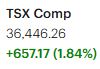

After closing below the psychologically important 36,000 level on Friday, the TSX rebounded strongly today, moving comfortably back above that threshold. Market breadth was positive, indicating broad-based buying activity.
Despite today’s encouraging performance, traders and investors should remain cautious and continue to prioritize capital preservation. Consider maintaining appropriate risk-management measures and limiting market exposure to approximately 30%–60% of total portfolio value, depending on individual risk tolerance and investment objectives. This cautious approach may help protect capital while allowing investors to participate selectively as we wait for a sustained market recovery to emerge and be confirmed.
Technically, the TSX Composite Index closed slightly above both its 25-day and 50-day moving averages, while remaining comfortably above its 200-day moving average. Although these developments are encouraging, further confirmation will be necessary before concluding that a more sustainable market turnaround is underway.
Monday’s TSX Market Statistics
At the Toronto Stock Exchange (TSX), advancing issues significantly outnumbered declining issues. Specifically, there were 1,791 advancers compared with 511 decliners, producing an advancer-to-decliner ratio of approximately 3.50:1, or roughly seven advancing stocks for every two declining stocks. An additional 128 issues closed unchanged.
Overall, market breadth was positive, reflecting broad-based strength across the exchange. Although market internal indicators remain relatively weak, they showed some improvement today, suggesting that underlying market conditions received additional support from the session’s positive performance.
The exchange recorded 14 new 52-week highs and 16 new 52-week lows, compared with 7 new highs and 12 new lows on Friday.
The ratio of new 52-week highs to new 52-week lows improved to 7:8, or approximately 0.87 (87%), compared with 7:12, or approximately 0.58 (58%), on Friday. This improvement indicates that a greater number of stocks reached new highs relative to new lows. Nevertheless, new lows continued to outnumber new highs, suggesting that underlying market weakness has not yet been fully resolved. Overall, market internals received some additional support during today’s session.
Total trading volume on the TSX reached approximately 533.74 million shares, essentially unchanged from the 535.81 million shares traded on Friday.
Although market volatility appeared to ease somewhat today, one session of reduced volatility is insufficient to establish whether the current period of heightened market fluctuations is ending or beginning to subside.
Investors and traders should therefore continue monitoring market breadth, trading volume, new 52-week highs and lows, and other internal market indicators. These measures can help identify early signs of a potential market turnaround. However, patience remains essential. Waiting for sufficient confirmation of a sustained recovery before committing to major or substantial trades remains a prudent approach to managing investment risk and protecting capital.
Monday’s Toronto TSX Market Wrap-Up Report
A Broad-Based Market Rally Lifts the TSX as Financials, Mining and Technology-Related Stocks Advance
The Toronto stock market delivered a broadly positive performance on Monday, with the S&P/TSX Composite Index gaining 657.17 points, or 1.84%, to close at 36,446.26. The strong advance extended Friday’s recovery and lifted the benchmark index comfortably back above the psychologically important 36,000 level.
Market participation was encouraging, with advancing issues significantly outnumbering declining issues. However, despite the broad-based gains, underlying market internals remain somewhat weakened, suggesting that investors should exercise caution before interpreting the latest advance as confirmation of a sustainable market turnaround.
Sector Performance
Electronic Technology was the strongest-performing sector on Monday, advancing 6.64%. Non-Energy Minerals followed with a gain of 4.79%, while Distribution Services rose 3.92%.
Other notable sector performances included Health Technology, which advanced 1.71%, and Finance, which gained 1.53%.
Technology Services was the session’s weakest-performing sector, declining 1.72%.
Overall, sector performance reflected broad-based buying interest, with particularly strong contributions from technology-related and mining-related stocks.
Notable Company and Stock Performances
Canada’s Big Six Banks
All six of Canada’s major banks finished Monday’s session in positive territory, providing additional support to the financial sector.
- Bank of Montreal (BMO) advanced 1.81% to close at $245.78, with approximately 2.8 million shares traded.
- Bank of Nova Scotia (BNS) gained 1.72%, recovering some of its previous session’s weakness.
- Toronto-Dominion Bank (TD) advanced 1.51%.
- Royal Bank of Canada (RY) rose 1.46%.
- National Bank of Canada (NA) gained 1.35%.
- Canadian Imperial Bank of Commerce (CM) advanced 1.29%.
- The broad-based strength across Canada’s major banks was an encouraging development, particularly given the importance of the financial sector to the overall performance of the TSX Composite Index.
Gold Mining Stocks
The major gold mining companies also participated in Monday’s rally. Agnico Eagle Mines Ltd. (AEM) advanced 3.64%, while Franco-Nevada Corporation (FNV) gained 3.37%.
Their positive performances provided additional strength to the mining-related segment of the Canadian market.
Other Notable Stocks
Shopify Inc. (TSX: SHOP) extended its positive momentum, gaining another 2.09% after advancing 4.59% on Friday. Approximately 2.4 million shares changed hands during Monday’s session.
Bombardier Inc. (TSX: BBD.B) was another notable performer, advancing 5.45% to close at $334.29, with approximately 287,500 shares traded.
Aritzia Inc. (TSX: ATZ) also recorded a strong session, gaining 4.55% to close at $162.05, with approximately 757,800 shares traded.
Market Breadth and Technical Perspective
Monday’s market statistics provided further evidence of broad-based buying interest. Advancing issues outnumbered declining issues by 1,791 to 511, producing an advancer-to-decliner ratio of approximately 3.50:1. Another 128 issues closed unchanged.
The TSX recorded 14 new 52-week highs against 16 new 52-week lows. Although new lows continued to exceed new highs, the ratio improved to approximately 0.88, compared with 0.58 on Friday. This represents an improvement in the market’s internal performance, although the balance between new highs and new lows has not yet turned decisively positive.
Total trading volume reached approximately 533.74 million shares, virtually unchanged from Friday’s 535.81 million shares.
From a technical perspective, the TSX Composite Index closed slightly above both its 25-day and 50-day moving averages while remaining comfortably above its 200-day moving average. This positioning is encouraging and suggests that the index has regained some short-term strength.
Nevertheless, further improvement in market breadth, new-high/new-low readings, and other internal indicators will be important in determining whether the latest recovery can develop into a more sustainable upward trend.
Key Takeaways for Traders and Investors
Monday’s performance was encouraging, but traders and investors should avoid becoming overly optimistic based on a single strong trading session.
The following considerations deserve attention:
- The TSX has regained the 36,000 level. The strong advance to 36,446.26 is a positive development. Maintaining this level and building further upward momentum would strengthen the recovery outlook.
- Market breadth has improved considerably. The 3.50:1 advancer-to-decliner ratio indicates strong participation in Monday’s rally. Sustained positive breadth over subsequent sessions would provide more convincing evidence of improving market conditions.
- Market internals still require improvement. New 52-week lows continued to exceed new highs, although the gap narrowed. Traders should watch for a sustained reversal in this relationship.
- Monitor the major moving averages. The index’s position above its 25-day and 50-day moving averages is encouraging. Continued strength above these averages would help reinforce the technical recovery.
- Maintain disciplined risk management. Investors and traders should continue prioritizing capital preservation, using appropriate stop-loss strategies and avoiding excessive portfolio exposure. Depending on individual risk tolerance and investment objectives, maintaining market exposure within approximately 30%–60% of portfolio value may be a prudent defensive approach while the market recovery remains unconfirmed.
- Wait for confirmation before making major commitments. A sustained improvement in market breadth, trading volume, new-high/new-low readings, and price action would provide stronger evidence of a genuine market turnaround.
Overall Market Assessment
Monday’s trading session was a welcome development for the Toronto stock market. The strong recovery in the TSX Composite Index, positive market breadth, broad-based advances across Canada’s major banks, and strength in selected mining and technology-related stocks all contributed to an encouraging market performance.
However, the continued excess of new 52-week lows over new highs serves as a reminder that underlying market conditions have not completely recovered.
For now, the market deserves cautious optimism rather than an outright bullish assessment. Traders and investors should remain selective, protect their capital, and closely monitor the market’s internal indicators for further evidence that a sustainable recovery is taking shape.
The priority remains capital preservation while positioning cautiously for opportunities that may emerge as the market establishes and confirms a more reliable upward trend.
.
The US Markets
Monday’s US Market Indexes
Wall Street Stages a Broad-Based Rebound as Major Indexes Post Strong Gains Ahead of Key Inflation Report
All four major US stock market indexes finished Monday’s session firmly in positive territory, with the Dow Jones Industrial Average surging more than 1,100 points as investors returned to equities following last week’s significant market weakness.
The Dow Jones Industrial Average vaulted 1,104.02 points, or 2.15%, to close at 52,389.75. The S&P 500 advanced 173.08 points, or 2.35%, finishing at 7,549.94. The Nasdaq Composite jumped 673.71 points, or 2.74%, to close at 25,253.14, while the Russell 2000 Index outperformed the other major indexes, gaining 86.71 points, or 3.15%, to finish at 2,840.81.

Monday’s advance represented an encouraging start to the trading week, particularly following the S&P 500’s substantial losses last week. All four indexes opened lower but gradually recovered throughout the session, eventually closing well above their respective session lows. This upward progression suggests that buying interest strengthened as the trading session advanced.
However, investors and traders should remain mindful of the economic calendar. One of the most important market events this week is the consumer inflation report scheduled for release on Tuesday. The inflation figures could influence expectations regarding interest rates, bond yields, and the Federal Reserve’s future monetary policy decisions. Consequently, the report may have a significant impact on market direction and volatility over the coming sessions.
Technical Analysis of the Major US Indexes
Despite Monday’s strong recovery, the technical positioning of the four major indexes continues to present a mixed picture. Their relationships with key moving averages suggest that the broader market has not yet fully resolved its recent weakness.
Dow Jones Industrial Average: The Dow Jones Industrial Average recorded an impressive rebound on Monday, gaining more than 1,100 points. However, the index remains in a technically sensitive position.
Although the index had moved above its 21-day and 50-day moving averages during the previous session, Monday’s technical picture, according to the supplied moving-average readings, places it back below both averages. Nevertheless, it continues to trade above its 200-day moving average.
This suggests that the Dow’s longer-term technical position remains relatively more favourable than its short-term position. Traders should watch for a sustained move back above the 21-day and 50-day moving averages before interpreting the recovery as a meaningful improvement in short-term momentum.
Nasdaq Composite: The Nasdaq Composite advanced 2.74% on Monday, recording the second-strongest percentage gain among the four major indexes.
Despite this substantial advance, the index remains clearly below its 25-day and 50-day moving averages. More encouragingly, it closed slightly above its 200-day moving average.
This technical positioning warrants caution. Although the recovery above the 200-day moving average is encouraging, the Nasdaq’s continued weakness relative to its shorter-term moving averages suggests that its short-term technical outlook remains vulnerable.
Investors should look for further confirmation before assuming that the technology-heavy index has established a sustainable recovery.
S&P 500 Index: The S&P 500 gained 2.35% on Monday, providing a strong rebound following last week’s significant losses.
Nevertheless, the index continues to trade considerably below its 25-day and 50-day moving averages. It remains above its 200-day moving average, indicating that its longer-term technical position has not deteriorated to the same extent as its shorter-term momentum.
The ability of the S&P 500 to regain its shorter-term moving averages will be an important development to watch. Until that happens, the recent advance should be viewed as a recovery attempt rather than confirmation of a renewed upward trend.
Russell 2000 Index: The Russell 2000 was Monday’s strongest-performing major US index, advancing 3.15%.
Despite its impressive performance, the small-cap benchmark remains below its 25-day and 50-day moving averages. However, Monday’s advance brought the index considerably closer to its 200-day moving average.
A sustained move above these important technical reference points would improve the index’s outlook. For now, the Russell 2000’s strong performance is encouraging, but additional confirmation is necessary.
Key Takeaways for Traders and Investors
Monday’s strong performance provided some relief following last week’s market weakness. However, the technical conditions across the major indexes suggest that traders and investors should remain selective and disciplined.
The following considerations deserve particular attention:
- Tuesday’s inflation report is a major market catalyst. The consumer inflation figures could influence interest-rate expectations and market sentiment. Traders should be prepared for potentially increased volatility following the announcement.
- The rebound is encouraging, but confirmation is still needed. All four major indexes posted substantial gains, but most remain below their shorter-term moving averages. Further upward movement will be necessary to establish a more convincing recovery.
- Pay close attention to the 200-day moving averages. The major indexes remain above their respective 200-day moving averages according to the supplied technical readings, although the Nasdaq is only slightly above this level and the Russell 2000 is approaching it. These levels deserve close monitoring.
- Do not confuse a strong rebound with a confirmed market turnaround. Monday’s gains are positive, but one strong session cannot establish that the recent market weakness has ended.
- Maintain disciplined portfolio exposure. Capital preservation should remain a priority. Traders and investors should avoid excessive exposure, apply appropriate risk-management measures, and remain selective when initiating new positions.
Overall US Market Assessment
Monday’s session was an encouraging development for Wall Street. The strong gains across the Dow Jones, S&P 500, Nasdaq Composite and Russell 2000 indicate that buying interest returned broadly across the US equity market.
Nevertheless, the technical picture remains mixed. The major indexes continue to face resistance from their shorter-term moving averages, while Tuesday’s consumer inflation report introduces another important source of potential market uncertainty.
For now, the appropriate assessment is cautiously optimistic. Traders and investors should monitor Tuesday’s inflation figures, the market’s subsequent reaction, and the ability of the major indexes to regain their shorter-term moving averages.
The key priority remains protecting investment capital while waiting for stronger technical and fundamental evidence that a sustainable market recovery is underway.
🔒 Premium Content
You must be a subscriber to access the remaining parts of this section. Current subscription rate is $40 CAD per month and $360 CAD per annum.
Login or Subscribe
Monday’s US Market Statistics
NYSE and NASDAQ Market Internals Show Significant Improvement, but Further Confirmation Is Needed
Monday’s US stock market statistics showed encouraging improvements across both the New York Stock Exchange (NYSE) and NASDAQ. Advancing stocks significantly outnumbered declining stocks on both exchanges, while the number of new 52-week highs increased and the number of new 52-week lows declined compared with Friday.
These developments indicate that market internals received some much-needed support during Monday’s session. However, despite the improvement, underlying market conditions remain weakened and will require several more positive trading sessions to establish a meaningful recovery.
1. New York Stock Exchange (NYSE)
Market Breadth
At the New York Stock Exchange, advancing issues significantly outnumbered declining issues. There were 2,209 advancers compared with 539 decliners, while another 64 issues closed unchanged.
This produced an advancer-to-decliner ratio of approximately 4.10:1, meaning that slightly more than four stocks advanced for every declining stock.
The NYSE therefore recorded strongly positive market breadth on Monday, indicating broad-based participation in the market’s advance.
New 52-Week Highs and Lows
The NYSE recorded 55 new 52-week highs and 80 new 52-week lows, compared with 23 new highs and 127 new lows on Friday.
This represented a substantial improvement in the exchange’s internal statistics:
- New 52-week highs increased by approximately 139% compared with Friday.
- New 52-week lows decreased by approximately 37%.
- The ratio of new 52-week highs to new 52-week lows improved to approximately 0.69, or 69%, compared with approximately 0.18, or 18%, on Friday.
Although new 52-week lows continued to outnumber new highs, the improvement was significant and suggests that the underlying market deterioration began to ease during Monday’s session.
The NYSE’s internal indicators therefore received meaningful support, although they have not yet recovered sufficiently to justify a more aggressive market outlook.
Trading Volume
Total NYSE trading volume reached approximately 5.94 billion shares, representing an increase of about 3.5% compared with Friday’s volume of approximately 5.74 billion shares.
The combination of positive market breadth, higher trading volume, an increase in new 52-week highs, and a decline in new 52-week lows represents an encouraging set of market statistics.
Nevertheless, the exchange’s internal indicators have been weakened for some time. One positive session, even one with such encouraging statistics, cannot fully repair the damage accumulated over previous sessions.
NYSE Market Assessment
Monday was a meaningful improvement for the NYSE. The positive market breadth and considerable improvement in the new-high/new-low relationship suggest that the market’s underlying condition is beginning to stabilize.
However, several more positive sessions will be necessary to establish whether this improvement can be sustained and whether market internals can recover toward levels recorded several weeks ago.
Traders and investors should therefore continue exercising considerable caution. Capital preservation should remain a priority, and positions should be monitored closely. Traders should maintain clearly defined exit strategies and be prepared to reduce or close positions if market conditions turn unfavourable.
2. NASDAQ Market Statistics
Market Breadth
NASDAQ also recorded strongly positive market breadth on Monday, with advancing stocks significantly outnumbering declining stocks.
There were 3,828 advancing issues compared with 1,147 declining issues, while another 135 issues closed unchanged.
This produced an advancer-to-decliner ratio of approximately 3.33:1, representing slightly more than three advancing stocks for every declining stock.
The positive market breadth indicates that Monday’s recovery extended across a substantial portion of NASDAQ-listed stocks.
New 52-Week Highs and Lows
NASDAQ recorded 120 new 52-week highs and 216 new 52-week lows, compared with 63 new highs and 385 new lows on Friday.
These figures represent a considerable improvement in the exchange’s internal indicators:
- New 52-week highs increased by approximately 90% compared with Friday.
- New 52-week lows declined by approximately 44%.
- The ratio of new 52-week highs to new 52-week lows improved to approximately 0.56, or 56%, compared with approximately 0.16, or 16%, on Friday.
Although new lows continued to exceed new highs, the improvement is noteworthy.
More importantly, NASDAQ’s internal indicators have now recorded two consecutive sessions showing signs of improvement. This is an encouraging development, particularly following the deterioration experienced during Thursday’s and Friday’s trading sessions.
The combination of positive market breadth and improving new-high/new-low statistics is the type of market development investors would like to see during the early stages of a potential recovery.
However, the internal indicators remain weakened, and additional confirmation is necessary before adopting a more bullish trading strategy.
Trading Volume
Total NASDAQ trading volume reached approximately 9.53 billion shares, representing a decline of approximately 11.6% compared with Friday’s volume of approximately 10.78 billion shares.
The lower trading volume is an important consideration when evaluating Monday’s advance.
Although the market recorded a substantial gain, the decline in trading volume suggests that the advance did not attract the same level of trading activity as Friday’s session.
This does not necessarily invalidate Monday’s positive performance, but it does indicate that the recovery would benefit from stronger volume confirmation in subsequent sessions.
Traders should therefore watch whether future advances are accompanied by improving trading volume and continued positive market breadth.
NASDAQ Market Assessment
NASDAQ’s market statistics showed encouraging signs of improvement on Monday. Positive market breadth, a substantial increase in new 52-week highs, and a significant reduction in new 52-week lows all suggest that the exchange’s internal condition is beginning to improve.
Nevertheless, the underlying technical damage remains considerable, particularly among technology and semiconductor stocks, many of which have experienced substantial chart deterioration.
Consequently, repairing the technical condition of these stocks may require several more positive sessions. Depending on market conditions, the recovery process could take weeks or even months.
At this stage, retail investors should consider maintaining a relatively defensive portfolio position, with market exposure of approximately 30% or less, depending on individual risk tolerance and investment objectives.
The priority should be capital preservation, identifying promising stocks, and building a watchlist of potential trading opportunities rather than aggressively committing additional capital.
Although a market turnaround may be developing, investors should wait for sufficient evidence of a sustained recovery before shifting to a more aggressive investment strategy.
3. Key Takeaways for Traders and Investors
Monday’s market statistics provided encouraging evidence that the underlying condition of the US stock market is improving. However, the recovery remains at an early stage, and several important considerations deserve attention.
- Market breadth is strongly positive on both exchanges. The NYSE recorded an advancer-to-decliner ratio of 4.10:1, while NASDAQ recorded 3.33:1. This indicates broad participation in Monday’s market advance.
- The new-high/new-low relationship improved significantly. Both exchanges recorded substantial increases in new 52-week highs and meaningful reductions in new 52-week lows. This is an encouraging development, although new lows still exceeded new highs on both exchanges.
- NASDAQ has recorded two consecutive sessions of improving internal indicators. This is worth monitoring closely. Sustained improvement over additional sessions would strengthen the possibility of a more durable recovery.
- Trading volume requires further attention. NYSE volume increased modestly, while NASDAQ volume declined approximately 12%. Stronger volume accompanying future advances would provide additional confirmation of buying interest.
- Avoid aggressive trading for now. Despite Monday’s positive performance, the market’s underlying technical condition remains weakened. Traders should be selective and avoid taking excessive risks.
- Concentrate on capital preservation and watchlist development. Investors should use this period to identify stocks showing relative strength, improving chart patterns, and the ability to recover above important moving averages.
- Wait for confirmation of a new upward trend. A few more sessions of positive breadth, improving internal indicators, and supportive trading volume would provide stronger evidence that the market is repairing its technical condition.
4. Overall US Market Internals Assessment
Monday’s market statistics represented a welcome improvement for both the NYSE and NASDAQ.
The strong positive market breadth across both exchanges, combined with the significant improvement in the number of new 52-week highs relative to new lows, suggests that the recent deterioration in market internals may be beginning to ease.
However, the improvement should not be mistaken for a completed market recovery. New 52-week lows still exceeded new highs on both exchanges, and NASDAQ’s lower trading volume indicates that Monday’s advance could benefit from stronger participation.
The market’s internal indicators have been weakened for some time. Consequently, repairing the underlying technical condition will likely require several additional positive sessions and sustained improvement across multiple market indicators.
Our position remains cautiously optimistic, but defensive. Traders and investors should continue prioritizing capital preservation, maintaining disciplined portfolio exposure, and preparing their watchlists for opportunities that may emerge as market conditions improve.
We will continue monitoring the NYSE and NASDAQ market internals closely and report on whether the recent improvements develop into a more sustainable market recovery.
For now, patience, selectivity, and disciplined risk management remain essential.
.
Monday’s US Market Wrap-Up Report
Wall Street Stages a Powerful Rebound as Technology and Small-Cap Stocks Lead Broad-Based Market Gains
Overall Market Performance: The major US equity indexes staged a strong recovery on Monday, extending buying interest across Wall Street following last week’s significant market weakness. The Nasdaq Composite and Russell 2000 were the two best-performing major indexes, with small-cap stocks outperforming both the S&P 500 and Dow Jones Industrial Average.
The Dow Jones Industrial Average surged 1,104.02 points, or 2.15%, to close at 52,389.75. The S&P 500 advanced 173.08 points, or 2.35%, finishing at 7,549.94. The Nasdaq Composite jumped 673.71 points, or 2.74%, to close at 25,253.14, while the Russell 2000 gained 86.71 points, or 3.15%, to finish at 2,840.81.
Monday’s performance was particularly encouraging for the Nasdaq, which has been attempting to recover from last week’s losses. The stronger performance of the Russell 2000 was also noteworthy, suggesting that buying interest extended beyond the largest US companies.
All four major indexes opened lower but gradually recovered throughout the session, closing well above their respective session lows. This upward progression was an encouraging indication that buyers became increasingly active as the trading session advanced.
Nevertheless, despite Monday’s impressive gains, the major indexes remain in need of further technical improvement. Most continue to trade below their shorter-term moving averages, suggesting that the broader market recovery remains unconfirmed.
US Sector Performance: Monday was a buoyant session across the US equity market, with all major market sectors finishing in positive territory.
Producer Manufacturing was the strongest-performing sector, advancing 5.92%. Communications and Consumer Durables also recorded notable gains, while Transportation rose 3.04%.
Utilities and Finance advanced 1.64% and 1.61%, respectively.
The broad-based sector strength was encouraging, particularly because the advance was not restricted to a handful of large-cap technology companies. Participation across multiple sectors suggests that investors were willing to increase exposure to a wider range of equities.
However, the sustainability of this improvement will depend on whether the positive sector participation continues over subsequent trading sessions.
Treasury Yields and Economic Developments: The US Treasury market recorded modest increases in yields on Monday. According to the supplied Tradeweb figures, the yield on the policy-sensitive two-year Treasury note increased by 0.6 basis point to 4.552%, while the 10-year Treasury yield advanced 0.8 basis point to 4.869%.
Investors are closely monitoring inflation developments because the latest consumer inflation report is an important economic event this week. The report could influence expectations regarding interest rates, Treasury yields, and the Federal Reserve’s future monetary policy decisions.
For equity traders and investors, Tuesday’s inflation figures represent an important potential market catalyst. A higher-than-expected inflation reading could put renewed pressure on equities, while a more favourable report could provide additional support for the current recovery.
Oil Market Developments: Oil prices came under pressure as traders assessed the possibility of a diplomatic resolution to the US-Iran conflict.
Expectations that diplomatic negotiations could reduce geopolitical tensions and the risk of further disruptions to oil supplies contributed to selling pressure in crude oil futures.
Lower oil prices could provide some relief from energy-related inflation pressures. However, investors should continue monitoring developments in the Middle East because geopolitical uncertainty can quickly influence energy prices and broader financial-market sentiment.
Notable Company and Stock Developments
Nvidia Corporation (NVDA)
Nvidia attracted considerable attention on Monday following news that its board of directors had initiated an independent investigation into reports that CEO Jensen Huang had been the target of a foreign intelligence effort.
The company confirmed that a committee of independent directors, assisted by outside legal counsel, would oversee the investigation. Nvidia’s board also stated that it had no reason to believe that company secrets or national security had been compromised.
The development created additional uncertainty surrounding Nvidia at a time when investors are already closely examining the valuations, growth prospects, and competitive position of major artificial intelligence companies.
Nvidia shares declined approximately 4.3% on Monday, even as the broader technology sector advanced.
Although the broader market largely looked past Nvidia’s weakness during Monday’s rally, the investigation could remain a company-specific concern and potentially create additional uncertainty for the AI investment theme in the near term.
Advanced Micro Devices (AMD)
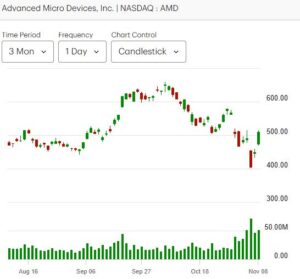
Advanced Micro Devices was one of Monday’s outstanding technology performers, surging 13.26% to close at $508.58, with approximately 51.3 million shares traded.
The advance extended the stock’s positive momentum following its 3.9% gain on Friday, when it closed at $466.83.
Investor interest in AMD continues to be supported by expectations of stronger demand for data-centre computing infrastructure and artificial intelligence-related products.
Some industry analysts expect data-centre revenue growth to become an increasingly important contributor to the company’s future financial performance.
AMD’s strong performance was particularly noteworthy given Nvidia’s weakness, suggesting that investors were willing to redirect some attention toward other companies participating in the AI and semiconductor industries.
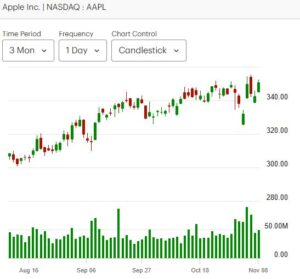
Apple Inc. (AAPL)
Apple advanced 2.43% on Monday, closing at $350.69, with approximately 48.8 million shares traded.
The stock participated in the broader technology-sector recovery, contributing to the positive performance of large-cap equities.
Moderna Inc. (MRNA)
Moderna recorded a strong session, gaining 5.83% to close at $269.00, with approximately 12.4 million shares traded.
Other Semiconductor and Technology Stocks
Several other semiconductor-related stocks also participated in Monday’s advance.
- SanDisk (SNDK) gained 6.16% to close at $886.51.
- Micron Technology (MU) advanced 6.25% to close at $733.15, with approximately 32.2 million shares traded.
- Qualcomm (QCOM) finished approximately unchanged.
The strong advances in AMD, SanDisk, and Micron were encouraging developments for the semiconductor group. However, given the technical damage experienced by many technology and semiconductor stocks during recent sessions, further positive performance will be necessary to repair their charts and establish more sustainable upward trends.
Market Breadth and Internal Indicators
Monday’s market statistics provided some of the most encouraging evidence of improvement across the US equity market.
At the New York Stock Exchange (NYSE), advancing issues significantly outnumbered declining issues. There were 2,209 advancers compared with 539 decliners, producing an advancer-to-decliner ratio of approximately 4.10:1.
The NYSE recorded 55 new 52-week highs and 80 new 52-week lows, compared with 23 new highs and 127 new lows on Friday.
This represented a substantial improvement in the exchange’s internal indicators. Trading volume also increased approximately 3.5% to 5.94 billion shares.
NASDAQ likewise recorded positive market breadth, with 3,828 advancers compared with 1,147 decliners, producing an advancer-to-decliner ratio of approximately 3.33:1.
The exchange recorded 120 new 52-week highs and 216 new 52-week lows, compared with 63 new highs and 385 new lows on Friday.
NASDAQ’s internal indicators have now recorded two consecutive sessions of improvement. Nevertheless, total trading volume declined approximately 11.6% to 9.53 billion shares.
The improvement in market breadth and the new-high/new-low relationship on both exchanges is encouraging. However, new 52-week lows continued to exceed new highs, indicating that underlying market weakness has not yet been fully resolved.
The decline in NASDAQ trading volume also suggests that Monday’s advance would benefit from stronger volume confirmation in subsequent sessions.
Key Takeaways for Traders and Investors
Monday’s strong market performance was encouraging, but traders and investors should distinguish between a significant one-day rebound and the establishment of a sustainable market recovery.
The following considerations deserve particular attention:
1. The market rebound is broad-based.
All four major indexes advanced, all major US sectors finished higher, and advancing stocks significantly outnumbered declining stocks on both the NYSE and NASDAQ. This is a positive combination that suggests improving investor participation.
2. Small-cap and technology stocks are showing encouraging strength.
The Russell 2000 and Nasdaq Composite outperformed the Dow Jones and S&P 500. AMD, Micron, and SanDisk also recorded strong gains. Continued strength in these groups would provide additional evidence of improving risk appetite.
3. Market internals are improving but remain weakened.
The significant reduction in new 52-week lows and the increase in new highs are encouraging. However, new lows still exceeded new highs on both exchanges. Several more positive sessions will be necessary to establish a stronger internal market condition.
4. Watch trading volume carefully.
NYSE volume increased modestly, while NASDAQ volume declined approximately 12%. Stronger trading volume accompanying future advances would provide more convincing confirmation of institutional and broader investor participation.
5. Tuesday’s inflation report could influence market direction.
The consumer inflation figures may have an important impact on Treasury yields, interest-rate expectations, and equity-market sentiment. Traders should be prepared for potential volatility following the announcement.
6. Monitor the major moving averages.
The Nasdaq and S&P 500 remain below their shorter-term moving averages, while the Russell 2000 is still below its 25-day and 50-day averages. A sustained recovery above these technical reference points would strengthen the market’s outlook.
7. Continue prioritizing capital preservation.
This is not the time to become excessively aggressive. Investors should remain selective, maintain appropriate portfolio exposure, use disciplined risk-management strategies, and avoid chasing stocks simply because they have experienced substantial one-day gains.
8. Build watchlists and wait for confirmation.
Use the current recovery period to identify stocks with improving relative strength, stronger trading volume, and constructive technical patterns. Wait for sufficient evidence of a sustained market turnaround before making major portfolio commitments.
[/restrict ]
Overall US Market Assessment
Monday’s trading session was a welcome development for Wall Street. The strong advances across all four major indexes, broad-based sector participation, and substantial improvement in market breadth and new-high/new-low statistics suggest that the US equity market is beginning to recover from its recent weakness.
The performance of the Nasdaq Composite and Russell 2000 was particularly encouraging, while the strength in selected semiconductor stocks indicated that buying interest was returning to parts of the technology sector.
Nevertheless, the market’s underlying technical condition remains weakened. Most major indexes continue to trade below their shorter-term moving averages, new 52-week lows still exceed new highs on both exchanges, and NASDAQ trading volume declined during Monday’s advance.
Tuesday’s consumer inflation report will be another important event for investors to monitor.
For now, our assessment remains cautiously optimistic but defensive. Monday’s performance provides encouraging evidence that a recovery may be developing, but additional confirmation is needed before concluding that the market has established a sustainable upward trend.
We recommend that traders and investors continue protecting their capital, maintaining disciplined exposure, and preparing their watchlists for potential opportunities.
The objective is not simply to participate in the first strong rebound, but to be properly positioned when the market provides convincing evidence that a sustainable turnaround has actually taken hold.
.
NOTICE TO READERS
The Canadian Vanguard Stock Market is about empowering you to build and manage your wealth by yourself. There is certainly no magic in managing finances or wealth but one needs to know what to do and commit to doing what is needed. When you are ready to start the journey to Take Charge and Put Your Destiny In Your Own Hands, start with reading The Canadian Vanguard every market day. If and when you need more related information or to advertise your business products or services in The Canadian Vanguard, Contact Us
Our readers are strongly advised to conduct their own research into individual stocks before making a purchase decision. In addition, investors are advised that past stock performance is no guarantee of future price appreciation. Any recommendation is not a guarantee of any particular stock’s future prices, and The Canadian Vanguard accepts no responsibility or liability for investors’ or readers’ purchases.
The dollar sign “$” in the Toronto Market section in the articles only stands for Canadian dollar and in the US market section “$” stands for US dollar.
(c) This article is published by The Canadian Vanguard on November 9, 2026