





‘The point is to build the certainty’: Mark Carney, premiers agree on ‘nation-building priorities,’ but First Nations raise alarms over lack of consultation
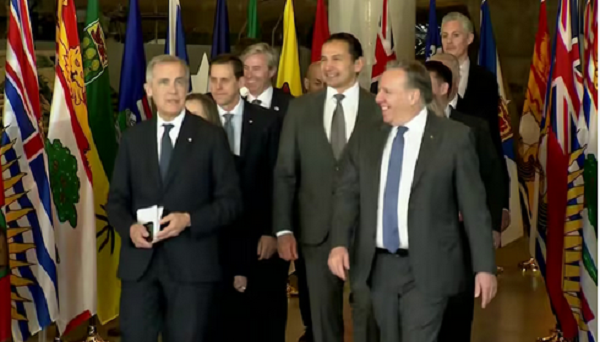
The harsh realities of governing Canada’s patchwork federation threw rookie Prime Minister Mark Carney‘s plan to move fast and build things into a slower gear Monday.
Carney, who pledged his government would act at unprecedented speed to accelerate “nation-building projects,” emerged from the first ministers meeting without his promised list of specifics that would be quickly greenlit.
Instead of unveiling detailed priorities, the prime minister outlined the broad principles that would guide the future selection of massive infrastructure projects.
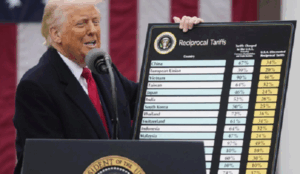
“The point is to build the certainty, the stability and the ambition that builders need to catalyze enormous investment, investment to make Canada into an energy superpower and to build the strongest economy in the G7,” said Carney, who was elected on April 28 with a mandate to quickly confront the threat posed by U.S. President Donald Trump’s tariffs.
While the prime minister did not provide a project list, he gave his strongest endorsement yet of a future oil pipeline to get Alberta bitumen from the oilsands to port, although there was an
The joint statement said the first ministers agreed that “Canada must work urgently to get Canadian natural resources and commodities to domestic and international markets, such as critical minerals and decarbonized Canadian oil and gas by pipelines, supported by the private sector, that provide access to diversified global markets, including Asia and Europe.”


Carney told the news conference that means “yes, for an oil pipeline … to get to tidewater,” adding the apparent caveat, saying “within the broader context of national interest, the interest is in … decarbonized barrels.”
Despite his lack of specifics on that, Alberta Premier Danielle Smith outlined a range of technologies that included “carbon capture, utilization and storage, ultimately using hydroelectric or small modular nuclear (reactors) to decarbonize and then, direct air capture” of carbon emissions “for the last mile.”
Carney said if that potential is developed, “the federal government will look to advance it,” but he stressed “it’s not only about oil pipelines,” and underlined other initiatives include an “energy corridor,” and critical minerals.
At the end of the day, Smith and Ontario Premier Doug Ford hailed the “change in tone” from the federal government and welcomed Carney’s goal of making Canada a “global energy superpower.”
“We haven’t heard that kind of language for some time on both conventional and clean power,” said an “encouraged” Smith, who has emphasized oil pipelines are critical to national unity against the backdrop of a possible referendum on Alberta secession.
Ford — who serenaded reporters with the 1977 disco hit “Love Is In The Air” as he accompanied Smith into the conference hall — said it was “the best meeting I’ve had in seven years” because Carney was so focused on the economy, and he likened the prime minister to Santa Claus.
“There was no expectations the prime minister was going to come out and say, ‘you get that project, you get that project,’ ” insisted Ford, whose wish-list includes developing the Ring of Fire mining region in northwestern Ontario and new nuclear reactors.
“Now the prime minister is going to go to work, get the legislation passed and we’ll divvy it up. I described him today as Santa Claus. He’s coming and his sled was full of all sorts of stuff. Now he’s taking off back to the North Pole, he’s going to sort it out and he’s going to call us.”
Manitoba Premier Wab Kinew, who is pushing new infrastructure to bring oil and gas for shipping from Churchill, quipped “we’re building a port at the North Pole.”
More seriously, Kinew emphasized the need to use the trade crisis as a catalyst for helping Canada’s most disadvantaged, including Indigenous Peoples.
“It’s a generational opportunity for Canadians, but it’s also a generational opportunity for some of the poorest communities in our country,” said Kinew.
“And if we have a window of opportunity to build up Canada, and we can get more kids tied into an education, to a pathway to trade, a college, a university, if we can put the road and transmission and hike infrastructure to build out those opportunities, this country is not just going to be better off in terms of the GDP growth.”
Carney pledged that Indigenous people would be consulted and accommodated in drafting the list of “nation-building priorities,” hours after the Assembly of First Nations warned that communities had not seen the bill that will enable fast-tracked approvals, and it risked spurring more conflict and litigation.
In a letter to Carney released Monday, the Assembly of First Nations warned there has not been enough time or consultation with Indigenous communities that will be impacted.
AFN National Chief Cindy Woodhouse Nepinak said regional chiefs and her office received a letter from Ottawa outlining the intent to change the law, along with a three-page background document and an invitation to comment by the end of last week — an “unacceptably tight deadline.”


Repeatedly citing the United Nations’ Declaration on the Rights of Indigenous Peoples, and what the AFN says is a comprehensive duty to ensure Indigenous engagement and consent at all stages in the legislative and approval process for projects, Woodhouse Nepinak predicted protests and lawsuits to come.
“If free, prior and informed consent is not obtained from First Nations, this legislation will be marred and mired in conflict and protracted litigation.”
When it comes to “nation-building projects,” the national chief urged “Canada to start with fast-tracking the basics like clean water, quality housing, modern schools, all-season roads and community infrastructure” on First Nations territories.
Carney said nation-building projects must strengthen the nation’s “economy, autonomy, resilience and security, provide undeniable benefits to Canada, have a high likelihood of successful execution, be a high priority for Indigenous leaders,” and should drive “clean growth potential.”
He said he will establish a new federal major project office that will “provide a single set of conditions that must be met for those projects to advance,” saying Ottawa will set a two-year timeline for approvals, and work with provinces to set up a “one-project-one-review” process to eliminate duplication of environmental assessments.
This article was first reported by The Star