



U.S. Dairy Industry Calls for Revisions to Canada’s Supply Management Quotas
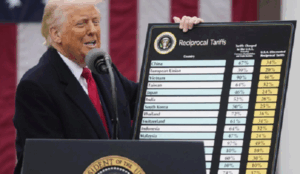
U.S. dairy exporters are demanding Canada rewrite its rules around who can import cheese, milk and other products as President Donald Trump threatens to impose a 35-per-cent tariff on Canadian goods beginning Aug. 1.
Last week, Mr. Trump sent a letter to Prime Minister Mark Carney threatening to impose more tariffs on a number of Canadian goods and complaining about Canada’s protectionist measures on supply-managed products such as dairy. The deadline for the Canada-U.S. trade deal has been postponed from July 21 to Aug. 1.
U.S. exporters want Canadian retailers and food-service companies to be able to import dairy tariff-free under the U.S.-Mexico-Canada Agreement. But Canada’s rules allow only processors and distributors to import U.S. dairy products without facing levies that can surpass 250 per cent. A limited amount can be imported without duties under a tariff rate quota, or TRQ.
The U.S. has long argued Canada’s TRQ licence rules are a breach of USMCA, and are why exporters have been unable to sell into the Canadian market at the volumes negotiated in 2018.
“It is just ridiculous that you would give the vast majority of the tariff rate quota licences to our competitors in the Canadian dairy industry who – frankly – have their own motivations for what they want to bring in,” said Shawna Morris, executive vice-president of trade policy and global affairs at the U.S. Dairy Export Council.
Canadian grocers and distributors also say the system benefits the dairy industry, and reduces the variety of products available to consumers from U.S. producers.


Canada has so far held firm against the U.S.’s demands. However, the stakes are higher today now that Washington and the U.S. dairy industry has Canada’s supply-management system in its sights. If U.S. exporters prevail with securing changes to the quota system, shoppers here could see a wider range of products on their grocer’s shelves at the expense of the Canadian dairy industry.
The U.S. Dairy Export Council has been assured by the Trump administration that overhauling the rules is a priority, Ms. Morris said. However, the government of Canada is not planning to change the administration and allocation policies under USMCA, Jason Kung, spokesperson for Global Affairs Canada, said in a statement.
“This government remains committed to maintaining, protecting and defending supply management, and standing up for the industries, farmers, workers and the communities they support.”
The USMCA trade agreement gave the U.S. dairy industry expanded access to approximately 3.5 per cent of the Canadian domestic market.
The value of exports has grown to US$1.18-billion in 2024 from US$697.09-million in 2016, according to the United States Department of Agriculture.
But the U.S. has not penetrated the market to the degree it negotiated, Ms. Morris said.
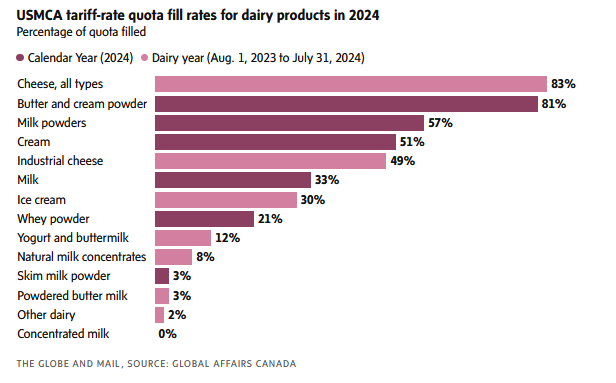
Market forces are a factor. The fill rate – the percentage of the tariff-free quota actually used to import products – is high for foods like butter and cheese, where there is strong consumer demand.
However, the rate falls far below its limits for a number of products, Ms. Morris said. She blames Canada’s rules around imports.
These processors directly compete with the U.S. dairy exporters, so have less incentive to import, Ms. Morris said.
The licensing rules also skew the type of product imported into Canada, said Santo Ligotti, spokesperson for the Retail Council of Canada (RCC).
The RCC has long advocated for retailers to be allocated tariff-rate quotas under USMCA, he said. But the government is not prioritizing retailers or Canadian consumers, he said.
“When it comes to dairy, the Canadian government always looks to favour producer interests over consumer interests,” Mr. Ligotti said.
Consider cheese. In 2024, 83 per cent of the TRQ allotment for “cheese of all types” was filled – the highest rate across all categories.
Because the licences are granted at a higher rate to processors, the vast majority falls into three categories: mozzarella, cheddar and grated and powdered cheese.
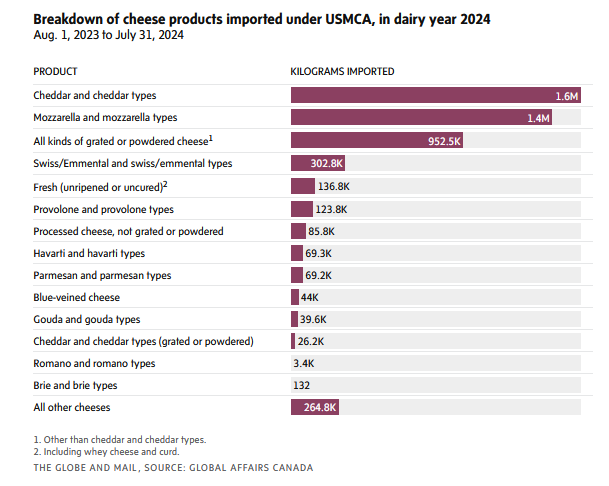
These processors can also import cheese under a second category: industrial. This includes bulk cheeses used for food manufacturing. Processors import less of the available quota under this category.
This is unfair and goes against the spirit of the trade agreement and free market economics, said Joe Dal Ferro, president Finica Food Specialties, a distributor that sells cheese to all major retailers across Canada.
The processor is not interested in providing variety to the Canadian consumer, said Mr. Dal Ferro, who is also chair of the International Cheese Council of Canada. They will only import cheese that does not compete with what they offer, he said.
The U.S. launched complaints against Canada in 2021 and 2023, but the panel found in the last dispute that Canada was not in breach of its commitments under USMCA. The panel decided that the trade deal gave Canada the right to exercise broad discretion in how it allocates quota, said Matthew Kronby, a partner in the international trade and investment practice at Osler, Hoskin & Harcourt LLP. Mr. Kronby has represented the Canadian dairy industry in its trade disputes with the U.S.
Total market access lost to foreign competitors for dairy products under all Canada’s trade commitments, including USMCA, was estimated at approximately 10 per cent of domestic production once the agreements will be fully implemented, Agriculture and Agri-Food Canada said in a statement.
Dairy Farmers of Canada estimates the loss to be closer to 18 per cent of domestic production.
“When previous governments conceded access to our domestic market, we yielded part of our milk production to other countries in perpetuity,” said David Wiens, president of Dairy Farmers of Canada. “That’s market share our farmers will never recover.”
This article was first reported by The Globe and Mail