





Trump under fire for controversial African deportation pacts
The Trump administration is facing a growing backlash from across Africa as it accelerates its plan to deport migrants and convicted criminals to some of the poorest and most authoritarian countries on the continent.
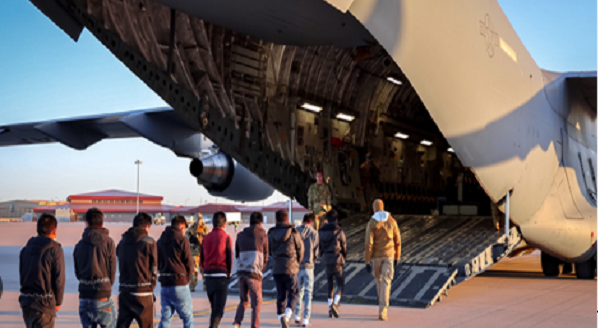
In recent weeks, U.S. President Donald Trump’s government has sent flights of deportees to South Sudan and the tiny kingdom of Eswatini, while also reaching an agreement to send up to 250 migrants to Rwanda.
Each deal was negotiated secretly with governments that are far from democratic, with each regime reportedly receiving money or other benefits from Washington in exchange for accepting the deportees.
Israel is reportedly seeking similar agreements with several African countries, hoping to send Palestinians from Gaza to those countries. Most recently, Israel has been discussing a possible deal with South Sudan to send Palestinians there, according to an Associated Press report this week. South Sudan has denied the report.
In earlier negotiations several years ago, Britain and Denmark brokered controversial deals to transfer asylum seekers to Rwanda, although the agreements were later cancelled.
As the deportation deals proliferate, many Africans are increasingly concerned that their continent is becoming a dumping ground for the unwanted people of wealthier countries. While poorer states can find it difficult to refuse the transactions, larger countries such as Nigeria and South Africa are criticizing the deals.
“The U.S. is mounting considerable pressure on African countries to accept Venezuelans to be deported from the U.S., some straight out of prison,” Nigerian Foreign Minister Yusuf Tuggar told a local broadcaster last month.
“It would be difficult for a country like Nigeria to accept Venezuelan prisoners,” he said. “We have enough problems of our own.”
South Africa, meanwhile, issued a statement saying it was “deeply concerned” about Eswatini’s decision last month to accept five U.S. deportees who had been convicted of serious crimes in the United States.
The South African foreign ministry said it was worried about “the potential adverse impact on South Africa’s national security and immigration policy” – especially because Eswatini shares a border with South Africa.


Some critics have used stronger language to denounce the U.S. deportation deals. “The continent must band together to stand against wealthy nations that regard Africa as nothing but a vast wasteland to be exploited and abused as they see fit,” said an editorial in The Times, a South African newspaper.
“Over the years, Africa has borne the brunt of global dumping – mostly plastic and toxic waste. Now it has graduated to dangerous criminals.”
Human-rights activists in Eswatini and South Africa have criticized the deportation deal as secretive and illegal. They say the detainees have been denied their rights to legal representation and consular access.
The government of Eswatini, formerly known as Swaziland, said it has imprisoned the five U.S. deportees – citizens of Jamaica, Laos, Cuba, Yemen and Vietnam – and will eventually send them to their home countries. It has refused to disclose the compensation that it received from the Trump administration.
In the meantime, its neighbouring countries are worried that the deportees could escape. Tricia McLaughlin, a senior official in the U.S. Department of Homeland Security, inflamed those fears by describing the five deportees as “depraved monsters” and “uniquely barbaric.”
In an earlier deal, South Sudan accepted eight U.S. deportees: One of its own citizens, along with others from Laos, Mexico, Myanmar, Cuba and Vietnam. Before being flown to South Sudan, the deportees were held for weeks in a shipping container at a U.S. military base in the small African country of Djibouti, while lawyers in the U.S. made a failed attempt to block the deportations.
South Sudan has been facing heavy pressure from the Trump administration since April, when the U.S. revoked the entry visas of all South Sudanese citizens and announced a ban on future visas. There is widespread speculation that this was one of the motivations for the deportation deal.
The Trump administration has also talked to many other African countries to discuss similar deals. A potential agreement with Libya came close to fruition earlier this year, but was not finalized. The same kinds of deals were reportedly discussed last month when the White House played host to the presidents of five African countries: Liberia, Senegal, Guinea-Bissau, Mauritania and Gabon.
Earlier this year, in the first of its deportation agreements, the Trump administration paid US$6-million to the government of El Salvador in exchange for sending hundreds of migrants to a prison in the country.
Most of the countries in the U.S. deportation deals have poor records on human rights. Some, like Rwanda and Eswatini, are run by autocratic regimes that suppress the media and civil society, leaving their citizens in the dark about the transactions that are negotiated and the benefits that their governments receive.
The deportation agreements have exposed “the stark power imbalance between the U.S. and developing countries, and raises serious concerns about security risks, human rights abuses and the denigration of international humanitarian law,” the Africa-based Institute for Security Studies said in a report last week.
This article was first reported by The Globe and Mail