






B.C. Farmers Face Severe Annual Harvest Losses from Wildfires
Ella Braden, the owner of Braden Hill Orchard & Farm, says she was on vacation when wildfires roared through Summerland, B.C.
She had to get in touch with friends to close up the farm, who were able to give her flock of chickens and ducks the best chance of survival by leaving lots of water and opening a back door so they could escape if needed. Her friends also shut off the irrigation system, closed windows and evacuated her daughter’s pet rabbit.
“Since then, we don’t know what’s happening with the farm and I think that is the biggest challenge for most folks in Summerland is that the regional district is valuing human life and safety as they absolutely should, but it’s so hard not to know,” Braden said in an interview.
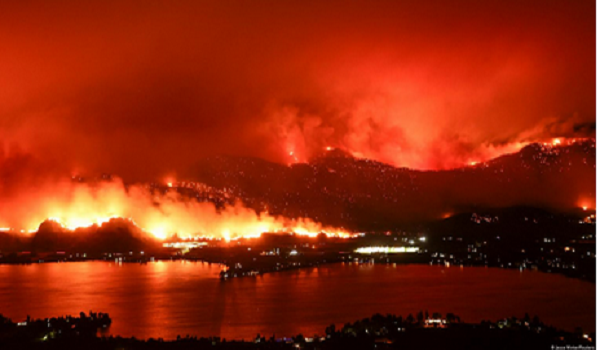
A thick layer of smoke settled over the nearby city of Penticton, drifting south from Summerland, where the Bald Range fire forced thousands to flee last weekend. The fires are hurting crops and bottom lines for farms, wineries and other growers in the area.
About 100 fires are burning across B.C., with about half of them out of control. The Bald Range wildfire, which erupted Friday, has since grown to 184 square kilometres.
Since the evacuation on Friday, Braden said she was contacted by an animal welfare organization that had a temporary access permit to check on the chickens and ducks. At that time, the flock remained unharmed and the property undamaged, but the same can’t be said for the crops.
“We will lose a lot of our annual crops since we are not able to be irrigating right now,” Braden said.
“The perennial crops will likely be OK, but the psychological challenge of knowing that things were not taken out in the fire, but are going to die slowly because we can’t be caring for our land is very hard.”
Perennials are those that don’t need to be replanted each year and can produce a yield for a longer period of time.
“I’m sure a lot of things will be withered and dry when I get back,” she said.
Braden and her family are now staying with her parents south of the border in Washington State.
She estimates that half of her annual income comes from fruit sales between the second half of August and October. The fire is certain to weigh on her farm’s bottom line, but the full financial impact is not yet clear.
“There will be crops that I won’t be able to get into storage, I don’t know how much, but it could be up to half of my income because I’m not getting the winter crops that are another quarter of my income or so tended and watered, and I bet my carrot and beet crops are feeding the pocket gophers really well right now,” she said.
As a result of the fire, Braden has had to indefinitely lay off a part-time employee.
With instances of wildfires becoming more common in recent years, Braden said she had already started to shift to more perennial crops, like rhubarb, asparagus, grapes and berries, which are “crops that even if I cannot access the property and irrigate, they’re going to be OK next year.”
“I’ll lose this year’s crop, but they’ll be fine next year,” she said.
B.C. Agriculture Minister Lana Popham told a briefing Tuesday that the situation was urgent for fruit and wine growers.
“The smoke is affecting the crops for sure, and soot,” she said.
“Right now it’s peach season in the Okanagan and the farmers who have worked all year to bring that harvest are now being kept away from their orchards … they are right now just heartbroken to see their crops rotting in the orchards.”
Popham said there were 269 registered agricultural premises that were affected by wildfire activity.
Mike Dickinson, an operator of Dickinson Family Farms located in Summerland, B.C., said his father Dwane has had the property for about 60 years, which had never been affected by wildfires before.
He said that when he first became aware of the wildfires, they were “quite a ways away,” and he wasn’t worried.
“Then a few hours later, I could see it coming over the hill; that’s when I really got concerned,” he said.
Dickinson said he decided to pack some of his belongings, and leave Friday night. He drove to Penticton and spent the night sleeping in a Canadian Tire parking lot. He said he was able to temporarily return to the property on Saturday and estimated the fire came within 500 meters of it.
Since his farm is a cherry orchard, and the harvest season has finished, Dickinson said his farm escaped any significant financial impacts.
As for Braden, she doesn’t doubt wildfires will continue to be an issue.
“There will be more wildfires in the future; they will be bigger, they will be more intense,” she said.
This article was first reported by The Canadian Press
Daniel Johnson, The Canadian Press