






Canada’s Temporary Resident Count Projected to Breach 2027 Federal Cap
The share of temporary residents in Canada could exceed 5 per cent of the total population by the end of 2027 – above the target that Ottawa set for itself, according to Immigration Minister Lena Metlege Diab.
At a meeting of the House of Commons immigration committee on Thursday, Ms. Metlege Diab said that the government’s current immigration plan projects that the number of temporary residents will be roughly “5.5 per cent or less” of the total population by the end of next year.
As of July 2026, the share of temporary residents was 6.7 per cent, a decline from the October 2024 peak of 7.4 per cent, when the country’s temporary-resident population surpassed three million people.

The federal Immigration Minister was responding to a question, at the committee meeting, from Saskatchewan MP Brad Redekopp about the Carney government’s permanent-resident and temporary-resident targets for the next three years. The figures became the subject of much controversy this past month after the federal immigration ministry said it would introduce a one-time measure to allow 200,000 temporary residents already in Canada to obtain permanent-resident status next year, in addition to the 380,000 permanent residents the government projects to admit in 2027.
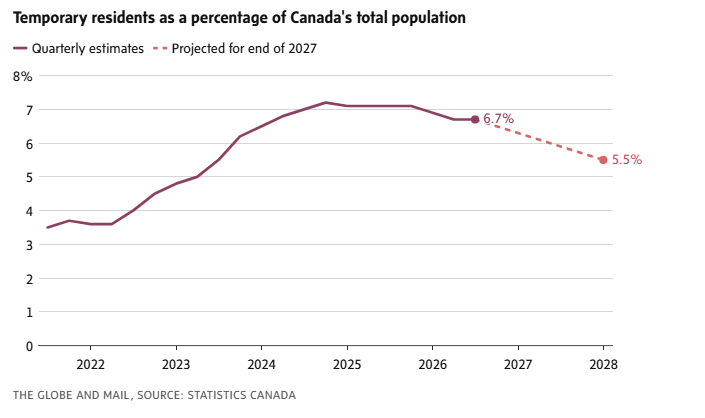
In March 2024, Ottawa first announced its plan to reduce the share of the non-permanent-resident population – mainly international students and foreign workers – to 5 per cent of the total population.
Between 2021 and 2024, in response to a surge of pandemic-related job vacancies, the Trudeau government loosened immigration rules to encourage international students and temporary foreign workers to come to the country. The result was rapid immigration growth.
The temporary-resident share of the population peaked a few months after the announcement in March 2024, then slowly decreased as stricter immigration policies limited the number of student visas and work permits issued to prospective immigrants.
While monthly arrivals of new immigrants into Canada have dramatically declined in the past two years, delays in processing permanent-resident applications at Immigration, Refugees and Citizenship Canada have meant the overall number of temporary residents in the country did not fall at a significant rate.
There were approximately 2.78 million temporary residents in Canada as of the end of June this year, compared with 3.12 million in October 2024. Yet the government has maintained its 5-per-cent target and says it will achieve it by reducing processing backlogs so that more temporary residents obtain permanent-resident status, while limiting the number of new arrivals into the country.

Deputy Immigration Minister Ted Gallivan told committee members that, in 2026, the number of temporary admissions was a third less than what it had been in previous years. “That’s a pretty significant variance,” he said.
IRCC set a target of 370,000 temporary-resident arrivals in 2026, but as of the end of August, only 195,000 people had arrived, according to the ministry’s data.
Ottawa – under fire from the Conservative Party for its recent move to grant permanent-resident status to 200,000 temporary residents – is also having to manage demands from business groups, who favour immigration growth.
Organizations such as the Canadian Chamber of Commerce and the Canadian Federation of Independent Business have been lobbying the feds to boost the quota of foreign workers employers can hire through the Temporary Foreign Worker Program – a key immigration stream. Earlier this month, Ottawa did loosen rules of the program, allowing select employers to hire more foreign workers and doubling the length of time a foreign worker can work for the same employer.
This article was first reported by The Globe and Mail