






Carney Dismisses Narrow Trade Deal Offer From the United States
Prime Minister Mark Carney says he is “not interested” in making a narrow deal that does not address all of President Donald Trump’s major tariffs on Canada, drawing a line in the sand as trade negotiations heat up.
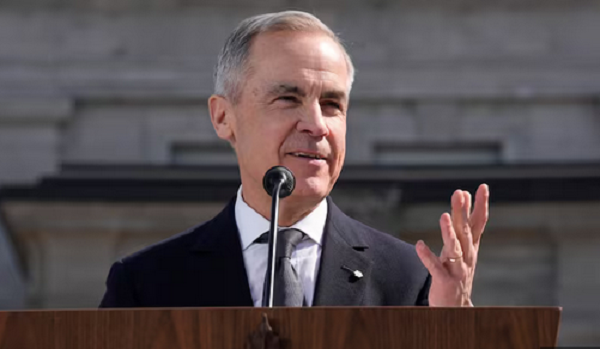
Speaking at an aluminum plant in Saguenay, Que., Thursday, Mr. Carney said he hoped there would be “pathways” to a wide-ranging agreement before Mr. Trump’s latest threatened tariffs take effect Aug. 19.
He dismissed the idea of making discrete, sector-by-sector deals.

“We’re not interested in a very targeted deal without connections to other sectors,” the Prime Minister said in French. In English, he added: “We’re interested in a more comprehensive deal, more global deal.”
Such a pact, he said, must address autos, steel, aluminum and forest products, all of which are currently subject to punishing U.S. tariffs. “Will we get all that by the 19th of August? We’ll see. But we want to have pathways in order to get that.”
Intergovernmental Affairs Minister Dominic LeBlanc and Janice Charette, Canada’s chief trade negotiator, met with U.S. Trade Representative Jamieson Greer on Thursday afternoon, the third day of their latest visit to Washington.
The sit-down, which had been scheduled for 30 minutes, lasted an hour and a half. When asked on his way in whether an agreement was possible by Aug. 19, Mr. LeBlanc replied, “I hope so.”
In a social-media post afterward, he wrote that he’d had a “constructive and detailed” discussion with Mr. Greer, accompanied by a photo of the grinning pair. “Our focus has been and will continue to be on striking a comprehensive deal that addresses sectoral tariffs.”
Republican Senator Kevin Cramer of North Dakota, who met with Mr. LeBlanc and Ms. Charette earlier in the week, said the talks have become more serious since Mr. Trump rolled out another suite of tariffs last month.
Those 50-per-cent levies would hit US$20-billion worth of Canadian goods, from electronic equipment to dairy products and alcohol.
“It’s easy to see that something’s happening, that there’s some movement taking place” in the negotiations, Mr. Cramer said in an interview. “It’s pretty clear to me that the leaders of the two countries have given the green light to a much more engaging and substantive discussion.”

Mr. Cramer, who co-chairs the U.S. Congress’s American-Canadian Economy and Security Caucus, praised Mr. Carney’s work on the file. “He’s handled it very well. He stands up for Canada’s sovereignty but does it respectfully. I think he’s balancing his politics pretty carefully.”
Mr. Greer has said he wants to make “interim” deals with Canada and Mexico before the end of the year, focused on bilateral irritants, before moving on to larger structural issues such as content rules for the three countries’ highly integrated auto industries.
Among the immediate U.S. demands are that Canada grant greater access to its protected dairy market and stop retaliating against Mr. Trump’s tariffs. Ottawa has imposed retaliatory tariffs on U.S. autos, and provincial governments have pulled U.S. alcohol from store shelves.
Washington’s negotiating sequence, however, clashes with Ottawa’s top imperative in the talks, which is to get Mr. Trump’s punitive tariffs on autos, steel and aluminum lifted or at least reduced. Mr. Greer’s preference would effectively see Canada give up negotiating leverage without a guarantee of tariff relief.
On Thursday, 168 Republican members of Congress signed a letter to Mr. Greer supporting his longer timeline for a deal. “We support the decision to prioritize outcomes over a deadline” on extending the U.S.-Mexico-Canada Agreement, the members wrote.
In Saguenay, Mr. Carney also pushed back against Mr. Trump’s repeated assertion that the U.S. does not need anything from Canada.
“There are many things that the Americans want from Canada. They say they don’t want them, but they do want them. It’s energy, it’s potash, it’s critical minerals, it’s aluminum,” he said.
And the Prime Minister downplayed comments the President made the day before in which he said that Canada has “nasty leadership,” saying it’s “easy for me to talk with Mr. Trump.”

“Yes, it’s a tough negotiation – you can change the adjective and say ‘nasty,’” Mr. Carney said in French.
During a speech at a Las Vegas casino Wednesday, Mr. Trump said Canada and other countries have taken advantage of the U.S. on trade, before describing Canada as “nasty” five times.
“Canada’s nasty, they are, they’re nasty. People think Canada – they’re nasty,” he said. “People, I love the people, but they’re nasty. Nasty leadership.”
This article was first reported by The Globe and Mail