
Fate of Canadian agricultural and seafood exports unclear as China tariff decision looms
Canadian farm and seafood producers are anxiously hoping for a decision, in the weeks ahead, on whether China will extend temporary tariff rollbacks granted earlier this year during Prime Minister Mark Carney’s diplomatic reset with Beijing.
Next month, Mr. Carney is expected to meet with Chinese President Xi Jinping during the Asia-Pacific Economic Cooperation summit and take stock of how their new strategic partnership has fared since a January breakthrough in relations.
The summit, taking place on Nov. 18 and 19 in Shenzhen, China, will provide the opportunity for Beijing to signal what will happen to a string of tariffs on Canadian goods that were suspended until the end of this year.

The initial tariffs on some Canadian agricultural and seafood products were put in place by Beijing in March, 2025, after Ottawa’s imposition of tariffs on Chinese steel, aluminum and electric vehicles.
This year, China scaled back tariffs on Canadian canola seed in exchange for Mr. Carney breaking with the United States and waiving a 100-per-cent tariff for imports of nearly 50,000 Chinese-made electric vehicles. There’s no time limit on Beijing’s rollback of canola seed levies.
But China also suspended a 100-per-cent tariff on peas and canola meal, and 25-per-cent levies on lobster and crabs as part of the Carney-Xi meeting in January. These suspensions are currently slated to end after Dec. 31.
There has been no word on the future of these tariffs or their rollbacks, which spells uncertainty for producers across Canada. Together, Chinese shipments of these Canadian commodities exceed $2-billion annually.
Chris White, president of the Canadian Meat Advocacy Office in Beijing, said a high-level Joint Economic and Trade Commission (JETC) meeting expected to take place in China near the end of October could help set the table for the Carney-Xi meeting in Shenzhen. International Trade Minister Maninder Sidhu is expected to attend the meeting in his capacity as Canadian chair of the JETC, the minister’s office said.
China has traditionally been Canada’s biggest export market for peas, according to Greg Cherewyk, president of Pulse Canada, which represents growers, traders and processors of Canadian pulses, such as dry peas, beans and lentils.
He said the signals from the January Carney-Xi meeting suggest both countries will take a pragmatic approach to trade.
He said without an update on China’s tariff plans, Canadian pulse shippers won’t want to risk dispatching vessels beyond early November “because of the risk of having it arrive Jan. 1 or after and potentially facing a 100 per cent duty.”
“I’m concerned that we’re going to come up against a timeline here where, you know, the Canadian trade will not be able to execute on sales without that certainty that the 100 per cent duty won’t apply on Jan. 1,” Mr. Cherewyk said.
Furthermore, he said, both importers and exporters will want certainty that the tariff suspension has been extended, including a posted bulletin by a government ministry before they conclude “it will be safe to execute on the trade and send vessels.”
Canadian pea exports to China totaled $3.7-billion between 2019 and 2024, the year before China hit the product with duties.
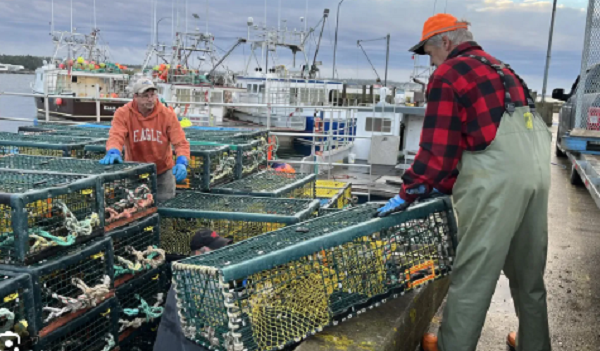
Canada exported close to $570-million of lobster to China in 2024, the year before the Chinese tariffs took effect. Most exports are live lobster.
Geoff Irvine, executive director of the Lobster Council of Canada, said the value of exports of live lobster to China dropped by 50 per cent in 2025. At the same time, Vietnam lobster was making inroads into China and Australian lobster just regained access into the Chinese market.
He said since the tariff was removed in March this year, exports have improved but only marginally due to poor economic conditions and competing protein products in China.
The resumption of the Chinese tariff on Canadian lobster would be one more problem for domestic producers.
“The loss or drop in demand from such a large market concerns everyone, so I don’t know how you measure anxiety, but add this to 50 other challenges and the entire sector is not very happy,” Mr. Irvine said.
There are still unresolved barriers for other Canadian products, including pork, which faces a 25 per cent tariff. A 100 per cent tariff remains on canola oil as well.
China is Canada’s second largest export market for canola products. In 2024, before Chinese tariffs hit, canola exports to China were valued at about $5-billion, with about $4-billion of that from canola seed. The balance was made up of meal, the second biggest canola export and oil in third place.
Chris Davison, president and CEO of the Canola Council of Canada, is hoping for good news on Beijing’s suspended tariff on canola meal.
“We want a more permanent solution to provide businesses on both sides with needed predictability and stability,” he said.
Jeff Mahon, a former deputy director of the China division at Global Affairs Canada, said Beijing’s suspension of tariffs on lobster, crabs, peas and canola meal is linked to Canada’s treatment of Chinese steel. Specifically, it’s connected to tariff relief Ottawa granted to imports of some Chinese steel.
Back in 2024, Canada slapped a 25-per-cent tariff on imports of Chinese steel and aluminum, blaming overproduction of these products for swamping global markets.
In 2025, Ottawa offered remission, or refunds, on these tariffs for some types of Chinese steel that it doesn’t produce domestically.

During his January, 2026, meeting with Mr. Xi, Mr. Carney extended this steel tariff remission program until the end of this year.
That’s the same end date for Beijing’s suspension of its tariffs on Canadian lobster, crab, peas and canola meal.
The challenge for Mr. Carney will be offering China more steel access given U.S. demands in the current trade dispute between the United States and Canada. In trade talks, which are suspended at the moment, the U.S. government has been trying to press Canada into aligning its tariffs with steep American levies against China.
“Steel is not going to be something that Canada is going to be able to deal with until it settles the American question,” Mr. Mahon said.
Mujtaba Hussain, press secretary to Mr. Sidhu, said the coming JETC meeting with China will be an opportunity to advance Canadian interests and resolve outstanding matters.
“Canada will always stand up for our farmers, fish harvesters and agri-food workers,” Mr. Hussain said, adding that Mr. Sidhu will travel to Shanghai in early November for the China International Import Expo, a trade fair dedicated to imports.
This article was first reported by The Globe and Mail