





Global Imbalances and U.S. Overinvestment Pose Distinct Financial Risks, Macklem Warns
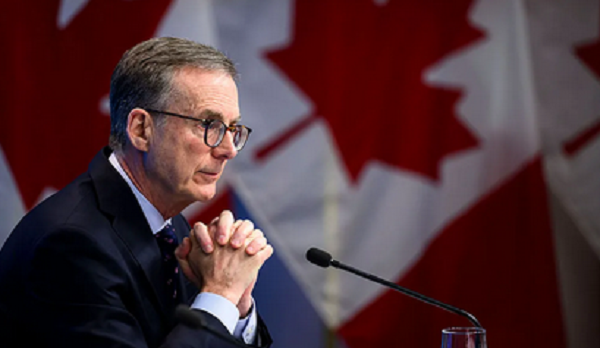
Bank of Canada Governor Tiff Macklem is warning that global economic imbalances may be leading to overinvestment in the United States and creating world-wide financial stability risks.
In a speech in Paris on Tuesday, Mr. Macklem said that capital flows between the world’s largest powers are being skewed by various economic forces, including China’s overreliance on exports, America’s dependence on foreign capital and Europe’s weak levels of investment.
Taken together, this has produced a situation where the United States runs chronic trade deficits while sucking in massive amounts of money from the rest of the world – fuelling both political backlash and a potential financial bubble in America.
“Cross-border finance is a good thing,” Mr. Macklem said in his address to the Chambre de commerce France-Canada. “But when flows become excessive, they can widen trade gaps, fuel protectionism and distort asset prices. Capital gets misallocated. Pressures cumulate and financial stability risks increase.”
These concerns aren’t new. However, they have taken on additional resonance given the massive run-up in U.S. equity markets on enthusiasm about artificial intelligence, as well as U.S. President Donald Trump’s attempts to reshape the global economic order using protectionist trade policy.
Mr. Macklem said there’s an additional concern. Changes in global finance, including increased involvement by non-bank entities such as hedge funds and private equity companies, mean there is less oversight of critical markets.
“As imbalances have been building, the way capital moves across borders has also been changing. The financial system is not just bigger. It’s faster, more complex and increasingly dominated by new players that are less regulated, less transparent and less tested under stress,” Mr. Macklem said.
“That leaves us with two clear risks,” he added. “First, large capital inflows into the United States could once again be misallocated – stretching valuations in equities and credit, and setting the stage for a painful correction. Second, those flows could reverse suddenly. Either outcome could send stress far beyond U.S. borders.”
The big question, he said, is whether governments, regulators and the private sector can address some of these issues before they “unwind in ways we cannot control.”
History suggests the U.S.’s current approach will be costly and unsuccessful, Mr. Macklem said. “Trying to shift the costs of domestic imbalances to foreigners using tariffs and currency devaluations doesn’t work. The mutual harm of trade wars lowers growth and living standards for everyone.”
Instead, you need to tackle the macroeconomic problems that underpin the imbalances.
There are some encouraging signs this is happening, Mr. Macklem said.
China’s latest five-year plan emphasizes domestic consumption, which could make Chinese consumers a bigger engine of growth to take some pressure off exports. In Europe, there is an increased focus on continental integration, and investment in infrastructure and defence. In the United States, there are aspirations to have a lower fiscal deficit.
“Of course, real progress requires moving from aspiration to action to adjustment. And adjustment will take time,” Mr. Macklem said.
Other countries can help by creating more investable assets, so global savings can flow into markets other than the United States. “In Canada, this includes eliminating interprovincial trade barriers and reducing regulatory uncertainty,” Mr. Macklem said.

While the speech was high-level and internationally focused, the Governor addressed the latest Canadian inflation numbers in a press conference after the speech.
On Monday, Statistics Canada reported that annual headline inflation hit 3.2 per cent in May, largely as the result of rising oil prices. Measures of core inflation remained around the central bank’s 2-per-cent target.
“Overall, we are not seeing, so far anyways, much spreading of higher oil prices to prices of other goods and services,” Mr. Macklem said, adding that “so far there’s no evidence of generalized inflation.”
He said the tentative peace agreement between the United States and Iran, and the reopening of the Strait of Hormuz to oil tankers, “certainly takes some upside risks away on inflation.”
This article was first reported by Reuters