







Rental Markets Slump in Tariff-Exposed Hubs
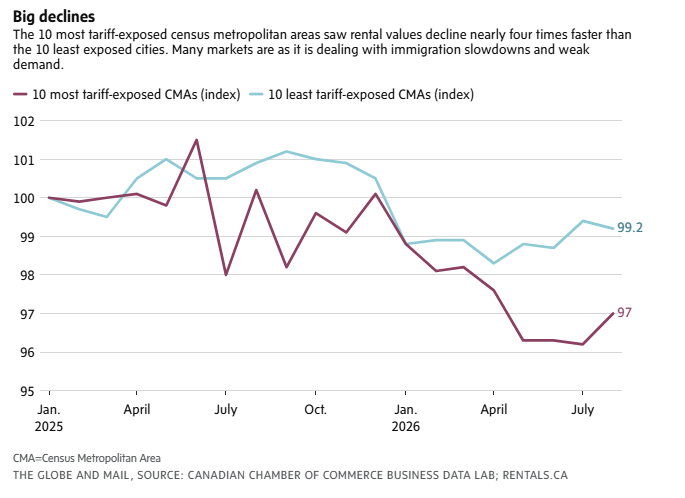
Rental rates are dropping nearly four times faster in cities that are the most exposed to U.S. tariffs than in the communities least affected by the trade war, according to new data from Rentals.ca and Urbanation.
Tariff-exposed cities, such as Oshawa, Ont., Kitchener-Waterloo, Ont., and Hamilton, face added headwinds to an already beleaguered rental market, Shaun Hildebrand, president of Urbanation, said in an e-mail. These three cities, hubs for auto manufacturing, steel and industrial exports, all rely on industries hit hard by U.S. President Donald Trump’s tariffs.
The 10 cities most vulnerable to U.S. tariffs, as determined by the Canadian Chamber of Commerce, saw average rents drop by 3 per cent since January, 2025, when Mr. Trump took office and launched his trade war.

In contrast, the 10 least tariff-exposed cities – which include Vancouver, St. John’s, Halifax and Saskatoon – have seen rents drop by only 0.8 per cent on average. The chamber created the ranking by quantifying how much Canadian cities depended on exports to the U.S.
Mr. Hildebrand said rental markets are expected to decline more broadly if the trade war continues.
“Rents respond to the labour market with a lag of several quarters, so what we are seeing now reflects the first round of tariffs, not the most recent ones,” Mr. Hildebrand said.
“If the trade war persists, the effect widens from job losses in a handful of industries to a broader reluctance to form new households, and that impacts far more renters.”
Oshawa was the weakest market included in the study, with rents there dropping by 8.9 per cent since January, 2025.
“Oshawa stands out as it is a market where one industry sets the tone for the entire local economy, so when the auto sector cuts shifts and jobs, it shows up in rents faster than anywhere else,” Mr. Hildebrand said.
Bill Senyk, a realtor and property manager in Oshawa, agreed that tariffs have had a chilling impact on his area’s real estate market.
He said properties that once took a month to fill with a tenant will now sit empty for two or three months because the market is so slow.
He pointed to General Motors’ decision to reduce shifts in response to the trade war, which in turn reduced operations at other manufacturing firms around Oshawa and created a downturn felt across the city.
“Restaurants that used to be jammed on a Friday or Saturday night will at most have eight tables sitting at one time,” said Mr. Senyk, who added that people’s ability to spend on housing has decreased, too.
“I don’t think we’ve even hit bottom yet.”
Not all tariff-affected cities saw values decline at the same pace. Rentals.ca data showed that Windsor (the second most exposed city) only saw rent decline by 2.4 per cent in the last year, which is half the national average of 4.8 per cent.

The report attributed the resilience of that city to its tight rental market, which has far fewer available listings than other communities.
The study also noted that the trade war will likely lead to supply shortages in cities such as Vancouver and Toronto in the coming years, as tariffs lead to increased building costs and fewer housing starts.
It found that steel framing costs have increased by 7.8 per cent since the onset of American tariffs and Canadian countertariffs.
“Tight supply will amplify rent increases when demand rises. Rental supply cannot respond quickly, and when demand grows, price is the only thing left that can adjust,” Mr. Hildebrand said.
This article was first reported by The Globe and Mail