







Top Dividend Growth Equities Selected for Balanced Long-Term Portfolios
School is back in session and the kids are beavering away at new challenges as they learn and grow.
Growth is also welcome in the markets where smaller stocks can be good bets because they have more room to grow than their larger counterparts. On the other hand, they can also be riskier because they may be hard hit during economic downturns.
The Smaller Stable Dividend portfolio offers growth potential with a side order of stability because it focuses on small low-volatility Canadian dividend stocks.
The portfolio generated strong returns with average annual gains of 14.4 per cent over the 27 years through to the end of August, 2026. In comparison, the Canadian stock market – as represented by the S&P/TSX Composite Index – climbed at an average annual rate of 9.1 per cent over the same period.
(The returns herein are based on backtests using monthly data from Bloomberg. They include dividend reinvestment but not fund fees, taxes, commissions or other trading costs. The portfolios are equally weighted and rebalanced monthly.)
The Smaller Stable Dividend portfolio is an extension of the original Stable Dividend portfolio and applies the same stock-picking method to smaller stocks. The portfolio skips over the largest 300 stocks (by market capitalization) on the Toronto Stock Exchange (TSX) and starts with the next 100 largest stocks on the exchange. It then narrows in on the dividend payers, which cuts the list from 100 to 37 stocks this week. The portfolio then picks the 20 dividend payers with the lowest volatilities over the prior 260 days.
But it’s worth looking at the impact of each step in the procedure.
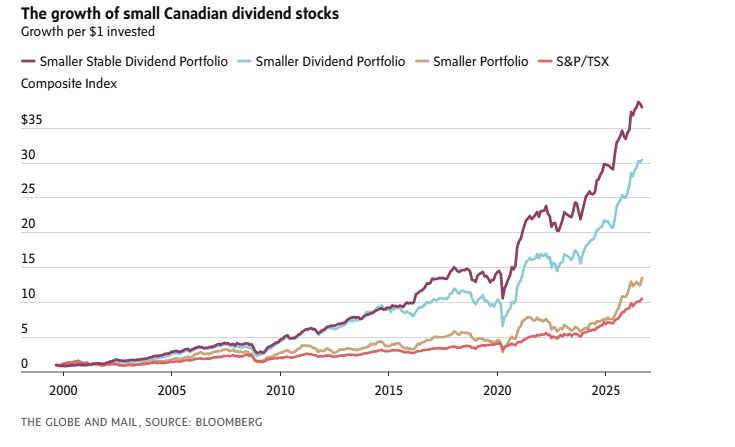
Starting at the top, the smaller portfolio follows the 100 smallest stocks from the largest 400 on the TSX. It gained an average of 10.1 per cent annually over the 27 years to the end of August, 2026. The smaller portfolio fared just a touch better than the Canadian market index, which is dominated by the largest stocks in the land.
The biggest return boost came from the next step that removed non-dividend payers from the smaller portfolio to create the smaller dividend portfolio. It gained an average of 13.5 per cent annually over the same 27 years.
The last step picks the 20 low-volatility stocks that are put into the Smaller Stable Dividend portfolio, which provided an average annual growth rate of 14.4 per cent over the 27 years.
It’s worth keeping in mind that simply buying an equally weighted portfolio of small Canadian dividend payers worked quite well over the 27 years and it didn’t require looking up volatilities along the way. Mind you, it’s also fairly easy to eyeball return graphs to find, and exclude, the most volatile stocks.
You can examine the gains of the Smaller Stable Dividend portfolio, and its related portfolios, in the accompanying graph, which also includes the returns of the market index.
Turning to measures of risk, the smaller portfolio was about 51 per cent more volatile than the Smaller Stable Dividend portfolio while the smaller dividend portfolio was roughly 13 per cent more volatile, over the 27-year period.
Seasoned investors will remember the markets’ big downturns such as the decline after the internet bubble burst in the early 2000s and the plunge during the financial crisis of 2008-09. On both occasions the market index fell 43 per cent. The index gave up a more modest 22 per cent in the sudden crash of 2020 that accompanied the COVID-19 pandemic.
The Smaller Stable Dividend portfolio (and the smaller dividend portfolio) basically sidestepped the market’s collapse in the early 2000s as investors turned away from high-tech stocks. The portfolio also fared a bit better than the market in the 2008-09 downturn with a loss of 34 per cent. On the other hand, it didn’t do well in the sharp plunge of 2020 when it fell 30 per cent.
Alas, dividend stocks are not immune to downturns and the Smaller Stable Dividend portfolio flounders from time to time.
But I’ve high hopes that the portfolio, and Canadian dividend stocks more generally, will continue to produce reasonable returns over the long term.
By Norman Rothery, PhD, CFA,
This article was first reported by The Globe and Mail