





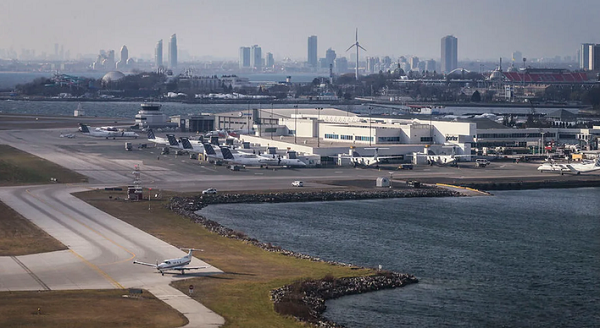
Toronto Business Leaders Urge Expansion to Save Billy Bishop Airport
After 16 months of shifting trade policies and tense relations with the United States, persistent uncertainty continues to hamper business investment in Canada – but a survey finds few companies are planning to expand operations into the U.S. or relocate there.
Ten per cent of Canadian manufacturing firms plan to delay major investments over the next 12 months in response to U.S. tariffs, compared with 5 per cent of all businesses, according to a quarterly survey conducted by Statistics Canada in partnership with the Canadian Chamber of Commerce.
The survey was conducted between April 1 and May 6, and included more than 9,200 responses. Because of the timeframe, it doesn’t account for reaction to the Trump administration’s recent announcement of 50-per-cent tariffs on a variety of Canadian goods, announced last week and set to take effect on Aug. 19.

“Every investment decision that gets postponed today is a factory expansion, technology upgrade or productivity improvement that doesn’t happen tomorrow,” Patrick Gill, vice-president of the Business Data Lab at the Canadian Chamber of Commerce, said in the press release. “That’s the hidden economic cost of uncertainty, and it’s one Canada can’t afford to continue.”
Lacklustre business investment has been a persistent challenge for the Canadian economy over decades, but has taken on heightened urgency during U.S. President Donald Trump’s second term, which has seen Canada’s largest trading partner turn increasingly protectionist.
Last year, the U.S. imposed Section 232 tariffs on key industrial sectors, including steel, aluminum and automobiles. The levies slammed manufacturing bases in Ontario and Quebec, leading to major factory layoffs and even shutdowns. On Friday, the U.S. enacted Section 301 duties related to forced labour on dozens of countries, including Canada, as part of the White House’s efforts to rebuild tariffs after legal setbacks.
Economic data and surveys show that trade uncertainty has weighed on hiring and investment plans.
Nearly 10 per cent of businesses across the natural-resource sectors – including oil and gas, mining, forestry and agriculture – also plan to delay major investments, according to the chamber’s analysis of Statscan survey data.
Business sentiment has been deteriorating for eight consecutive quarters, dating back to the third quarter of 2024, the survey found.
Even so, very few companies plan to move their operations to the States. Over all, less than 1 per cent of businesses plan to establish U.S. operations, while just 0.4 per cent plan to acquire or partner with a U.S. business.
“Tariffs appear to be delaying Canadian investment more often than it is encouraging relocation to the United States,” the chamber’s report said.
The uncertainty caused by the trade war has reverberated across exporting industries, dampening business confidence and sending the economy into a mild contraction over a six-month period straddling 2025 and 2026.
Since then, the economy has stabilized. Gross domestic product has perked up in recent months, suggesting Canada is heading for annualized growth of more than 2 per cent in the second quarter. The upturn in the Canadian economy is likely to be tested by the U.S.’s recent tariff plans.
The survey found that among businesses not planning to apply for financing, 62 per cent could take on additional debt – above the survey’s five-year average of 56 per cent, and suggesting that financing capacity alone does not explain Canada’s weak investment performance.

“Without stronger confidence, improved market opportunities and renewed incentives to invest, today’s resilience risks giving way to a prolonged period of slower productivity, weaker competitiveness and lower long-term prosperity,” Mr. Gill wrote in the report.
Since the survey was conducted, the United States-Mexico-Canada Agreement passed its renewal deadline on July 1. The continental pact will now undergo annual reviews over the next decade, after which it will expire. The 50-per-cent tariffs announced last week would apply to roughly US$20-billion of imports from Canada, equal to about 5 per cent of Canada’s shipments to the U.S. in 2025.
Crucially, those new duties would not exempt goods that meet the USMCA’s rules-of-origin thresholds, which specify what percentage of a product must originate in North America to receive preferential tariff treatment.
“When investment waits, productivity, wages and long-term growth wait too,” Mr. Gill said.
This article was first reported by The Star