




Trump Excludes Canadian Goods from Federal Contract Schedules
President Donald Trump is moving to further restrict Canadian companies from selling goods and services to the U.S. government in the latest escalation of his trade war against Ottawa.
In a memo on Wednesday, Mr. Trump ordered Russell Vought, the director of the White House’s Office of Management and Budget, and U.S. Trade Representative Jamieson Greer to identify and remove “Canadian origin items” from the federal civil procurement system using “all steps permitted by applicable law.”
The President said the move was in response to Buy Canadian programs that provincial governments have set up over the last year-and-a-half in retaliation against Mr. Trump’s earlier tariffs.

“Canada has unreasonably imposed new barriers to United States companies seeking to access the Canadian government procurement market,” he wrote in the memo.
He also instructed Mr. Vought and Mr. Greer to present other government officials with American-made alternatives to Canadian products.
Separately, he also threatened to hammer the European Union with more tariffs if it follows through on a proposal to make Canada the first associate member in the bloc’s history.
On Wednesday evening, Mr. Trump told reporters that European Commission President Ursula von der Leyen’s suggestion that Canada could become an associate member of the EU was “laughable.” But if such a thing happens, he said, he might punish the 27-member trade bloc.
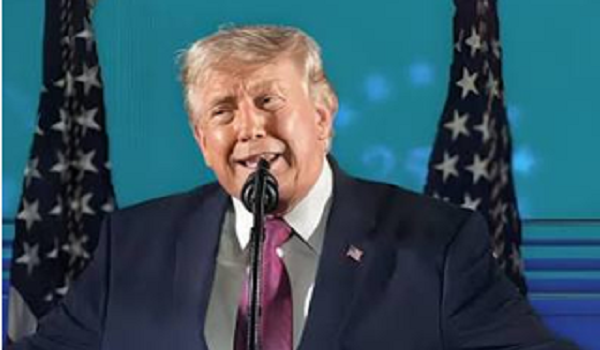
“Canada’s been a terrible trade partner,” he said after disembarking Air Force One in Charlotte, North Carolina, ahead of a midterm election rally. “If they do that, if I think it’s at all a hostile act, I will put very serious tariffs or stop trading with Europe on many things.”
Mr. Trump’s order to remove Canadian products from the U.S. government’s procurement system on Wednesday goes much further than an announcement he made last week on the same subject.
In the previous announcement, he said he would bar Canadian companies from part of the General Services Administration’s procurement program, which covers such things as information technology and office supplies for government workers.
The Wednesday order applies to a broader range of government contracting. It said Mr. Vought and Mr. Greer would work with the Federal Acquisition Regulatory Council, which co-ordinates procurement across the government.
Still, the wording of the memo gives Mr. Vought and Mr. Greer some discretion on whether to remove items, telling them to take action “if warranted.”
In fiscal 2025, all agencies and departments of the U.S. government committed roughly US$2.02-billion to goods and services of Canadian origin, according to an analysis of awards reported by the government website USASpending.gov.
Of that amount, the vast majority, around US$1.75-billion, was committed by the Department of Defence, while US$270-million came from all other agencies.
These dollar amounts are obligations, not contract values, and represent the money the government has actually committed to pay for goods and services under a contract, which can span multiple years.
In a statement, a spokesperson for Dominic LeBlanc, the Minister responsible for U.S. trade, said the Canadian government “will review” the President’s latest measures.
“We take note of the Administration’s latest update, which advances previously announced procurement restrictions,” Gabriel Brunet, Mr. LeBlanc’s communications director, wrote in an e-mail.
The memo is “harsh” in its wording as it covers all use of Canadian goods and services by the U.S. government “to the extent it can be imposed” by law, said Laurence Schor, Washington based lawyer with Asmar, Schor & McKenna, PLLC, who focuses on procurement law.
The language around restricting goods of Canadian origin is also “usually attached to product from countries where the labour is being tortured and where there is trafficking of labour” and raises questions about the legality of the action.
Mr. Schor said Mr. Trump’s latest restrictions are meant “as a slap” against Prime Minister Mark Carney and Ontario Premier Doug Ford for not backing down in the face of the trade war.
Canada-U.S. trade talks ended abruptly in August when Mr. Carney rejected a deal that he said would have infringed on Canada’s sovereign right to make trade agreements with other countries, and guaranteed the destruction of its auto industry. Mr. Trump then imposed 50-per-cent tariffs on $28-billion worth of Canadian exports, and Mr. Carney retaliated with tariffs on $28-billion worth of U.S. exports.

The President retaliated against Canada’s retaliatory levies by banning Canadian alcohol and motorcycles from the U.S., and hitting more products with 50-per-cent tariffs, including cheeses and furniture.
The two countries have been locked in a trade war since last year, when Mr. Trump imposed a previous set of sector-specific tariffs on autos, steel, aluminum and other goods.
Ms. von de Leyen made her pitch for Canada to strengthen its ties to the EU in a speech to the European Parliament in Strasbourg, France, on Wednesday with Mr. Carney in attendance.
She did not define what associate membership would entail specifically or how Canada and the EU would go about negotiating it. Canada and the EU, for example, signed a trade agreement a decade ago, but 10 of the bloc’s countries, including France and Italy, have still not ratified it.
The EU last year signed a lopsided trade deal with Mr. Trump, in which Brussels agreed to accept U.S. tariffs in exchange for Washington not setting the tariffs even higher.
With a report from Dexter McMillan
This article was first reported by The Globe and Mail