






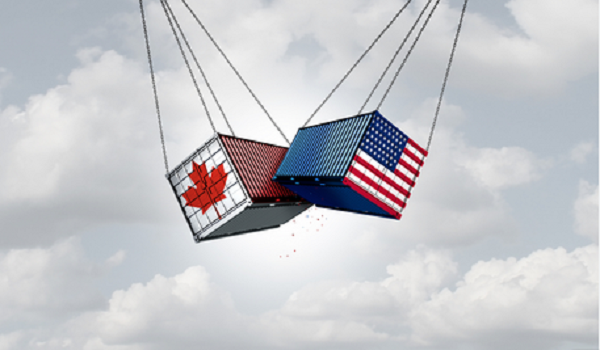
U.S. Producers Brace for Canadian Tariffs Amid Shared Supply Chain Concerns
Over the past two weeks, Jim Coudal has been rushing orders to Canadian retailers from his Chicago warehouse ahead of new retaliatory tariffs on U.S. products.
Starting Sept. 8, Coudal’s company, Field Notes, which makes small pocket notebooks and memo books, will face a 50 per cent tariff when its products enter Canada, where they are sold by retailers including Toronto Pen Shoppe and Take Note Pens & Stationery Store.
Although Canada accounts for only about five per cent of his business, Coudal worries higher prices from the tariffs will deter customers and eat into his sales. Since the trade war began, Coudal has already seen a decline in international orders.

“I blame the American government for starting this whole nonsense,” said Coudal. ”(The tariffs) don’t help anybody. It just makes everything more expensive for everyone, and it’s ridiculous.”
More than 700 U.S. products worth $27.6 billion are expected to be hit by Prime Minister Mark Carney’s “dollar-for-dollar” counter-tariffs. The list largely mirrors Donald Trump’s Section 338 tariffs, covering goods ranging from steel and aluminum to dairy products, appliances, agricultural equipment, pulp and paper, and plastics.
American industry groups and manufacturers told the Star the tariffs could add to an already difficult business environment, though one Canadian economist notes the impact of the levies on the overall U.S. economy will likely be negligible.
Some industries will be hit harder than others, and Michigan, Kentucky and Ohio are the states that will be the most impacted, said Ali Jaffery, KPMG’s chief economist.
“The U.S. economy is 20 times the size of our economy,” Jaffery said. “What we have tariffed is half a per cent of their imports from all over the world.”
Jaffery added that Canada will likely feel more pain than the U.S., but it will “be pretty small” because the counter-tariffs were carefully designed to avoid fuelling widespread inflation.
His main concern is whether the U.S. will retaliate once the Canadian counter-tariffs take effect — and how hard it will hit back.
The doubling of tariffs on U.S. steel and aluminum to 50 per cent has left equipment manufacturers among the industries most concerned about the escalating trade war.
The American equipment manufacturing industry exports about 30 per cent of what it produces, with the vast majority going to Canada, according to Kip Eideberg, senior vice-president of government and industry relations at the U.S.-based Association of Equipment Manufacturers.

“It could very likely be catastrophic if these tariffs set in for the long haul,” he said.
While the U.S. holds a trade surplus of about $5.7 billion in equipment, including agricultural and construction machinery, that advantage could shrink as trade between the two countries declines, Eideberg said.
“We are trapped in this tit-for-tat doom loop of ever-escalating tariffs that will only serve to undermine the North American market,” he said, arguing that both U.S. and Canadian manufacturers will lose their competitive edge in the global market if the production costs go up.
He added that he wants both sides to come back to the table and work toward a long-term trade agreement rather than moving further apart and digging in their heels.
Charlie Souhrada, vice-president of regulatory and technical affairs at the North American Association of Food Equipment Manufacturers, said the 25-to-50-per-cent counter-tariffs will hit at the heart of what his members make, including refrigerated display cabinets, cooking equipment and other appliance components.
Of the association’s 600 members surveyed in 2024, 90 per cent said their products are used in Canada, Souhrada said. But how deeply the tariffs will affect their businesses remains uncertain, he added.
“The bottom line is that it’s difficult for our members to control their overall costs, maintain their profit margins, and manage their businesses with such a roller coaster approach to trade policy,” he said.
Souhrada’s association has publicly condemned the use of tariffs and voiced support for free trade, but he fears there is only so much a trade group can do to move the needle with Trump.
“Do I blame Canada? No, I really don’t. I am rather sympathetic to the folks in Ottawa and appreciate the fact that they’re going through some challenging discussions.”

William Pellerin, an international trade partner at McMillan LLP, told the Star that by matching the U.S. 50 per cent tariffs on Canadian goods, this round of counter-tariffs appears aimed more at shoring up the domestic market than applying political pressure on the U.S.
If Canadian producers are shut out of the American market, imposing a similar tariff on U.S. goods could limit American competition and help Canadian companies gain domestic market share, he explained.
“It’s about protecting domestic manufacturers, and making sure there is a source of demand for their products,” he said.
This article was first reported by The Star