


Warsh Prepares for Fed Policy Showdown, Demands Internal Debate
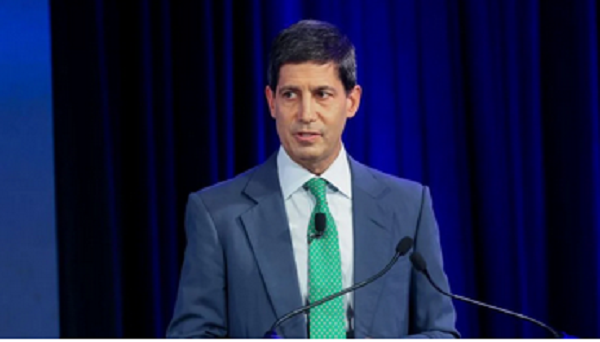
Federal Reserve chief nominee Kevin Warsh says he wants a “good family fight” at the policymaking table once he takes over as head of the U.S. central bank.
And a fight, or at least stiff resistance, may be exactly what he gets if he tries to deliver the steep interest rate cuts that President Donald Trump expects from his nominee when Fed Chair Jerome Powell’s leadership term ends on May 15.
Of the 19 Fed officials who set interest rates and who will convene on Tuesday for what’s likely to be their final two-day policy meeting under Powell’s leadership, roughly half lean hawkish, meaning they are more concerned about the prospect of rising inflation than labor market weakening, and therefore are hard-pressed to support rate cuts.
About a third are solidly centrist, and only three have argued for near-term reductions in borrowing costs. Fed Governor Stephen Miran, in this dovish minority, is set to step down to make room for Warsh to join the Fed’s Board of Governors.
The Senate Banking Committee on Wednesday is expected to advance Warsh’s nomination for consideration by the full Senate, increasing the chance that the 56-year-old lawyer and financier will be in place to preside over the Fed’s June 16-17 meeting.
Here is a look at how Warsh’s new colleagues fit in relation to the incoming Fed chief’s views.
LABOR MARKET
“I think broadly speaking, the economy is running about close to full employment … if Americans that want a job can find a job, by the Fed’s metric we’re at full employment,” Warsh told lawmakers at his confirmation hearing last week.

He may get little argument at the table on that score. Though monthly job creation has plummeted over the last year, so has the number of job seekers, largely because the number of immigrants has slowed sharply and the U.S.-born population continues to age into retirement. Those changes have kept a cap on the unemployment rate, which ticked down in March to 4.3%.
That’s not to say there isn’t concern about labor market fragility, especially among the Fed’s more dovish members.
“I continue to see weakness in the labor market that leaves it vulnerable, starting with data showing low numbers of both hires and people losing their jobs,” Fed Governor Christopher Waller said earlier this month.
But for now the majority of Fed policymakers see the labor market as balanced and are looking to inflation data for direction on what to do with monetary policy.
INFLATION
Warsh testified at his confirmation hearing that he felt inflation “has improved somewhat in the last year,” a view at odds with many Fed policymakers who point to the Trump administration’s new import tariffs last year as a reason for stalled progress on inflation and who say they are worried the Iran war and sharply higher oil prices will push inflation back up.
Underlying inflation, as measured by the year-over-year change in the core Personal Consumption Expenditures Price Index, was 3% in February and economists estimate it rose to 3.2% in March. The 12-month change in the PCE Price Index, which the Fed targets at 2%, is estimated to have hit 3.5% in March.
Warsh said last week he feels that trimmed-mean measures – which lop off the fastest-rising and sharpest-falling prices to get a picture of where most prices are heading – are better gauges of the inflation trend. The Dallas Fed’s trimmed mean reading was 2.3% in March.
If those comments were a veiled signal that Warsh wants to revisit the Fed’s 2% inflation target, he may get few takers. Nearly all current U.S. central bank policymakers have signaled no appetite for revisiting that goal, especially given that it has missed its target for the past five years.
That said, most central bankers already look at a range of inflation measures. Dallas Fed President Lorie Logan, whose regional Fed bank produces the best-known trimmed-mean measure, is one of the central bank’s leading hawkish policymakers.
INTEREST RATES
Powell has said the Fed’s monetary policy is “well-positioned,” a term that many of his colleagues have also adopted and that signals comfort with leaving the policy rate in its current 3.50%-3.75% range, as the central bank is universally expected to do at this week’s meeting.
Some of the more hawkish-leaning policymakers have even expressed support for changing the Fed’s policy statement to signal as much openness to a rate hike as a next move as to a rate cut. Others say inflation pressures at the least call for delaying any rate cut, perhaps even into next year. The going bet in financial markets is for no rate cuts this year.
Warsh at his confirmation hearing did not reiterate the support for immediate rate cuts that he had expressed when Trump was still weighing his options for his Fed chief nominee. His muteness on that front, however, may have more to do with his view that Fed policymakers should not give any “forward guidance” about their upcoming decisions or even about their rate-path views.
Warsh did not push back against a question about whether the Fed ought, as Trump has said, to cut its policy rate to 1% by the end of this year, a drastic reduction to a level most usually associated with recessions and crises, not a growing economy.

BALANCE SHEET
Warsh told lawmakers any discussion of the proper setting of interest rates should also involve discussion of the balance sheet, because “those tools should be working in concert, not at cross purposes.” Indeed, he argues that shrinking the balance sheet will give policymakers room to lower short-term interest rates, a view that has so far found just one public taker among Fed policymakers.
Most of Warsh’s future Fed colleagues see discussion of the balance sheet as distinct from interest rate policy, except during a crisis. Warsh wants to shrink the balance sheet at a time when most Fed policymakers see it expanding, if marginally, in line with the growth of the economy and the demand for U.S. currency. Where they do appear to agree with Warsh is that any changes to the balance sheet should be gradual.
HOW ARTIFICIAL INTELLIGENCE WILL CHANGE THINGS
Warsh’s view that artificial intelligence will likely push up economic productivity in the longer term has a sympathetic ear at the policymaking table. A productivity growth spurt, the argument goes, could open the door to rate cuts because it would allow the economy to grow faster without the risk of pushing up inflation.
But timing matters. In the short term, artificial intelligence investment may be adding to price pressures, several Fed policymakers have warned. And the long-term implications for rates are unclear because AI will also affect the labor market in ways Fed policymakers are only beginning to parse.
Reporting by Ann Saphir; Editing by Paul Simao
This article was first reported by Reuters