



China Targets 5% Growth Despite U.S. Trade Tensions, Structural Risks Persist
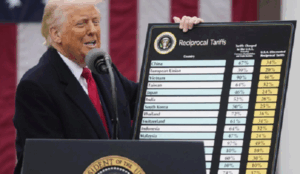
The Chinese economy bore the brunt of U.S. President Donald Trump’s trade war last year, with both sides engaging in tit-for-tat tariffs that threatened to spiral out of control until Mr. Trump agreed a new trade deal with Chinese leader Xi Jinping at a summit in South Korea.
At one point, Washington imposed cumulative tariffs of 145 per cent on most Chinese goods, a rate that threatened to essentially halt exports from China to its largest trading partner. But for all the uncertainty this engendered, in China and global markets, Beijing refused to back down, imposing its own tariffs and negotiating hard ahead of the October agreement.
That tactic appeared to have paid off Monday, as China reported it had hit its full-year GDP growth target of 5 per cent, with exports to other markets more than compensating for slowing U.S. demand.
READ MORE ON OUR DAILY STOCK MARKET REPORTS – Major Indexes Pause As Small Caps Continue To Lead
The world’s second largest economy posted a record trade surplus of US$1.19-trillion in 2025, underlining how China remains the dominant global supplier despite competition from developing markets and domestic challenges including increasing labour costs and a shrinking population.
Though growth dropped to 4.5 per cent in the fourth quarter, raising fears of slowing momentum heading into 2026, Beijing has cause to remain optimistic on this front, having stabilized trade with the U.S. – for now – and agreed to new trade deals with Canada and South Korea, as well as making progress on similar agreements with Britain and the European Union.
“Trump’s tariffs have essentially failed to deliver the desired effect,” said Huang Weiping, a professor of economic at Renmin University in Beijing, pointing to increased diversification and a growth in exports to Southeast Asia and other developing markets.

Indeed, China has been helped in this regard by Mr. Trump: the U.S. president’s advisers once framed tariffs as a means of containing Beijing, but instead Washington’s all-out global trade war has driven many countries – Canada among them – closer to China.
That includes even the EU, where longstanding concerns about oversupply and a yawning trade deficit are being offset by new threats of U.S. tariffs over Greenland and even a potential invasion of the Danish territory. China agreed to open its market to Spanish pork and Irish beef following recent visits by those countries’ leaders, while French President Emmanuel Macron is reportedly planning to invite Mr. Xi to a G7 summit hosted in France this summer.
In an editorial Monday, the state-run Chinese newspaper Global Times said “China has always viewed Europe as an indispensable force in a multipolar world and genuinely supports Europe in pursuing strategic autonomy.”
For all that China’s export economy – long the engine of its stratospheric growth in recent decades – remains relatively rosy, domestic consumption did not improve significantly in 2025, despite concerted efforts to boost demand both to offset external pressures and reduce China’s increasingly politically toxic trade deficit with overseas partners.
“The domestic contradiction of strong supply and weak demand is prominent, and there are still many old problems and new challenges in economic development,” National Bureau of Statistics official Kang Yi told a briefing Monday.
Chinese policymakers have vowed to “significantly” boost domestic consumption over the next five years, including by adopting proactive fiscal measures. Despite this, household spending in China remains around 20 per cent below the global average, making up less than 40 per cent of annual economic output.
In a note, analysts at the Economist Intelligence Unit said China “remains a K-shaped economy in 2025, characterized by a robust external sector and soft domestic demand.”
Xu Mingqi, deputy director of the Institute of World Economy at the Shanghai Academy of Social Sciences, said “consumption remains underwhelming, prompting the rollout of a raft of pro-consumption measures spanning fiscal, tax and financial policies.”
These policies could yet “deliver notable effects in 2026,” Prof. Xu said.
However, falling property prices – investment in the sector slumped 17.2 per cent last year – high youth unemployment, and a weak social safety net have all combined to drive down domestic demand, and Chinese consumers have so far responded tepidly to stimulus measures like vouchers or government-backed electronics trade-in programs.
As well as the growth statistics released Monday, China also published its latest population figures, with the one-time world’s most populous country shrinking for the fourth consecutive year. The total number of births in 2025 was 7.92 million, the lowest in decades, down from 9.54 million in 2024.
While China is far from the only developed country in East Asia to be grappling with a rapidly ageing population, the situation is exacerbated by the legacy of the “one child policy,” which has created a situation where one person of working age may be supporting six people: two parents and four grandparents.
With files from Alexandra Li in Beijing and Reuters
This article was first reported by The Globe and Mail