





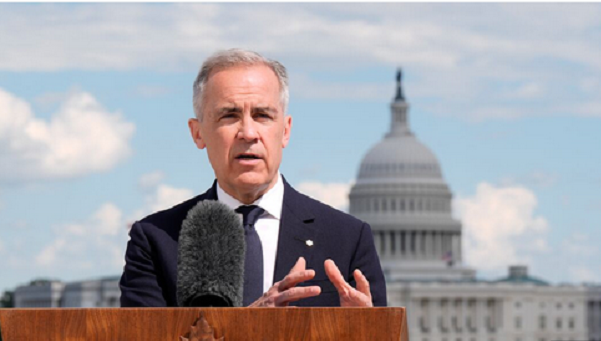
Addressing Trade Irritants Can Reopen Canadian Market to US Liquor, Says Carney.
Prime Minister Mark Carney says U.S. trade irritants such as provincial bans on sales of American liquor can be rapidly resolved as part of talks on the future of the United States-Mexico-Canada Agreement, as long as progress is made in addressing Canada’s grievances.
Mr. Carney, speaking to reporters Thursday at an unrelated Ottawa-area announcement, was talking about the turbulent discussions with U.S. President Donald Trump’s administration on a scheduled review of the USMCA – talks that also include Canada’s efforts to undo hefty tariffs that Washington has placed on steel, aluminum and autos.
Before formal negotiations even begin, sources say, the U.S. has been asking Ottawa for upfront concessions to address its concerns with Canadian trade practices. On Wednesday, Mr. Carney pushed back on the notion that the U.S. would be able to set conditions for trade talks. “It’s not a case of the United States dictates the terms. We have a negotiation,” Mr. Carney said.
A day later, the Prime Minister appeared to be outlining Canada’s own strategy. Mr. Carney said Canada can resolve some irritants as long as there is give-and-take on matters of interest to Canadian negotiators.
Read More On Our Daily Stock Market Reports – Markets Lower as U.S.–Iran Talks Remain Stalled
“Issues such as decisions on which alcohol to put on the shelves – we can make progress very quickly on that with progress in other areas,” Mr. Carney said.

As The Globe and Mail reported Wednesday, two sources familiar with the talks say Mr. Trump’s administration has asked Canada to change or scrap domestic policies – including dairy supply management, provincial bans on American liquor, the Online Streaming Act and the Online News Act – before it will sit down to negotiate.
On Thursday, Mr. Carney said Canada also has irritants it wants the United States to address: The tariffs on steel, aluminum, and autos, as well as levies on Canadian forest products.
“Those are more than irritants. Those are violations of our trade deal,” the Prime Minister said.
In remarks to U.S. legislators on Wednesday, U.S. Trade Representative Jamieson Greer specifically mentioned the refusal of provincial government liquor stores to sell U.S. alcohol – restrictions enacted last year as Mr. Trump hit Canada with tariffs.
Mr. Greer said he is considering launching a separate “enforcement action” against Canada related to the provincial alcohol bans.
“I think we’re kind of at the end of our rope in just asking for them to do this,” Mr. Greer said.
The USMCA’s formal review date is July 1, but both Canadian and American officials have said they expect negotiations to extend beyond that date.
The parties must decide whether to extend the agreement for another 16 years, or move to annual reviews for 10 years, after which it will expire if they don’t agree to extend it. Any of the three parties can also withdraw from the agreement with six months’ notice.
Mexico and the United States recently announced that they will hold their first official bilateral negotiating round for the USMCA review with the United States in Mexico City the week of May 25.
However, Mark Wiseman, Canada’s ambassador to the United States, told MPs Thursday that there was no date set yet for formal talks between Canada and the United States on the USMCA renewal.
“I think, at times, we have to look below the bluster,” Mr. Wiseman said, adding later, “and get down to business.”
He said Canada is ready to start discussions and is already talking to the U.S. about the hefty tariffs that Mr. Trump has imposed on Canadian steel, aluminum and autos under Section 232 of the Trade Expansion Act of 1962.
“We are ready, willing and able to commence the review process and we are in active dialogue to reduce the 232 tariffs that have been imposed on Canadian industry,” Mr. Wiseman said.
Conservative Leader Pierre Poilievre, who has called for Canada to leverage its store of critical minerals as a means to secure free trade with the U.S., said he has no issue with keeping American alcohol off shelves.
Mr. Poilievre said that when Canada has dropped other measures that the U.S. saw as irritants – like the digital services tax – it netted the government nothing in return. The DST was a 3-per-cent levy on Canadian revenue from digital services that would have applied to tech giants such as Google, Meta and Amazon.
But he said Mr. Carney owes Canadians clarity on how he is going to actually get a deal with the Americans.
“We need to focus on the real issues of getting tariffs removed on steel, aluminum, lumber and autos and getting back to tariff-free trade. That’s what our focus should be,” he said.
“And I think the Prime Minister should get away from all of the theatrics, the YouTube videos and the distractions, and tell us how he’s going to achieve that.”
Mr. Wiseman, who in the past has criticized Canada’s protectionist supply management system, on Thursday declined to discuss his personal opinions, saying they are “completely irrelevant” because his mandate and government instructions are to defend supply management in talks with the United States.
Ontario Premier Doug Ford told The Globe’s Intersect conference this week that he won’t return U.S. alcohol to provincial liquor stores while Mr. Trump attacks key sectors such as steel and autos with tariffs.
Speaking to CNN’s Wolf Blitzer on Thursday, Mr. Ford responded to U.S. Commerce Secretary Howard Lutnick’s comments Wednesday where Mr. Lutnick called it outrageous and disrespectful for provinces to remove U.S alcohol.
“We never started this tariff war, and I don’t believe the American people did. It was Secretary Lutnick, followed by President Trump as well, that attacked our joint economies,” Mr. Ford said.
“You see what’s going on around the world, there’s one country that stands shoulder to shoulder for the last 200 years with the U.S., and that’s Canada.”

Mr. Ford said Canada wants to get to the table and have a “free and fair” trade agreement, and that the U.S. is losing out on tens of billions of dollars in lost tourism money. “It’s unfortunate that Canadians are boycotting,” he said.
“This can come to a quick end, everyone can thrive and prosper,” Mr. Ford said, adding that Mr. Trump should look to late president Ronald Reagan, who promoted free trade, as an inspiration.
Separately, former prime minister Justin Trudeau warned Thursday that U.S. tariffs threaten to drive Canada closer to China in the auto sector.
Speaking at a CNBC event in Singapore on Thursday, Mr. Trudeau said “economic pressures and coercion” nearly drove Canadian aerospace company Bombardier “into China’s arms” almost a decade ago.
Mr. Trudeau said a similar scenario is playing out now, with Mr. Trump’s tariffs on Canada’s automakers pushing the country to explore closer auto-sector ties with China.
With a report from The Canadian Press
This article was first reported by The Globe and Mail