






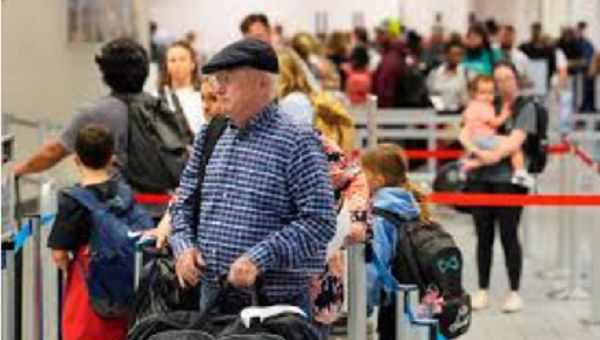
Canadian Travellers Shun U.S., Shifting Preference Toward Overseas Destinations
For the 14th consecutive month, Canadians have been taking fewer trips to the United States, coinciding with U.S. President Donald Trump’s return to office, according to data released by Statistics Canada on Thursday.
The number of Canadians who returned from trips to the U.S. decreased by 12.5 per cent in February compared with the same period last year. Of the 1.2 million trips Canadians took to the U.S. by car in February, more than 70 per cent were same-day outings.
“We have seen a consistent softening on leisure cross-border travel since February 2025,” said travel agency Flight Centre spokesperson Amira Dura.
“Hearing everything that’s coming out of the U.S. administration, there seems to be a lot of negative rhetoric against Canadians and Canada in general. The perception that we’re not welcome is causing a lot of Canadians to pause.”
In February 2025, then-Prime Minister Justin Trudeau urged Canadians to “choose Canada” and reconsider vacation plans south of the border, hours after Trump announced a 25 per cent tariff on imported Canadian goods.
The Statistics Canada data also noted Canadians took 6.8 per cent more overseas trips in February than they did during the same time the year before.
Read More On Our Daily Stock Market Reports – Markets Lower as U.S.–Iran Talks Remain Stalled
“Europe is really holding strong. Places like Portugal, Netherlands and and the UK all feel very welcoming to Canadians,” Dura noted.

The data comes at a time when travel is poised to become increasingly difficult as airlines reduce flights due to higher jet fuel costs spurred by war between the U.S. and Iran.
On Wednesday, Air Transat announced it will be cutting about 1,000 flights — a roughly six per cent capacity reduction — during the critical travel months of May to October because of surging fuel prices.
The carrier said it plans to reduce the number of flights on some routes to Europe and the Caribbean and extend its suspension of service to Cuba from June to October amid a U.S. energy blockade of the island. It will also be postponing the launch of a new route between Toronto and Accra, Ghana, and cutting back its service between Montreal and Guadalajara, Mexico.
“The recent volatility in aviation fuel prices reflects an exceptional environment affecting the entire sector,” said Transat president and CEO Annick Guérard in a press release. He added that additional adjustments could be made “beyond our control” depending on how the situation evolves.
Air Canada and WestJet recently announced fewer flight services and additional fees, pointing to higher oil prices caused by the war between the U.S. and Iran.
Air Canada announced the suspension of a half-dozen routes on Friday, citing roughly doubled fuel costs that render the flights unprofitable. The slashed services represent one per cent of the carrier’s planned capacity, the company said in a statement. Last week, Air Canada moved to raise baggage fees from $35 to $45 for the first checked bag in its basic economy class on domestic, U.S. and “sun destination” flights.
On Monday, WestJet announced flight capacity cuts amounting to about one per cent in April, three per cent in May and 5.5 per cent in June. Most of the adjustments will affect domestic routes, with minimal impact to the airline’s operations in the U.S. and “to sun destinations,” spokesperson Julia Kaiser said. The airline also hiked baggage fees for the third time in two-and-a-half years on Thursday.
Passengers will pay an extra $5 for the first and second bag checked in advance, and an extra $10 for the first and second bag checked at the airport. Beginning April 8, WestJet introduced a temporary fuel surcharge of $60 on all bookings made with its rewards voucher, and a week later it applied a $50 surcharge per person on all Sunwing Vacations and Vacances WestJet Québec trips.
Porter Airlines said it has not reduced or cancelled flights due to fuel constraints, but is monitoring the situation.
According to StatCan, most Canadian airlines hiked fare prices nearly five per cent on average in March compared with February’s prices, citing spikes in energy costs that are passed down to travellers.

The international fuel shortage has been slowly mounting since the U.S. and Israel launched a war on Iran in late February, triggering blockades of the crucial Strait of Hormuz oil passage.
The International Energy Agency (IEA) warned Europe is on the brink of a jet fuel crisis, cautioning the continent has enough supply to last until late May.
“The world now is facing a shortage, a situation where airports and countries are starting to ration fuel,” said John Gradek, a former Air Canada executive and aviation lecturer at McGill University. “Probably in a couple weeks, we’ll start running out.”
The IEA noted in a report last week that Europe is particularly vulnerable due to its reliance on imported jet fuel because 75 per cent of its supply was being imported from the Middle East.
“The loss of Middle East jet fuel exports has thrown a proverbial wrench into the inner workings of the aviation fuel markets,” the report said, adding that the region is now turning to international markets to replace the lost supply and the impact is expected to be concentrated in the second quarter of 2026.
With files from The Canadian Press
This article was first reported by The Star