






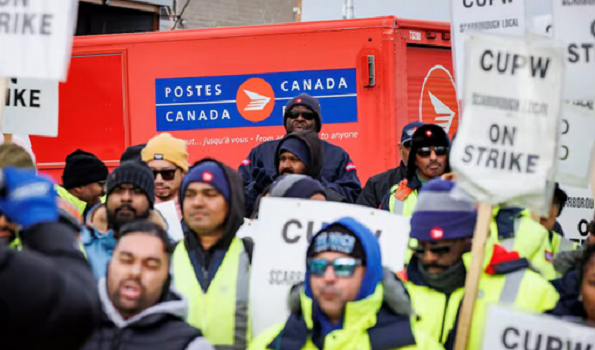
Canada Post Workers Overwhelmingly Approve New Five-Year Agreement
More than 53,000 postal workers have overwhelmingly ratified a tentative agreement with Canada Post, bringing an end to a two-year contract dispute that led to two national strikes, and clearing the way for the Crown corporation to move ahead with a massive restructuring.
Members of the Canadian Union of Postal Workers’ (CUPW) urban bargaining unit approved the deal 89 per cent to 11 per cent, while CUPW’s rural and suburban unit approved their deal 85.9 per cent to 14.1 per cent, in voting which began April 20 and closed Saturday.
In a bulletin to members, CUPW national president Jan Simpson — who had come out publicly against the deal — said the union needs to remain united as it pushes back against the Crown corporation’s restructuring, which was given the green light by the federal government in September.
Read More On Our Daily Stock Market Reports – Wall Street Rises on Technology Strength as TSX Slips
“We still have our work cut out for us. To win the fights ahead, prepare for the next round of bargaining and mobilize against the government’s attacks on our public postal service, we all have to regroup and unite in our struggle,” Simpson said.

In a written statement, Canada Post CEO Doug Ettinger said the Crown corporation will try to rebuild trust with its customers, and said the restructuring will help them do that.
“Thank you to Canadians and businesses large and small for their patience over the last two years. We will work hard to regain your trust,” said Ettinger of the agreements, which will last until Jan. 31, 2029. “The new agreements are critically important as the corporation moves ahead with its transformation.”
The agreement is for a five-year deal, with wage increases of 6.5 per cent and three per cent in the first two years, and increases to match inflation in the final three years. The agreement also maintains job security provisions for mail carriers.
The restructuring plan includes the end of home delivery, increased use of community mailboxes, as well as the closure of some rural and suburban post offices. Canada Post and the federal government have said the restructuring is vital to put the money-losing Crown corporation back on a stronger financial footing.
Canada Post lost $205 million in the first quarter of 2026, up from a $41 million loss in the same period last year. The corporation blamed slumping parcel volumes and labour unrest for the loss. The loss follows a record annual loss of $1.57 billion in 2025, the eighth straight year of red ink at the corporation.
A relieved Joël Lightbound, federal minister of Government Transformation, Public Works and Procurement, called the ratification an important moment.
“This is an important moment for workers, for Canada Post, and for the millions of Canadians and businesses who rely on a stable and reliable postal service every day,” said Lightbound. “The status quo was simply not an option. Canada Post cannot continue absorbing record financial losses year after year.”
Brock University labour studies professor Larry Savage said the large majority is a “sharp rebuke” to Simpson, and showed “a significant disconnect” between the national president and her membership.

Postal workers, said Savage, likely voted to approve the deal because they’d been ground down by two years of hard bargaining which included two national strikes, a forced vote last year, and the federal government giving the greenlight for a postal restructuring.
“The union was divided, Canada Post was struggling, and the federal government has mandated sweeping restructuring. Given the context, I think the workers simply came to the conclusion that a strike wouldn’t get them any further ahead, and might even leave them worse off in the long run,” said Savage.
Simpson was part of a contingent of senior CUPW leaders who rallied against the tentative agreement. Roughly one third of the union’s national executive board — including Simpson — was against it. The rest recommended ratifying it.
The “no” campaigners struggled to explain their strategy, said York University labour studies professor Steven Tufts.
“The ‘no’ vote did a good job of highlighting the limits of the agreement. I don’t think they did as good a job of explaining how rejecting this would lead to a better deal,” said Tufts.
In April, Canada Post announced it would start converting the remaining customers who still get home mail delivery to community mailboxes later this year.
Last August, CUPW members rejected the Crown corporation’s “final” offer in balloting ordered by the federal government and overseen by the Canada Industrial Relations Board.
In late September, the federal government gave the green light for a broad restructuring of Canada Post, including elimination of home delivery, increased use of community mailboxes and shuttering of some rural post offices.

Lightbound said the restructuring was necessary to fight an “existential crisis” faced by the financially struggling Crown corporation. Many of the changes approved by the minister were recommended in a report last May by the Industrial Inquiry Commission led by veteran mediator William Kaplan.
Within hours of Lightbound’s September announcement, CUPW launched its second national strike in a year. That strike was subsequently downgraded to a series of rotating regional strikes.
On Nov. 7, the Crown corporation gave the federal government its implementation plan for the restructuring, but said it wouldn’t make details public until the plan is finalized and approved. The union has said the restructuring would lead to service cutbacks and job losses.
Ettinger reiterated before a parliamentary committee in December that the Crown corporation is expecting 16,000 employees to retire or take voluntary departure by 2030, with another 14,000 leaving by 2035.
This article was first reported by The Star