







Wall Street Rises on Technology Strength as TSX Slips
The Canadian Vanguard Stock Market Report Monday June 1, 2026 Edition
.
The Toronto Market
Monday’s Toronto Market Index
The S&P/TSX Composite Index declined 34.25 points, or 0.10%, to close at 34,734.89 on Monday. Despite the modest loss, the session was notably volatile, with the index spending much of the day in negative territory before staging a partial recovery during the afternoon.
At its intraday low, the TSX was approximately 270 points below the previous session’s close, reflecting considerable selling pressure early in the day. The index remained firmly negative until around 2:00 p.m., when buying activity lifted it slightly above Friday’s closing level. However, the recovery lacked momentum, and the market traded within a narrow range for the remainder of the session before finishing marginally lower.
The fact that the index closed well above its intraday low suggests that investors stepped in to buy during the afternoon decline, helping to stabilize the market. Nevertheless, the inability to sustain gains above the previous close indicates a cautious tone among market participants.
Trading volume was closer to recent daily averages, in contrast to Friday’s elevated activity. The higher volume recorded on Friday may have been driven in part by profit-taking following recent market gains, while Monday’s more typical trading volume suggests a return to normal market participation levels.


Monday’s TSX Market Statistics
Market breadth on the TSX was slightly negative on Monday, as declining issues modestly outnumbered advancing issues. There were 1,147 decliners compared with 1,079 advancers, resulting in a decliner-to-advancer ratio of 1.06:1. In addition, 126 issues closed unchanged. The narrow margin between decliners and advancers suggests that overall market sentiment was relatively balanced, despite the index finishing the day lower.
Market internals remained constructive, with 276 stocks reaching new 52-week highs compared with just 34 new 52-week lows. This compares with 241 new highs and 24 new lows recorded on Friday. The increase in new highs indicates that underlying strength persisted in several sectors, even as the broader market experienced a modest pullback.
Total TSX trading volume reached 493.1 million shares, down 25% from the 661.4 million shares traded on Friday. While Friday’s volume was significantly above the 50-day average—likely reflecting heightened trading activity and profit-taking—Monday’s volume returned to a level closer to recent norms. The lower volume accompanying the market’s decline suggests that selling pressure was relatively contained rather than broad-based.
Monday’s Toronto Market Wrap-Up Report
The S&P/TSX Composite Index slipped 34.25 points, or 0.10%, to close at 34,734.89 on Monday, ending a volatile trading session that saw the benchmark recover significantly from its intraday lows. The index spent most of the day in negative territory and at one point traded approximately 270 points below Friday’s close before attracting buying interest during the afternoon. A rebound beginning around 2:00 p.m. briefly lifted the TSX above its previous closing level, but the recovery lost momentum late in the session, leaving the index narrowly in the red.
For investors and traders, Monday’s trading action reflected a market attempting to consolidate recent gains rather than one experiencing broad-based selling pressure. The fact that the index closed well above its intraday low suggests that buyers remained willing to step into weakness, while the modest decline indicates that profit-taking was largely orderly.
Market breadth was slightly negative, with 1,147 declining issues compared with 1,079 advancing issues, producing a decliner-to-advancer ratio of 1.06:1. Another 126 securities closed unchanged. While breadth favored decliners, the narrow margin suggests underlying market sentiment remained relatively balanced despite the index’s decline.
Importantly, internal market strength remained constructive. The TSX recorded 276 new 52-week highs against only 34 new 52-week lows, improving from Friday’s 241 new highs and 24 new lows. The strong ratio of new highs to new lows indicates that leadership remains intact and that many stocks continue to participate in the broader uptrend.
Trading volume totaled 493.1 million shares, down 25% from Friday’s elevated volume of 661.4 million shares. Friday’s activity was significantly above the 50-day average and likely reflected increased profit-taking and portfolio repositioning. Monday’s lighter volume, combined with the modest decline in the index, suggests that selling pressure was relatively contained rather than indicative of widespread institutional distribution.
In the fixed-income market, the yield on the benchmark 10-year Government of Canada bond continued its recent decline, falling to 3.45%. After reaching a two-year high of approximately 3.70% on May 19, bond yields have trended lower, providing some support for growth-oriented and interest-rate-sensitive sectors.
Sector performance highlighted a notable divergence beneath the surface of the broader market. Technology led all sectors with a gain of 4.41%, supported by strong advances in several large-cap technology names. Industrials rose 1.94%, Energy gained 1.48%, and Telecommunications Services advanced 0.74%. Overall, six of the TSX’s ten major sectors finished the session higher.
Offsetting these gains were declines in several heavyweight sectors. Financials fell 1.20%, exerting significant downward pressure on the index, while Basic Materials declined 1.29%, making it the weakest-performing sector of the day. The weakness in Financials was particularly important given the sector’s substantial weighting within the TSX.
The Big Six Canadian banks were generally lower. Canadian Imperial Bank of Commerce declined 2.52%, Toronto-Dominion Bank fell 2.80%, Bank of Nova Scotia lost 1.53%, and Royal Bank of Canada slipped 1.27%. Manulife Financial Corporation also declined 0.91%. Bank of Montreal was the notable exception, advancing 0.58%.
Among individual stocks, technology and growth-oriented names attracted significant investor interest. Celestica Inc. extended Friday’s powerful rally, gaining 10.38% to close at $588.24 on volume of 567,000 shares. The stock was the top-performing TSX constituent for the second consecutive session and continued to benefit from strong investor demand for companies with exposure to advanced computing and artificial intelligence infrastructure.
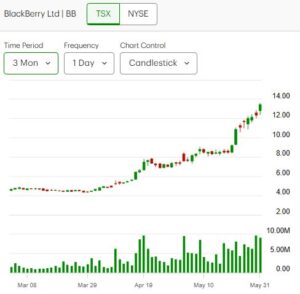
Other notable gainers included BlackBerry Ltd., which rose 8.74% to $13.44 on volume of 9.0 million shares, and Thomson Reuters Corp., which advanced 8.60% to $129.86 on volume of 826,300 shares. Shopify Inc. gained 4.42% on volume of 1.92 million shares, contributing materially to the Technology sector’s leadership, while Open Text Corp. rose 7.10% to $35.11 on volume of 2.8 million shares.
In corporate news, Kinaxis Inc. announced the appointment of Kristin Russell as Chief Marketing Officer. Russell brings extensive leadership and entrepreneurial experience, including founding fintech company Anachron, which was subsequently acquired by ING Bank.
Overall, Monday’s session presented a mixed but generally constructive picture for investors. While the TSX closed modestly lower, strong new-high statistics, resilient afternoon buying, leadership from the Technology sector, and a decline in bond yields suggest that underlying market conditions remain supportive. The principal challenge for the broader market remains weakness in Financials and Materials, sectors that continue to offset strength elsewhere. For traders, the TSX’s ability to recover from substantial intraday losses may be viewed as an encouraging sign that buyers remain active on market pullbacks.
.
The US Markets
Monday’s U.S. Market Indexes
U.S. equity markets delivered a mixed performance on Monday, with the major large-cap indexes extending their gains, albeit at a much slower pace than Friday’s rally. The market’s advance was led by technology and growth-oriented stocks, while small-cap shares continued to underperform.
The Dow Jones Industrial Average gained 46.42 points, or 0.09%, to close at 51,078.88. The S&P 500 advanced 19.90 points, or 0.26%, ending the session at 7,599.96, while the Nasdaq Composite rose 114.19 points, or 0.42%, to finish at 27,086.81. In contrast, the Russell 2000 Index declined 13.58 points, or 0.47%, to close at 2,905.76, effectively matching its negative performance from Friday.
Although three of the four major U.S. indexes finished higher, Monday’s gains were relatively modest compared with the stronger advances recorded on Friday. Trading activity reflected a more cautious tone, with investors showing less conviction after last week’s rally.
The Dow Jones Industrial Average spent most of the trading session in negative territory before a late-afternoon recovery lifted the index into positive territory during the final hour of trading. The index’s gain of 46 points represented a sharp slowdown from Friday’s performance, with the magnitude of the advance declining by approximately 80% from the previous session.
Market breadth within the Dow was notably weak despite the index’s positive close. Only nine of the thirty constituent stocks advanced, highlighting the narrow nature of the day’s gains. The positive performance of a limited number of higher-weighted components was sufficient to offset declines across most of the index’s members.
The divergence between the large-cap indexes and the Russell 2000 suggests investors continued to favor larger, more established companies over smaller-capitalization stocks. Meanwhile, the Nasdaq’s outperformance relative to the broader market indicates that technology and growth stocks remained a key source of market leadership.
Overall, Monday’s session reflected a continuation of the broader upward trend in U.S. equities, but with reduced momentum and narrower participation compared with Friday’s stronger advance. Investors appeared willing to maintain exposure to large-cap and technology stocks, while remaining more cautious toward smaller-cap companies and economically sensitive segments of the market.

Monday’s U.S. Market Statistics
New York Stock Exchange (NYSE): Market breadth on the New York Stock Exchange was slightly negative on Monday, as declining issues narrowly outnumbered advancing issues. The NYSE recorded 2,317 decliners versus 2,222 advancers, resulting in a decliner-to-advancer ratio of 1.04:1, while 364 stocks closed unchanged. The near-even distribution between winners and losers suggests that investor sentiment remained relatively balanced despite the modest gains recorded by the major U.S. equity indexes.
Despite the mixed breadth figures, underlying market leadership remained constructive. The NYSE recorded 519 new 52-week highs compared with 144 new 52-week lows, an improvement from Friday’s 491 new highs and 102 new lows. The increase in new highs indicates that many stocks continue to participate in the broader market uptrend, although the rise in new lows suggests some pockets of weakness are beginning to emerge beneath the surface.
NYSE trading volume totaled 6.74 billion shares, down 18% from Friday’s 8.22 billion shares. The decline in volume suggests a moderation in trading activity following Friday’s stronger session and may indicate that investors were less aggressive in either buying or selling positions. Lower volume accompanying a relatively stable market is generally viewed as a sign of orderly consolidation rather than widespread distribution.
NASDAQ: Market breadth on the NASDAQ was marginally positive, with advancing stocks narrowly exceeding declining stocks. The exchange recorded 2,483 advancers and 2,438 decliners, producing an advancer-to-decliner ratio of 1.02:1, while 358 issues finished unchanged. The positive breadth reading aligns with the Nasdaq Composite’s outperformance relative to the broader market and reflects continued investor interest in technology and growth-oriented shares.
Internal market strength remained favorable. The NASDAQ posted 427 new 52-week highs against 120 new 52-week lows, up from 405 new highs and 89 new lows on Friday. The increase in new highs reinforces the view that leadership remains concentrated in sectors benefiting from strong earnings momentum and continued investor demand, particularly within technology-related industries.
NASDAQ trading volume reached 10.54 billion shares, down 15% from Friday’s 12.40 billion shares. Similar to the NYSE, the decline in volume suggests reduced trading intensity following the previous session’s stronger activity. The combination of positive breadth, expanding new highs, and lighter volume indicates that investors largely maintained their positions rather than engaging in significant profit-taking.
Market Takeaway
For investors and traders, Monday’s market statistics paint a picture of a market that continues to trend higher but with moderating momentum. Breadth was mixed, with the NYSE slightly negative and the NASDAQ marginally positive, while both exchanges recorded an increase in new 52-week highs. Trading volumes declined noticeably from Friday’s elevated levels, suggesting a period of consolidation rather than a meaningful shift in market sentiment.
The data indicate that market leadership remains intact, particularly among technology and growth-oriented stocks, although participation across the broader market remains somewhat uneven. The continued expansion in new highs supports the bullish intermediate-term outlook, but the relatively narrow breadth readings suggest investors should continue monitoring whether leadership broadens beyond the market’s strongest-performing sectors.
Monday’s U.S. Market Wrap-Up Report
U.S. equities extended their advance on Monday despite a backdrop of growing geopolitical uncertainty. While developments surrounding U.S.-Iran peace negotiations appeared increasingly uncertain, investors largely looked past the geopolitical headlines and continued to favor growth and technology-oriented stocks. The major large-cap indexes finished higher, although gains were more subdued than those recorded on Friday.
The Dow Jones Industrial Average rose 46.42 points, or 0.09%, to close at 51,078.88. The S&P 500 gained 19.90 points, or 0.26%, ending at 7,599.96, while the Nasdaq Composite advanced 114.19 points, or 0.42%, to finish at 27,086.81. In contrast, the Russell 2000 Index fell 13.58 points, or 0.47%, to 2,905.76, marking its second consecutive daily decline and highlighting continued weakness among small-cap stocks.
For traders, Monday’s session reflected a continuation of the market’s recent leadership trends. Large-cap technology and artificial intelligence-related stocks remained the primary drivers of performance, while smaller-cap and more economically sensitive companies lagged behind. The Nasdaq’s outperformance relative to the broader market underscores investors’ continued preference for companies with strong earnings growth and AI-related exposure.
The Dow Jones Industrial Average spent most of the session trading in negative territory before a late-afternoon rally pushed the index modestly into positive territory. Despite the positive close, market participation within the Dow was notably narrow, with only nine of the index’s thirty constituent stocks advancing. This suggests that gains were concentrated in a relatively small group of influential stocks rather than being broadly distributed across the market.
Market breadth across the broader market was mixed. On the New York Stock Exchange, decliners narrowly outnumbered advancers by a ratio of 1.04:1, while the NASDAQ recorded a slight positive breadth reading with advancers exceeding decliners by a ratio of 1.02:1. The mixed breadth figures indicate that while the major indexes moved higher, participation remained uneven beneath the surface.
However, market internals continued to show signs of underlying strength. The NYSE recorded 519 new 52-week highs compared with 144 new lows, while the NASDAQ posted 427 new highs against 120 new lows. Both exchanges improved on Friday’s new-high figures, suggesting that leadership remains intact and that many stocks continue to participate in the broader uptrend despite the relatively narrow breadth readings.
Trading activity moderated following Friday’s stronger session. NYSE volume declined 18% to 6.74 billion shares, while NASDAQ volume fell 15% to 10.54 billion shares. The lower volume accompanying modest index gains suggests investors were generally maintaining existing positions rather than aggressively initiating new ones. From a technical perspective, lighter volume combined with stable or rising prices is often viewed as a sign of orderly consolidation rather than significant institutional selling.
Energy markets remained a focus for investors as oil prices moved higher amid continuing uncertainty surrounding developments in the Middle East. Rising oil prices could complicate the inflation outlook if sustained, potentially influencing expectations for future Federal Reserve policy. For now, however, equity investors appeared more focused on earnings momentum and corporate fundamentals than on geopolitical risks.
Among Dow components, technology and growth-oriented stocks delivered the strongest performance. Salesforce Inc. led the index with a gain of 9.68%, closing at $209.60 on volume of 27.6 million shares. IBM continued its strong uptrend, advancing 7.60% to $320.42 on volume of 32.9 million shares. Nvidia Corp added 6.26% to close at $224.36, with a substantial 212.9 million shares traded, further reinforcing investor demand for artificial intelligence-related leaders.
Elsewhere within the Dow, Chevron gained 1.85% as higher oil prices supported energy shares, while Goldman Sachs rose 2.70%, making it the only financial stock within the Dow Jones Industrial Average to finish the session higher.
One of the dominant themes of Monday’s market was the continued rotation into technology and software companies. Investors maintained a strong preference for businesses viewed as beneficiaries of artificial intelligence spending and digital transformation initiatives. Palantir Technologies helped lead the software sector higher, while Salesforce remained one of the session’s standout performers.
In corporate news, Hewlett Packard Enterprise emerged as one of the market’s biggest winners following the release of better-than-expected quarterly earnings after the closing bell. The company exceeded analysts’ forecasts and raised its full-year 2026 guidance. Particularly encouraging for investors was management’s stronger-than-expected revenue outlook for the quarter ending in July.
The positive results triggered a significant after-hours rally, with HPE shares surging 28.04%, or $13.18, to $60.18. During the regular session, the stock had already gained 9.20% to close at $47.00 on exceptionally strong volume of 115.6 million shares. The strong reaction highlights continued investor enthusiasm for companies positioned to benefit from accelerating demand for AI infrastructure and enterprise computing solutions.
Notably, all three major AI server infrastructure manufacturers—Dell Technologies, Hewlett Packard Enterprise, and Celestica Inc.—posted gains during Monday’s regular trading session, reinforcing one of the market’s strongest investment themes: the ongoing expansion of artificial intelligence infrastructure spending.
Market Takeaway
For investors and traders, Monday’s market action was constructive but revealed a degree of selectivity beneath the surface. The major indexes continued to advance, new 52-week highs expanded on both major exchanges, and technology-related leadership remained firmly intact. However, mixed breadth readings, declining trading volume, and continued weakness in small-cap stocks suggest that the rally remains concentrated in a relatively narrow group of market leaders.
As long as earnings momentum remains strong and institutional capital continues flowing into technology and AI-related sectors, the market’s upward bias is likely to remain intact. Nevertheless, traders should continue monitoring breadth and small-cap participation for signs that market leadership is either broadening or becoming increasingly concentrated.
.
IMPORTANT NOTICE TO READERS
The Canadian Vanguard Stock Market’s focus is on empowering our readers to build and manage wealth by themselves. There is certainly no magic in managing finances or wealth but one needs to know what to do and commit to doing what is needed. When you are ready to start the journey to Take Charge and Put Your Destiny In Your Own Hands, read The Canadian Vanguard every market day. Stock market investing is a lot cheaper to get into, more liquid and easier than real estate investing.
Our readers are strongly advised to conduct their own research into individual stocks before making a purchase decision. In addition, investors are advised that past stock performance is no guarantee of future price appreciation. Any recommendation is not a guarantee of any particular stock’s future prices, and The Canadian Vanguard accepts no responsibility or liability for investors’ or readers’ purchases.
Stock Market Wrap Up Report and Market Strategy sections will be available from now on only to Paying Subscribers. The dollar sign “$” in the Toronto Market section in the articles only stands for Canadian dollar and in the US market section “$” stands for US dollar.
(c) This article is published by The Canadian Vanguard on June 1, 2026