






Suburban Shift: Townhomes Outpace Condos Amid Evolving Buyer Preferences
For decades, acres of green fields have remained untouched in Breslau, a community in the heart of Waterloo Region. But starting next year, hundreds of townhomes will fill the landscape.
The planned Wild Indigo development is a 15-minute drive to downtown Waterloo and the Kitchener GO station. With universities, an international airport, and tech giant offices nearby, it’s being marketed as an extension of all the great offerings of Toronto but at an affordable cost.
Developer Madison Group is betting big on the development. With homes starting in the $600,000s, the goal is to build 1,500 townhomes and detached homes combined in the coming years. In the first phase, around 150 homes will be ready to close starting in the summer of 2027. And so far sales are in their favour.
At a time when homebuilders have struggled to get shovels in the ground, Wild Indigo has only four townhome units left for sale.

“The pricing has been very attractive,” said Raul Aragon, director of new homes and business development at Corcoran Horizon Realty, which leads sales for Wild Indigo. “You can actually get a townhome for pretty much the same prices as a condo in downtown Toronto. It just makes sense to get more space for the same price.”
New townhomes have recently gained traction as investors flee the cratering condo space and the expanded HST rebate gives prospective buyers a discount of up to $130,000 on the price of a new-build home.
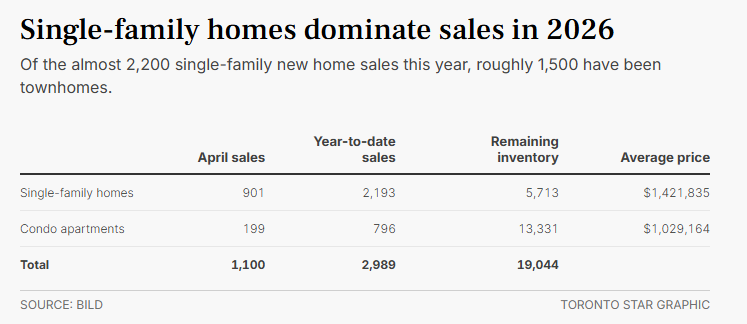
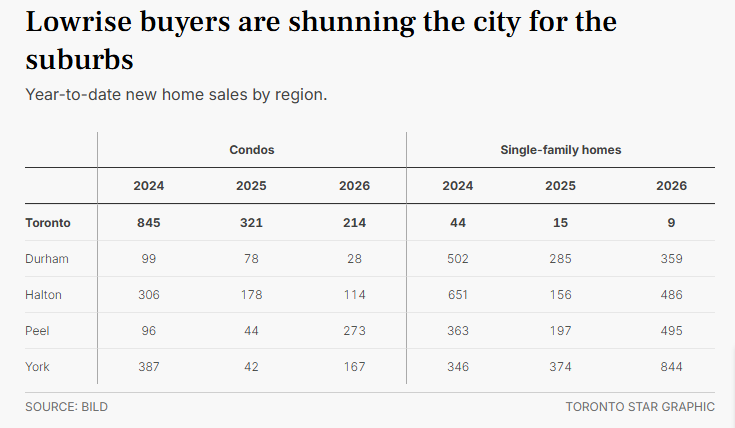
Overall single-family home sales more than tripled year over year in April, which coincided with the start of the expanded HST rebate. From January to April, townhomes made up roughly 68 per cent of the nearly 2,200 single-family home sales, up from 53 per cent of the just over 1,000 single-family sales over the same period in 2025, according to sales data from the Building Industry and Land Development Association.
Experts say townhomes are capturing renewed interest for their lower price tag, as they’re more affordable than detached homes but with the space buyers need to expand their families. Conversely, the rebate may also attract investors as townhomes become more affordable to scoop up and rent out, a situation not too different from Toronto’s condo boom.
“There’s inventory of new single-family housing units out there that is being absorbed now,” said Frank Clayton, senior research fellow at Toronto Metropolitan University’s Centre for Urban Research and Land Development. “Buyers are especially going after townhouses because they’re more affordable.”
As demand pushes developers to build more townhomes, it will promote new housing supply in the GTA in regions such as Brampton, Mississauga, Caledon and just beyond to Oakville, Kitchener-Waterloo and London, but not Toronto.
It could put Toronto at a disadvantage in terms of delivering the type of housing buyers want, pushing them further out of the city. Already, from 2020 to 2024, 80,000 residents a year left the GTA, largely due to affordability concerns. If the affordable homes are being built further out, more people will move, Clayton said.
“Cities grow up and they grow out,” said Clayton. “While you want cities to grow up more than grow out (to increase densification) you have to accommodate what people want. People go farther and farther out where their housing needs are met.”
‘We’re seeing big, active hot spots’
Outside the city, more than 100 townhouses could transform 14 acres of vacant north Brampton farmland in the coming years.
According to the City of Brampton, the site proposal includes 74 freehold townhouses, 28 condo townhouses, and a commercial block.
On April 17, a city staff report recommended approving the application as the site is located close to existing public transit and potential future rapid transit corridor, “providing connectivity to local and regional transit networks.”
Developers say it’s part of a trend.
“We’re seeing big, active hot spots west of the GTA,” said Ryan Rabinovich, founder of Rare Real Estate, a real estate development firm in Toronto.
He said his firm is “definitely seeing a pick up at our sites” in terms of sales in markets like Oakville, Caledon, Brampton, Burlington and Mississauga.
Brad Carr, CEO of Mattamy Homes, said the company has seen a “substantial uptick” in single-family home interest across Ontario with sales roughly doubling in the last two months compared to February and March, “which has been fantastic to see.”
The largest impact has been for homes below $1.5 million, and specifically below $850,000, Carr noted.
He said Mattamy Homes has taken the time to reconnect with consumers to find out the type of housing they want, which is often not the “really big stuff which has a lot of space” and it’s not the “really small stuff that feels too constrained for the life we live.” In other words, it’s somewhere in the middle.
TMU’s Clayton said people move further out to more affordable markets to buy the homes they want with developers following the demand.
That demand is currently being boosted by the expanded HST rebate, experts told the Star.

On March 25, the Ontario government announced an HST rebate for all new home buyers for up to one year that maxes out at $130,000 for homes between $1 million and $1.5 million and gradually drops to $24,000 at the $1.85 million threshold. (That $24,000 rebate has been on the books for the past 15 years or so.)
The waiver of HST on all new home purchases started on April 1, expanding on the existing rebate introduced last fall that was only available to first-time buyers. However, the proposed legislation for the expanded rebate has not yet passed.
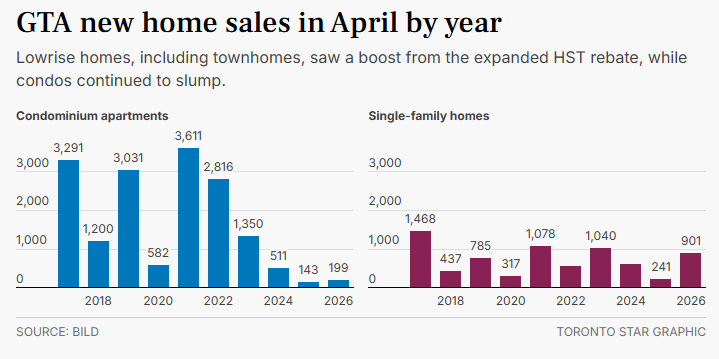
In April, sales of single-family homes (detached, semi-detached and townhomes) surpassed the 10-year average for the first time in three years. There were 901 single-family home sales; the 10-year average is 744 sales. And sales for new single-family homes were three times higher than April of last year.
Meanwhile, there were just 199 condo sales in April, well below the 10-year average of 1,673 sales, according to the Building Industry and Land Development Association’s monthly report.
From the start of the year to April, 1,488 townhomes, excluding stacked townhomes, sold in the GTA compared to just 545 sales during the same period last year, the report added. Another 290 stacked townhomes sold in 2026 to date, compared to 31 in 2025.
“We have to ask ourselves, what does our customer value? Not, what can we sell today? And the market of the past pretty much allowed for the development community to sell whatever it brought to the market,” Carr said.
“I think the buyer today has more choice, is very discerning and wants to see the building community really meet their needs.”
Lower prices, faster to build
Condos dominated the new build market for years, largely driven by investor demand. Now that demand is gone, and end users — people who want to actually live in their homes — are driving the current market. They don’t want small condos, and pricing for single-family homes, specifically townhomes, is finally moving in their favour.
A survey of 1,400 renters in Metro Vancouver, Greater Vancouver and Central Okanagan found that more than half of the renters said townhomes with three bedrooms were their preferred choice, according to a May report by real estate service company Rennie Intelligence.
There’s a similar desire in the GTA, with a recent Ipsos survey finding almost 80 per cent of GTA residents want a single-family home instead of a condo apartment.
“Lowrise is always going to be an attractive product,” said Stefano Guglietti, vice-president of highrise sales at Rosehaven Homes, adding part of the reason is that single-family homes can be built relatively quickly compared to condo.
Typically, a single-family home takes about a year to build versus a condo building that can take up to five years. Condo prices and values are also continuing to drop, and while that makes them more affordable, interest rates on mortgages are in a precarious position due to rising oil prices and inflation, adding a level of unpredictability that makes the long wait time for a condo undesirable.
“Condos have a long runway and people are having trouble predicting what will happen five years from now. That’s why, in part, we’ve seen a shift with a lot of people going back to lowrise,” Guglietti said. “It’s a shorter timeline, a little bit more manageable, and the price point on a townhome is always better than a semi or detached, which is why townhomes have become very popular.”
In addition, because the expanded HST rebate is active for a year (purchase agreements must be signed between April 1, 2026 to March 31, 2027) and construction for primary residences must begin by Dec. 31, 2028, and be substantially completed by Dec. 31, 2031, it’s easier to find single-family home projects that fit into this timeline, experts say.
Even though there was a craze to build highrise residential buildings in the last decade, there’s always been more demand for lowrise homes from end users, said Guglietti.
That doesn’t mean investors won’t catch up. While they haven’t yet turned to lowrise in droves, investors are eligible under the rebate, which will only revive investor demand as private funds are already bulk buying condos, warns the Canadian Centre for Policy Alternatives (CCPA) in a report.
No matter who’s buying, Toronto is being left in the lurch when it comes to providing the bigger units that suit buyers needs.
“The problem is in Toronto, the land is too expensive. There’s not a lot of it that supports lowrise. And the land that’s left really is designed to be highrise or midrise,” Guglietti said.
This article was first reported by The Star