







The Canadian Vanguard Stock Market Report Weekend June 12 – 14, 2026 Edition
Market Rally Extends as Investors Look for Easing Geopolitical Tensions
The Canadian Vanguard Stock Market Report is updated regularly during the weekend
Sunday Evening Update – -BREAKING News !!!
Futures are up Sunday evening on news report that the US and Iran have agreed on a deal to end the war. The deal has not been signed yet. The signing is scheduled for Friday June 19. This news piece is good for the markets. Dow futures, S&P 500 futures and NASDAQ futures rose but oil price is down. Pretty well every other market benchmark is up. Gold, precious and industrial metals are all up Sunday evening after the news. Asian markets are up with Japan’s Nikkei up 5% as at the time of this update – Sunday 9:30 pm.
.
The Toronto Market (as at Friday Market Close)
Friday’s Toronto Market Index
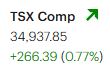
The S&P/TSX Composite Index gained 266.39 points, or 0.77%, to close at 34,937.85 on Friday. Following Thursday’s strong advance, the Toronto market posted another solid gain, although at a more moderate pace.
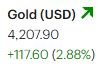
Market sentiment continued to be influenced largely by geopolitical developments. There were news report that President Trump announced on Saturday that a peace agreement between the United States and Iran is likely to be signed on Sunday. The Canadian Vanguard has not independently confirmed that such a peace agreement will be signed on Sunday and readers are advised not make decisions based on the report until they have independently confirmed signing of the peace deal agreement. If such an agreement is signed, it could represent a significant market-moving event. The Basic Materials sector, which has been a key driver of recent gains in the TSX, could continue to benefit, potentially providing further support for the broader index.

Friday’s TSX Market Statistics
On the TSX, advancing issues (advancers) outnumbered declining issues (decliners) by a wide margin. There were 1,559 advancers and 587 decliners, resulting in an advancer-to-decliner ratio of 2.65-to-1, or approximately five advancers for every two decliners. An additional 160 issues closed unchanged. While market breadth remained strongly positive, the number of unchanged issues increased considerably compared with the previous session.
The exchange recorded 209 new 52-week highs and 20 new 52-week lows, compared with 142 new highs and 35 new lows on Thursday. The sharp increase in new 52-week highs, coupled with the decline in new lows, reflects improving market strength and broader participation in the rally.
Total trading volume on the TSX reached 454.3 million shares, down 14% from the 526.2 million shares traded on Thursday. Although the TSX index advanced on Friday, trading activity moderated from the previous session. Thursday’s elevated volume likely reflected heightened investor activity following three consecutive days of market weakness earlier in the week. Friday’s lower volume suggests that buying interest remained sufficient to push prices higher, but with less urgency than was evident on Thursday. Overall, market breadth remained positive, supporting the day’s gain in the TSX index.
Friday’s TSX Market Wrap-Up Report
The S&P/TSX Composite Index gained 266.39 points, or 0.77%, on Friday to close at 34,937.85, extending Thursday’s strong advance and finishing the week on a positive note. Market sentiment remained heavily influenced by geopolitical developments and a broad rally in commodity-related stocks, particularly within the Basic Materials sector.
Market breadth remained firmly positive. Advancing issues outnumbered declining issues by 1,559 to 587, resulting in an advancer-to-decliner ratio of 2.65-to-1. The TSX also recorded 209 new 52-week highs versus only 20 new 52-week lows, a notable improvement from Thursday’s 142 new highs and 35 new lows. The increase in new highs confirms that buying interest was widespread and not limited to a handful of large-cap stocks.
Trading volume totaled 454.3 million shares, down 14% from Thursday’s 526.2 million shares. While lower volume accompanied Friday’s advance, the positive market breadth and expanding list of new highs suggest that investor sentiment remained constructive heading into the weekend.
Sector Performance
Basic Materials led all sectors on Friday, advancing 3.08% as investors continued to accumulate gold, precious metals, and industrial metals producers. The sector’s strong performance was a major contributor to the TSX’s gain and reflects growing investor interest in commodity-related opportunities amid ongoing geopolitical uncertainty.
Other notable gainers included:
- Financials: +0.82%
- Industrials: +0.68%
- Utilities: +0.35%
Weaker sectors included:
- Energy: -0.18%
- Healthcare: -0.69%
- Consumer Discretionary Goods & Services: -1.31%
- Technology: -2.03%
Technology was the weakest-performing sector of the session, weighed down in part by weakness in Shopify Inc. (SHOP) and other growth-oriented technology names.
While Basic Materials dominated Friday’s leadership board, investors should recognize that many mining stocks remain small-cap companies. Small-cap resource stocks can generate significant returns during favorable commodity cycles but often experience elevated volatility and inconsistent performance. As a result, position sizing and risk management remain important considerations for traders participating in the sector.
Weekly Sector Performance
For the week, Consumer Discretionary Goods & Services emerged as the strongest-performing sector, advancing 3.30%.
Other top-performing sectors included:
- Financials: +2.90%
- Telecommunications Services: +1.70%
- Basic Materials: Positive weekly gain
Lagging sectors included:
- Technology: -1.11%
- Healthcare: -3.30%
The week’s leadership by retail-related companies and financial institutions suggests investors remained comfortable allocating capital toward economically sensitive sectors despite ongoing market uncertainty.
Financial Sector Highlights
Financial stocks contributed significantly to Friday’s market advance.
Notable performers included:
- Manulife Financial Corp. (MFC): +1.53%, closing at $56.32 on volume of 4.25 million shares.
- Canadian Imperial Bank of Commerce (CM): +1.70%, closing at $158.71 on volume of 2.0 million shares.
- Bank of Nova Scotia (BNS): +1.87%, closing at $117.43 on volume of 2.9 million shares.
Manulife continued to demonstrate technical strength, recording a new 52-week high for the second consecutive trading session. The financial sector’s resilience remains an important pillar supporting the broader TSX advance.
Space and Satellite Sector Developments
One of the week’s most closely watched stories involved Space Exploration Technology Corp. (SPCX), which generated considerable investor attention following its IPO debut on Friday.
The strong reception for SPCX appears to have diverted capital away from several established satellite and space-related companies. It would appear that investors aggressively pursued exposure to the new issue while reducing positions in existing operators and satellite infrastructure companies.
Among the affected stocks, Telesat Corporation (TSAT) declined 6.24% on Friday, closing at $65.40 on volume of 58,900 shares.
Whether this rotation proves temporary or marks the beginning of a broader repricing within the space sector remains to be seen. Investors should monitor the performance of established operators closely over the coming weeks.
.
Key Takeaways for Traders and Investors
- Market Breadth Remains Strong: The TSX advance was supported by broad participation, with nearly three advancing stocks for every declining stock and a sharp increase in new 52-week highs. This is generally a constructive signal for near-term market momentum.
- Basic Materials Continue to Lead: Commodity-related stocks remain the market’s leadership group. Continued strength in metals and mining stocks could provide additional support for the TSX if geopolitical developments remain favorable.
- Financials Are Quietly Supporting the Rally: Canada’s major financial institutions continue to trend higher and are providing important support to the broader market. Strong performance from banks and insurers remains a positive indicator for the TSX.
- Technology Remains a Relative Weak Spot: While the overall market advanced, technology stocks continued to underperform. Traders should watch for signs of renewed institutional buying before becoming aggressively bullish on the sector.
- Watch Weekend Geopolitical Developments: Markets remain highly sensitive to geopolitical news. Any significant developments involving international relations or commodity markets could influence the direction of the TSX and resource sectors when trading resumes.
.
Outlook
The TSX enters the new week with improving market breadth, expanding new highs, and strong leadership from Basic Materials and Financials. While lower trading volume on Friday suggests some investor caution ahead of the weekend, the overall technical backdrop remains constructive. If commodity prices remain firm and geopolitical developments support risk appetite, the TSX may continue to challenge higher levels in the sessions ahead.
.
The US Markets
Friday’s U.S. Market Index Review
U.S. equities finished higher on Friday, with all four major indexes posting gains and recovering much of the weakness experienced earlier in the week.
The Dow Jones Industrial Average advanced 353.51 points, or 0.70%, to close at 51,202.26. The S&P 500 gained 37.16 points, or 0.50%, ending the session at 7,431.46. The Nasdaq Composite rose 79.18 points, or 0.31%, to close at 25,888.84, while the Russell 2000 Index led the major averages with a gain of 22.96 points, or 0.79%, finishing at 2,943.99.
The broad-based advance reflects improving investor sentiment following the sharp market pullback earlier in the week. However, leadership within the market shifted toward value-oriented and economically sensitive sectors, while large-cap technology stocks continued to lag.
Dow Jones Shows Relative Strength
The Dow Jones Industrial Average remained the strongest performer among the large-cap indexes on Friday. The index traded in positive territory throughout the session and finished comfortably above the psychologically important 50,000 level.
From a technical perspective, the Dow has largely erased the effects of the early-week sell-off. The index closed above its 25-day moving average and continues to demonstrate relative strength compared with the broader market. Institutional investors appear willing to rotate capital into established blue-chip companies as they seek stability amid ongoing market uncertainty.
As long as the Dow remains above both the 50,000 level and its short-term moving averages, the near-term trend remains constructive.

Small Caps Lead the Market
The Russell 2000 Index was Friday’s top-performing major index, advancing 0.79%.
Small-cap stocks often benefit when Treasury yields decline because lower borrowing costs improve financing conditions for smaller companies that typically rely more heavily on debt markets. If the recent moderation in the 10-year Treasury yield continues, small-cap stocks could remain an area of relative strength in the weeks ahead.
The Russell 2000 also displayed notable intraday strength, remaining firmly positive during the second half of the trading session. Such price action often indicates sustained buying interest rather than short-covering activity.
Traders should continue to monitor small-cap performance closely, as leadership from the Russell 2000 can be an early signal of improving market risk appetite.
Nasdaq Continues to Rebuild Momentum
The Nasdaq Composite posted a modest gain of 0.31% on Friday, although the index continued to lag the Dow and Russell 2000.
Trading throughout the session was choppy, with the Nasdaq fluctuating around the previous day’s closing level before attracting buyers during the final hours of trading. While the index finished higher, the technical damage inflicted during the first half of the week has not yet been fully repaired.
The Nasdaq closed below its 50-day moving average on Wednesday, recovered to that level on Thursday, and ended Friday just below its 25-day moving average. This suggests that momentum remains mixed and that technology stocks are still working through a short-term consolidation phase.
The recent pullback does not necessarily signal the end of the broader rally, but it does indicate that the market’s strongest leadership may be shifting away from high-growth technology stocks toward other sectors, including financials, industrials, and small-cap companies.
Technical Outlook
Friday’s market action improved the technical outlook for U.S. equities, particularly for the Dow Jones Industrial Average and the Russell 2000.
Several encouraging developments emerged:
- All four major indexes closed higher.
- The Dow Jones recovered above key short-term support levels.
- The Russell 2000 outperformed and displayed strong intraday momentum.
- The S&P 500 maintained its position near record highs.
- Market buyers returned despite continued geopolitical uncertainty.
At the same time, caution remains warranted. The Nasdaq has not yet reclaimed all of its important moving averages, and traders should watch closely to see whether Friday’s buying strength carries over into the new week.
.
Key Takeaways for Traders and Investors
For Traders
- The Russell 2000 is showing improving relative strength and may offer attractive short-term trading opportunities if interest rates continue to moderate.
- The Dow Jones remains the strongest major index and continues to attract institutional capital.
- Technology stocks remain vulnerable to additional consolidation until the Nasdaq decisively moves back above its key moving averages.
For Investors
- Market leadership appears to be broadening beyond mega-cap technology stocks.
- Financials, industrials, and small-cap companies are beginning to attract greater investor interest.
- The overall market trend remains positive despite the recent pullback.
- A sustained decline in bond yields could provide additional support for economically sensitive sectors and small-cap stocks.
Looking Ahead
Friday’s session demonstrated that buyers remain willing to step into the market following periods of weakness. The key question for investors heading into Monday is whether the relative strength seen in the Dow Jones and Russell 2000 can continue and whether the Nasdaq can regain its technical footing.
If buying momentum broadens and the technology sector stabilizes, the major indexes could resume their advance. However, traders should continue to monitor Treasury yields, market breadth, and sector rotation closely, as these factors are likely to determine leadership in the next phase of the market rally.
Friday’s U.S. Market Statistics
New York Stock Exchange (NYSE): Market breadth remained strongly positive on the New York Stock Exchange (NYSE) on Friday, with advancing issues significantly outnumbering declining issues. The exchange recorded 2,959 advancing stocks compared with 1,429 declining stocks, while 387 issues finished unchanged. This produced an advancer-to-decliner ratio of approximately 2.07-to-1, meaning that more than two stocks advanced for every stock that declined.
The strong breadth figures support Friday’s gains in the major market indexes and indicate that buying activity was broadly distributed across multiple sectors rather than concentrated in a small number of large-cap stocks.
The NYSE recorded 372 new 52-week highs and only 66 new 52-week lows, a substantial improvement from Thursday’s 247 new highs and 134 new lows. The increase in new highs combined with the sharp decline in new lows suggests that market momentum strengthened as the week came to a close.
From a technical perspective, the expansion in new highs is an encouraging sign for bullish investors because it demonstrates increasing participation in the market’s advance. Healthy rallies are generally supported by expanding new highs and strong market breadth.
Total NYSE trading volume reached 5.08 billion shares, down 13% from Thursday’s 5.80 billion shares. Although volume declined, the reduction likely reflects a normalization of trading activity following elevated participation earlier in the week. The combination of positive breadth and expanding new highs suggests that Friday’s advance retained credibility despite lighter trading volume.
NYSE Takeaway
The NYSE data points to a healthy market environment characterized by broad participation, improving momentum, and expanding leadership. Traders should view the increase in new highs as a constructive signal, while investors may take comfort in the fact that buying activity is extending beyond a narrow group of stocks.
NASDAQ: The NASDAQ also posted positive market breadth on Friday, although the strength was more moderate than that observed on the NYSE.
Advancing stocks totaled 2,693 compared with 2,202 declining stocks, producing an advancer-to-decliner ratio of 1.22-to-1. An additional 215 issues closed unchanged. While advancers exceeded decliners, the margin was relatively narrow, indicating that buying pressure was less widespread than on the NYSE.
The NASDAQ Composite Index recorded its second consecutive daily gain, extending the recovery that began after the market weakness seen earlier in the week. However, market participation remained mixed, reflecting continued investor caution toward growth-oriented and technology stocks.
One encouraging development was the improvement in the exchange’s new-high/new-low statistics. The NASDAQ posted 229 new 52-week highs and 197 new 52-week lows, compared with 193 new highs and 227 new lows on Thursday. The increase in new highs and decline in new lows suggests that internal market conditions improved during Friday’s session.
Unlike the NYSE, trading volume on the NASDAQ increased. Total volume reached 10.68 billion shares, up 1.6% from Thursday’s 10.51 billion shares. Rising volume accompanying a market advance is generally viewed as a positive technical development because it indicates greater investor participation in the move higher.
While the NASDAQ continues to recover, traders should note that the exchange’s breadth statistics remain less robust than those of the NYSE. Technology and growth stocks continue to work through the effects of the recent pullback, and further improvement in market breadth would strengthen confidence that a sustainable recovery is underway.
NASDAQ Takeaway
The NASDAQ’s second consecutive gain is a positive development, particularly because it occurred alongside a modest increase in trading volume and improved new-high/new-low statistics. However, market breadth remains only moderately positive, suggesting that the recovery in growth stocks is still developing rather than fully established.
Key Takeaways for Traders and Investors
For Traders
- NYSE breadth remains strong, with more than two advancing stocks for every declining stock.
- NASDAQ breadth improved but continues to lag the broader market.
- The sharp increase in NYSE new highs indicates that bullish momentum remains intact.
- Rising NASDAQ volume accompanying higher prices is a constructive short-term signal for technology and growth stocks.
For Investors
- The broad improvement in market internals suggests the recent market pullback may have been corrective rather than the beginning of a major trend reversal.
- Expanding new highs across both exchanges indicate that institutional buying remains active.
- Leadership continues to broaden beyond a handful of mega-cap stocks, which is generally positive for the sustainability of the overall market advance.
- Continued improvement in NASDAQ breadth will be an important signal to monitor in the coming week.
Overall Assessment
Friday’s market statistics painted a constructive picture for U.S. equities. Both exchanges reported positive market breadth, new 52-week highs increased significantly, and new lows declined. While trading volume trends were mixed, the underlying market internals improved across the board.
The data suggests that investors remained willing buyers into the weekend and that the broader market continues to exhibit characteristics consistent with an ongoing bullish trend. The key question for the coming week will be whether the improving breadth and momentum can continue, particularly within the technology-heavy NASDAQ.
.
Friday’s U.S. Market Wrap-Up Report
U.S. equities finished higher on Friday, extending Thursday’s recovery and ending the week on a positive note. All four major indexes advanced, with the Dow Jones Industrial Average gaining 0.70%, the S&P 500 rising 0.50%, the Nasdaq Composite adding 0.31%, and the Russell 2000 leading with a 0.79% gain.
The market’s tone improved considerably as investors looked beyond the sharp sell-off earlier in the week and focused on signs of easing geopolitical concerns, declining Treasury yields, and continued strength in economically sensitive sectors. While uncertainty surrounding international developments remains elevated, market participants appear increasingly willing to position for a more stable investment environment.
Market Internals Remain Constructive
Friday’s gains were supported by healthy market breadth across both major U.S. exchanges.
On the NYSE, advancing stocks outnumbered declining stocks by more than two-to-one, with 2,959 advancers versus 1,429 decliners. The exchange also recorded 372 new 52-week highs compared with only 66 new lows, a significant improvement from Thursday’s readings.
NASDAQ market breadth was positive as well, although somewhat less robust. The exchange recorded 2,693 advancing stocks and 2,202 declining stocks, while new 52-week highs rose to 229 and new lows declined to 197.
The increase in new highs and decline in new lows on both exchanges suggest that buying interest broadened as the week progressed. This is an encouraging sign for investors because sustainable market advances are typically supported by expanding participation rather than a narrow group of leadership stocks.
Sector Performance
Basic Materials was once again the strongest-performing sector, gaining 2.17% and marking its second consecutive session at the top of the performance rankings. Strength in commodity-related stocks reflected improving risk appetite and continued investor interest in resource-related investments.
Nine of the ten major sectors finished higher on Friday.
Top-performing sectors included:
- Basic Materials: +2.17%
- Telecommunications Services: +1.65%
- Utilities: +1.44%
- Financials: +1.26%
The strong gains in both cyclical sectors and traditional defensive sectors were particularly noteworthy. Financials and Basic Materials generally benefit from improving economic expectations, while Utilities and Telecommunications are often viewed as defensive holdings. The fact that both groups advanced strongly suggests broad-based buying rather than a narrowly focused rally.
Technology gained 0.41%, participating in the advance but failing to lead the market. Consumer Discretionary Goods & Services rose only 0.12%, while Healthcare was the only major sector to finish lower, declining 0.15%.
Weekly Sector Review
Despite the market volatility experienced earlier in the week, all major sectors finished the week in positive territory.
Leading sectors included:
- Telecommunications Services: +4.05%
- Basic Materials: +3.72%
- Consumer Discretionary Goods & Services: +3.16%
- Financials: +3.03%
The broad-based weekly gains illustrate how quickly sentiment can change in a news-driven market environment. Thursday’s powerful rally and Friday’s follow-through buying effectively offset much of the earlier weakness and reinforced the importance of maintaining discipline during periods of heightened volatility.
For longer-term investors, the week’s trading served as another reminder that sharp market declines are not always the beginning of sustained downtrends. Markets frequently reprice rapidly when sentiment shifts and new information emerges.
Technology Sector Rotation
Technology stocks delivered mixed performance on Friday.
Semiconductor shares generally outperformed, while several areas of the artificial intelligence ecosystem and communications infrastructure sector remained under pressure. This divergence suggests investors are becoming more selective within technology rather than buying the sector indiscriminately.
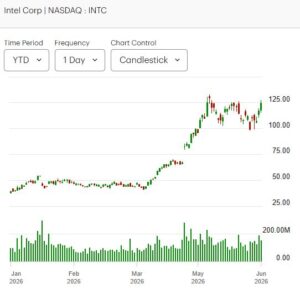
Intel Corporation (INTC) was among the session’s strongest performers, surging 6.51% to close at $124.57 on exceptionally heavy volume of 151.5 million shares. The rally allowed Intel to recover the losses incurred during the earlier market sell-off and demonstrated renewed institutional interest in semiconductor stocks.
Oracle Corporation (ORCL) continued to experience selling pressure during most of Friday’s session but recovered from intraday lows during the final hour of trading. The stock’s late-session rebound suggests buyers remain active, although the broader AI infrastructure segment has recently lost some of its leadership position.
Investors should continue monitoring sector rotation within technology, as capital appears to be shifting toward selected semiconductor names while moving away from portions of the AI infrastructure and communications technology segments.
Space Sector Experiences Major Rotation
One of the most significant themes of the week was the capital rotation surrounding the IPO debut of Space Exploration Technology Corp. (SPCX).
SPCX surged 19.22% on its first trading day, closing at $160.95 on extraordinary volume of 522.1 million shares. The strong debut attracted substantial investor attention and appears to have drawn capital away from several established satellite operators and space-related companies.
Several stocks within the sector experienced sharp declines:
- Momentus Inc. (MNTS): -26.69%
- AST SpaceMobile Inc. (ASTS): -15.53%
- Telesat Corporation (TSAT): -6.40%
- ViaSat Inc. (VSAT): -3.95%
While it is too early to determine whether this represents a temporary rotation or a longer-term shift in investor preferences, Friday’s trading clearly demonstrated that SPCX became the dominant focus within the space and satellite industry.
Traders should monitor whether capital returns to established operators in the coming sessions or whether the sector continues to experience rotation toward newly listed companies.
.
Key Takeaways for Traders
- Market Breadth Improved Significantly: Strong breadth on both the NYSE and NASDAQ supports the durability of Friday’s advance and suggests institutional participation increased into the weekend.
- Small Caps Are Showing Leadership: The Russell 2000 outperformed all major indexes, a constructive sign for risk appetite and market sentiment.
- Basic Materials Remain the Leadership Group: Commodity-related stocks continue to attract capital and remain one of the strongest areas of the market.
- Technology Leadership Is Narrowing: Semiconductor stocks are outperforming, while portions of the AI infrastructure segment remain under pressure.
- Watch Treasury Yields: Lower Treasury yields have recently provided support for small-cap and growth-oriented stocks. Continued weakness in yields could support additional upside in these areas.
Key Takeaways for Investors
- The Broader Uptrend Remains Intact: Despite the volatility earlier in the week, market breadth, new highs, and sector participation all improved by Friday’s close.
- Sector Rotation Is Creating Opportunities: Leadership is expanding beyond mega-cap technology stocks into financials, telecommunications, industrials, and materials.
- Financials Continue to Provide Stability: Banks and financial institutions remain an important source of support for the broader market.
- Diversification Matters: This week’s trading demonstrated the value of maintaining exposure across multiple sectors rather than concentrating solely in one investment theme.
Outlook for Monday
Friday’s session ended with positive momentum across most major asset classes and sectors. Market breadth improved, new highs expanded, and investors demonstrated a willingness to buy into weakness. Attention now shifts to weekend geopolitical developments and their potential impact on commodity prices, Treasury yields, and investor sentiment.
If market breadth remains strong and sector participation continues to broaden, the major indexes could build on Friday’s gains. Traders should pay particular attention to the Russell 2000, Basic Materials, Financials, and Semiconductor stocks, which currently represent some of the market’s strongest areas of relative strength.
.
NOTICE TO READERS
The Canadian Vanguard Stock Market is about empowering you to build and manage your wealth by yourself. There is certainly no magic in managing finances or wealth but one needs to know what to do and commit to doing what is needed. When you are ready to start the journey to Take Charge and Put Your Destiny In Your Own Hands, read The Canadian Vanguard every market day. If you need more related information, Contact Us
Our readers are strongly advised to conduct their own research into individual stocks before making a purchase decision. In addition, investors are advised that past stock performance is no guarantee of future price appreciation. Any recommendation is not a guarantee of any particular stock’s future prices, and The Canadian Vanguard accepts no responsibility or liability for investors’ or readers’ purchases.
Stocks In The News/ Stocks To Watch and Market Strategy will soon be available only to Paying Subscribers. The dollar sign “$” in the Toronto Market section in the articles only stands for Canadian dollar and in the US market section “$” stands for US dollar.
(c) This article is published by The Canadian Vanguard on June 13, 2026