






U.S. Equities Advance as AI Infrastructure and Semiconductor Leaders Rebound Strongly
The Canadian Vanguard Stock Market Report Thursday July 30, 2026 Edition
.
The Toronto Market
Thursday’s Toronto Market Index
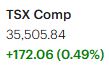
The S&P/TSX Composite Index advanced 172.06 points, or 0.49%, to close at 35,505.84.
The TSX opened higher but pulled back during the first hour of trading, briefly moving into negative territory. After approximately an hour, the index regained positive momentum, climbed above the previous session’s closing level, and remained in positive territory for the rest of the day. Buying activity accelerated during the final hour of trading, lifting the index by roughly 100 points. The TSX closed near its session high, with buyers continuing to outnumber sellers into the close.
Overall, Thursday was another constructive session for Canadian equities. The TSX continues to exhibit underlying strength, trading above its 25-day moving average and well above its 50-day and 200-day moving averages. This technical picture suggests that the broader intermediate- and long-term uptrend remains intact.
Thursday’s TSX Market Statistics
Market breadth was positive on Thursday, with advancing issues comfortably outnumbering declining issues. A total of 1,445 stocks advanced, while 711 stocks declined, resulting in an advancer-to-decliner ratio of 2.03:1, or approximately two advancing stocks for every declining stock. An additional 127 issues closed unchanged.
The TSX recorded 58 new 52-week highs and 33 new 52-week lows, compared with 161 new highs and 53 new lows in the previous session. New highs continued to outnumber new lows by nearly 2:1, reflecting positive underlying market breadth, although the number of stocks reaching new highs declined from the previous day’s elevated level.
Total trading volume on the TSX was 411.4 million shares, approximately 12% lower than the 467.3 million shares traded in the previous session. Despite the lighter trading volume, the strong advancer-to-decliner ratio and favorable new highs-to-new lows ratio indicate that buying interest remained broad across the market.
Thursday’s Toronto TSX Market Wrap-Up Report
The S&P/TSX Composite Index extended its advance on Thursday, gaining 172.06 points (0.49%) to close at 35,505.84. After opening higher, the index briefly slipped into negative territory before recovering and remaining in positive territory for the rest of the session. Buying momentum strengthened during the final hour of trading, allowing the TSX to finish near its session high. The strong close, combined with the index remaining above its 25-day, 50-day, and 200-day moving averages, continues to reinforce the market’s underlying technical strength.
Market breadth also supported the bullish tone. Advancing issues outnumbered declining issues by more than 2-to-1, while new 52-week highs exceeded new lows by nearly 2-to-1. Although total trading volume declined approximately 12% from the previous session, buying interest remained broad across the market.
Six of the TSX’s ten major sectors finished higher. Basic Materials led the advance, climbing 3.07% as strength in gold and mining shares attracted buyers. Healthcare gained 1.99%, while Financials advanced 1.09%, supported by gains across Canada’s six largest banks. Consumer sectors produced mixed results, with Consumer Discretionary rising 0.94%, while Consumer Staples/Durable Consumer Goods & Services declined 1.08%. The weakest sectors were Industrials, down 2.04%, and Information Technology, which fell 4.37% and was the day’s largest sector laggard.
Resource stocks dominated the list of top-performing TSX companies. Strong performances from precious metals, base metals and uranium-related companies helped offset weakness in technology shares and provided the market with important leadership.
The Canadian banking sector staged a modest rebound after Wednesday’s sharp selloff. All six major Canadian banks closed higher, although Thursday’s gains recovered only part of the losses sustained in the previous session, when most bank stocks declined by roughly 3%. Bank of Montreal (BMO) led the group, rising 2.13% on 1.4 million shares traded. Toronto-Dominion Bank (TD) gained 1.98% to close at $167.77 on 3.4 million shares, while Bank of Nova Scotia (BNS) advanced 1.62% to $123.10 with 2.5 million shares traded. The banking sector remains an important area to monitor, as continued buying would strengthen confidence in the broader TSX rally.
Among individual stocks, Hut 8 Corp. (HUT) delivered one of the day’s strongest performances, surging 22.39%. Mining shares also enjoyed a strong session. Agnico Eagle Mines (AEM) gained 3.98% to $211.22, Teck Resources Class B (TECK.B) climbed 8.24% to $87.53, while Teck Resources Class A (TECK.A) advanced 7.17% to $87.44. Celestica Inc. (CLS) rose 6.92%, and Cameco Corp. (CCO) gained 3.98% to close at $123.56.
Despite Thursday’s strong gain, traders should continue to monitor Cameco’s technical picture. The stock remains below its key short-, intermediate-, and long-term moving averages, suggesting that the recent rally may represent a recovery attempt rather than a confirmed trend reversal. Additional technical improvement would be desirable before establishing new short-term positions.
Key Takeaway for Traders and Investors
Thursday’s session reinforced the TSX’s constructive technical outlook. The index closed near its daily high, market breadth remained firmly positive, and buyers were active into the closing bell. Leadership rotated toward resource and financial stocks, while technology lagged. For traders, continued strength in mining shares and a sustained rebound in the banking sector could provide attractive short-term opportunities. For longer-term investors, the TSX’s position above its major moving averages and the broad participation across advancing stocks suggest that the primary uptrend remains intact. However, investors should continue to monitor whether financials can fully recover from Wednesday’s selloff and whether technology stabilizes, as both sectors are likely to influence the market’s next directional move.
This version reads like the market wrap-up section you would find in a professional investment newsletter. It connects the market action, sector rotation, breadth, technical analysis, and stock highlights into a cohesive narrative rather than presenting isolated statistics.
.
The US Markets
Thursday’s U.S. Market Indexes
U.S. equities staged a strong rebound on Thursday, with all four major market indexes posting solid gains after Wednesday’s broad-based selloff. Investor sentiment improved significantly, producing a risk-on session led by large-cap growth and technology stocks.
The Dow Jones Industrial Average gained 613.92 points (1.19%) to close at 52,208.06. The S&P 500 advanced 121.48 points (1.66%) to finish at 7,437.63, fully recovering the losses from Wednesday’s sharp decline. The Nasdaq Composite rallied 679.24 points (2.78%) to close at 25,122.18, while the Russell 2000 Index rose 39.79 points (1.37%) to 2,946.10.

Thursday’s rally reversed much of the previous session’s weakness. The Dow recovered roughly half of Wednesday’s decline, while the S&P 500 erased all of its prior day’s losses. The Nasdaq delivered the strongest performance among the major indexes, reflecting renewed buying interest in technology and growth stocks following recent profit-taking.
Technology shares have faced considerable selling pressure throughout July as investors rotated away from high-growth technology and artificial intelligence stocks toward other sectors. Thursday’s robust advance suggests that buyers are returning to the sector, although additional follow-through will be needed to confirm that a sustainable recovery is underway.
From a technical perspective, the major indexes remain at different stages of recovery. The S&P 500 is currently trading below its 25-day moving average while testing support around its 50-day moving average. The Russell 2000 has also slipped below its 25-day moving average and finished the session near its 50-day moving average, although it remains comfortably above its 200-day moving average.
The Nasdaq Composite continues to show the greatest technical damage. Following Wednesday’s sharp decline, the index remains below both its 25-day and 50-day moving averages, although it continues to trade above its 200-day moving average. While Thursday’s powerful rally did not fully repair the chart, it represents an encouraging first step. Continued buying over the coming sessions would improve the Nasdaq’s technical outlook and could allow the index to reclaim its key moving average levels.
Key Takeaway for Traders and Investors
Thursday’s rally demonstrated that buyers remain willing to step into the market following periods of heavy selling. The complete recovery in the S&P 500 and the Nasdaq’s outsized gain indicate that investor confidence has not disappeared, despite the recent volatility. However, the technical picture remains mixed. While the longer-term uptrend is still intact for the major indexes, several remain below important short-term moving averages. Traders should watch for additional follow-through buying in technology shares and monitor whether the S&P 500 and Nasdaq can reclaim their 25-day and 50-day moving averages. A sustained move above these technical levels would strengthen the case that the recent pullback was a normal correction within an ongoing bull market rather than the beginning of a more prolonged decline.
Thursday’s U.S. Market Statistics
New York Stock Exchange (NYSE): Market breadth on the NYSE improved on Thursday, with advancing issues outnumbering declining issues. A total of 2,801 stocks advanced, while 1,721 stocks declined, resulting in an advancer-to-decliner ratio of 1.62:1, or approximately three advancing stocks for every two declining stocks. An additional 500 issues closed unchanged, reflecting broad participation in the market’s rebound.
The NYSE recorded 153 new 52-week highs and 144 new 52-week lows, compared with 221 new highs and 243 new lows in the previous session. Although both new highs and new lows declined from Wednesday, the gap between them narrowed considerably, with new highs modestly exceeding new lows. This suggests that while underlying market conditions remain mixed, the broad deterioration seen in the previous session eased noticeably.
Total NYSE trading volume reached 5.73 billion shares, approximately 4% lower than the 5.95 billion shares traded on Wednesday. The lighter volume, combined with positive market breadth, indicates that buyers regained control without an unusually large surge in trading activity.
NASDAQ: The NASDAQ also experienced a constructive session, with 3,210 advancing stocks and 1,729 declining stocks, producing an advancer-to-decliner ratio of 1.85:1, or nearly two advancing stocks for every declining stock. Another 172 issues finished unchanged, confirming that buying interest was broad across the exchange.
The exchange recorded 120 new 52-week highs and 172 new 52-week lows, compared with 164 new highs and 351 new lows in the previous session. Although new highs declined modestly, the number of new lows fell by more than half, representing a significant improvement in market internals. While new lows continued to outnumber new highs, the new highs-to-new lows ratio improved substantially from Wednesday, indicating that selling pressure eased considerably.
NASDAQ trading volume totaled 9.51 billion shares, approximately 10% higher than Wednesday’s 8.62 billion shares. The increase in volume accompanied a strong advance in the Nasdaq Composite, suggesting renewed institutional participation rather than indiscriminate selling.
Technology shares remained the primary focus of investors. Although the Nasdaq Composite staged a powerful rebound, semiconductor and chip-related stocks continue to experience sector rotation after an extended period of leadership. From a technical perspective, the Nasdaq remains below both its 25-day and 50-day moving averages while holding above its 200-day moving average. Until the index and leading semiconductor stocks reclaim these important technical levels, traders should continue to manage risk carefully and look for confirmation that institutional buying has returned before establishing significant new positions in the sector.
Key Takeaway for Traders and Investors
Thursday’s market statistics were more constructive than the headline volatility might suggest. Both the NYSE and NASDAQ posted solid advancer-to-decliner ratios, indicating broad buying interest across the market. Although new 52-week highs remain below recent levels, the sharp reduction in new lows—particularly on the NASDAQ—is an encouraging sign that selling pressure is beginning to subside.
For traders, the focus should remain on whether improving market breadth is sustained over the next several sessions. A continued increase in new highs, combined with a decline in new lows and the Nasdaq reclaiming its key moving averages, would strengthen the bullish case. Until then, maintaining selective exposure and waiting for technical confirmation—especially in technology and semiconductor stocks—remains the more prudent approach.
Thursday’s U.S. Market Wrap-Up Report
U.S. equities staged an impressive comeback on Thursday, reversing much of Wednesday’s broad-based selloff. All four major indexes finished sharply higher as investors returned to risk assets, led by technology, semiconductor, AI infrastructure and financial stocks. The broad participation across the market was reflected in positive market breadth on both the NYSE and NASDAQ, while the S&P 500 fully recovered Wednesday’s losses.
The Dow Jones Industrial Average gained 613.92 points (1.19%) to close at 52,208.06. The S&P 500 advanced 121.48 points (1.66%) to 7,437.63, completely erasing Wednesday’s decline. The Nasdaq Composite rallied 679.24 points (2.78%) to 25,122.18, delivering the strongest performance among the major indexes, while the Russell 2000 added 39.79 points (1.37%) to finish at 2,946.10.
The week’s performance has also improved significantly following Thursday’s rally. The Nasdaq has returned to positive territory for the week, while both the S&P 500 and Dow Jones have also recovered enough ground to move back into weekly gains after Wednesday’s sharp decline.
Market internals confirmed the strength of Thursday’s advance. On the NYSE, advancing stocks outnumbered declining stocks by 1.62-to-1, while on the NASDAQ the ratio improved to 1.85-to-1, demonstrating that buying was broad-based rather than concentrated in only a handful of large-cap stocks. Although new 52-week highs remain below recent levels, the sharp decline in the number of new lows—particularly on the NASDAQ—suggests that selling pressure has eased considerably. Trading volume was generally close to average, indicating healthy institutional participation without signs of panic buying.
Thursday’s rally was clearly a risk-on session. Seven of the eleven major S&P sectors finished higher. Information Technology led the market with a 3.91% gain, followed by Basic Materials (+2.04%) and Financials (+1.47%). Energy rose 0.98%, while Consumer Discretionary added 0.80%. Defensive and economically sensitive sectors lagged, with Communication Services declining 1.83% and Consumer Staples/Durable Consumer Goods & Services falling 2.01%.
Technology stocks, particularly semiconductor and AI infrastructure companies, led Thursday’s recovery after experiencing heavy selling over the previous two sessions. The rebound reflected renewed investor confidence, although many of these stocks continue to trade below important technical resistance levels.
Among Thursday’s standout performers were:
Company Ticker Price at Market Close Gain
IREN Limited IREN $38.26 +30.54%
Nebius Group NV NBIS $188.43 +27.13%
Sandisk Corp. SNDK $1,279.96 +25.99%
Hut 8 Corp. HUT $108.27 +22.78%
Astera Labs ALAB $299.69 +20.00%
Sterling Infrastructure TSEM $211.16 +12.41%
Seagate Technology STX $851.68 +11.41%
Semiconductor stocks were among the strongest performers after leading the market lower earlier in the week. Sandisk Corp. (SNDK) surged 25.99%, recovering most of its recent losses. Micron Technology (MU) climbed 18.36%, while Tower Semiconductor (TSEM) gained 12.41%. Storage technology companies also participated in the rally, with Western Digital (WDC) advancing 15.37% and Seagate Technology (STX) adding 11.41%.
AI infrastructure and optical networking stocks also attracted strong institutional buying. Applied Optoelectronics (AAOI) gained 17.76%, Lumentum Holdings (LITE) advanced 15.09%, Coherent Corp. (COHR) rose 12.13%, and Corning Inc. (GLW) added 9.23%, reflecting renewed investor interest in companies benefiting from continued AI-related capital spending.
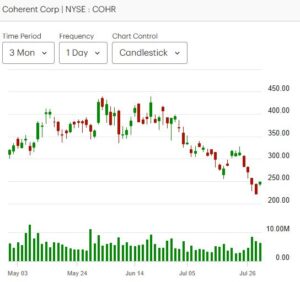
Most Semiconductor and AI Infrastructure Stocks like Coherent Corp
have damaged charts
Following the closing bell, investors turned their attention to corporate earnings. Amazon reported second-quarter results that exceeded analysts’ expectations, sending its shares sharply higher in after-hours trading. Apple also reported earnings, although its shares traded lower following the release as investors evaluated the company’s outlook.
Although Thursday’s rally was encouraging, traders should remember that many of the market’s recent leaders still have technically weakened charts following the sharp selling experienced during July and, in many cases, since late June. While Thursday represented an important first step toward repairing those technical patterns, many stocks remain below their 25-day and 50-day moving averages. Strong follow-through buying over the coming sessions will be needed before a durable uptrend can be confirmed.
Key Takeaway for Traders and Investors
Thursday’s rebound was broad, powerful and supported by positive market breadth, suggesting that institutional investors returned to the market after Wednesday’s selloff. The complete recovery in the S&P 500 and the Nasdaq’s leadership are encouraging signs that the primary bull market remains intact. However, many leading growth, AI and semiconductor stocks still have damaged technical charts despite their impressive gains.
For traders, patience remains essential. Rather than chasing stocks after a single strong session, it is prudent to look for continued follow-through buying, improving relative strength, and breakouts above key moving averages before increasing exposure. For longer-term investors, the market continues to offer attractive opportunities, but building positions gradually while respecting technical signals remains the preferred strategy. As always, price and volume action—and the stock’s chart—remain the market’s most reliable guides.
.
NOTICE TO READERS
The Canadian Vanguard Stock Market is about empowering you to build and manage your wealth by yourself. There is certainly no magic in managing finances or wealth but one needs to know what to do and commit to doing what is needed. When you are ready to start the journey to Take Charge and Put Your Destiny In Your Own Hands, start with reading The Canadian Vanguard every market day. If and when you need more related information or to advertise your business products or services in The Canadian Vanguard, Contact Us
Our readers are strongly advised to conduct their own research into individual stocks before making a purchase decision. In addition, investors are advised that past stock performance is no guarantee of future price appreciation. Any recommendation is not a guarantee of any particular stock’s future prices, and The Canadian Vanguard accepts no responsibility or liability for investors’ or readers’ purchases.
Stocks In The News/ Stocks To Watch and Market Strategy will soon be available only to Paying Subscribers. The dollar sign “$” in the Toronto Market section in the articles only stands for Canadian dollar and in the US market section “$” stands for US dollar.
(c) This article is published by The Canadian Vanguard on July 30, 2026