






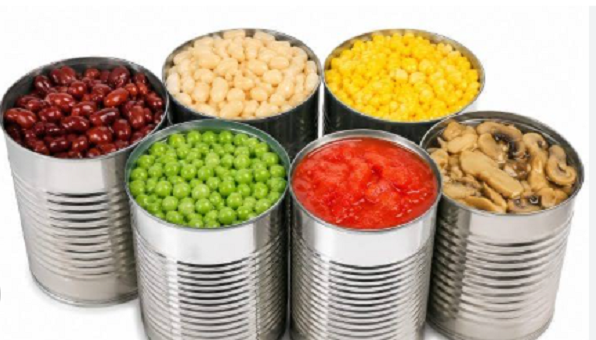
Trade Policy Shift: New 10% Tariff Introduced on Imported Canned Vegetables
Some imports of canned vegetables will be subject to a 10-per-cent tariff as Ottawa rushes to protect domestic processors who claim they are threatened by a surge of cheap overseas goods.
The surtax comes into effect Friday and will last for a maximum of 200 days, according to a Friday announcement from the Department of Finance. It will not apply to products from the United States, Mexico, Israel, Chile and developing countries.
The surcharge comes three months after the Canadian International Trade Tribunal launched a rare safeguarding investigation into a surge in imports of canned and frozen vegetables. The investigation will conclude Sept. 9.
The Department of Finance implemented the surtax before the inquiry’s conclusion because an internal investigation found the volume of imports was “disproportionately harming our Canadian producers,” said John Fragos, press secretary for the Office of the Minister of Finance and National Revenue, in an interview.

“We needed to act swiftly to protect Canadian producers.”
But Canadian retailers are concerned that the Department of Finance has rushed through what should be a predictable legal process.
“They’re tinkering with the thinking of the courts on this,” said Kim Furlong, chief executive officer of the Retail Council of Canada. “The timing of it is what I think makes people very uncomfortable.”
Safeguarding inquiries are rare, and they examine whether an unanticipated surge of imports has seriously injured, or threatened to seriously injure a domestic industry. Prior to March, the trade tribunal had only launched one safeguarding inquiry in the last 20 years.
When the inquiry was launched, Finance Minister François-Philippe Champagne said “unforeseen developments in global trade” may have contributed to a damaging surge in imports.
U.S. President Donald Trump’s global tariffs are likely to have diverted trade to Canada, said Rambod Behboodi, a trade lawyer for Borden Ladner Gervais LLP.
“It’s trade policy 101 that every time a major economy reduces imports through the imposition of trade measures, open economies end up getting hit with the brunt of that trade diversion.”
An internal investigation from the Department of Finance – in collaboration with the departments of agriculture, trade, public safety and industry – found that the surge in imports “far exceeded the threshold” of what would be needed to justify safeguarding measures, Mr. Fragos said.

The data used to back this decision will not come out until the tribunal’s investigation and its full findings are made public in September, he said.
Data from Statistics Canada suggest that imports of canned vegetables climbed from around $21-million in May, 2024, to $25-million in April, 2026 – a 23-per-cent hike.
There have been substantial increases in imports across the same time period from Thailand (179 per cent), Turkey (159 per cent) and Peru (85 per cent).
Regardless of a surge in imports, the Department of Finance’s measures are “highly unusual,” said Matthew Kronby, trade lawyer with Osler, Hoskin & Harcourt LLP.
When the need to protect a domestic industry from a surge is critical, a preliminary tariff is usually applied at the beginning of an inquiry, not halfway through, he said.
Implementing the surtax at the start of the investigation would have been acceptable, Ms. Furlong said. If the court then found the injury to be substantiated, the duties would continue. If not, they would be reimbursed.
Mounting a defence and contributing to a safeguarding inquiry is also costly, she said, and acting outside the process sends the signal that the outcome is predetermined.
“The process needs to be robust. People need to trust that you’re going to get a fair hearing and people are going to get to make their arguments, and the evidence is what’s going to drive the conclusion.”

The safeguarding inquiry was launched at the request of the Canadian Association of Vegetable Growers and Processors.
Some large Canadian vegetable processors have highlighted competition from foreign imports across the last nine months and have been lobbying the federal government on the issue.
Quebec vegetable-processing giant Nortera Foods Inc. has in recent months made plans to close two plants, citing concerns about import competition. It announced the closure of its Lethbridge, Alta., plant in March, and its Saint-Césaire, Que., plant last October.
Nortera is backed by the Caisse de dépôt et placement du Québec and Fonds de solidarité FTQ.
This article was first reported by The Globe and Mail