


Markets Rebound as Geopolitical Relief Overshadows Rising Interest Rate Concerns
The Canadian Vanguard Stock Market Report Thursday June 18, 2026 Edition
.
The Toronto Market
Thursday’s Toronto Market Index
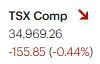
The S&P/TSX Composite Index declined 155.85 points, or 0.44%, to close at 34,969.26 on Thursday. The Toronto market ended lower for a second consecutive session, following a three-session winning streak that began last Friday.
Although the index finished in negative territory, the relatively modest decline of less than 0.5% suggests the move was more of a routine market pullback than a significant shift in sentiment. After recently reaching record highs and trading in uncharted territory, some degree of consolidation or profit-taking is generally considered a normal part of market behavior.


Thursday’s TSX Market Statistics
Market breadth on the TSX was positive on Thursday, with advancing issues outnumbering declining issues. A total of 1,331 stocks advanced, while 925 declined, resulting in an advancer-to-decliner ratio of 1.44-to-1, or roughly three advancing stocks for every two declining stocks. An additional 132 issues closed unchanged.
The exchange recorded 296 new 52-week highs and 42 new 52-week lows. This compares with 323 new 52-week highs and 29 new 52-week lows reported the previous trading session, indicating a slight moderation in the number of stocks reaching fresh highs.
Trading activity increased, with total volume reaching 553.2 million shares, up 5% from the 524.8 million shares traded yesterday. Overall, despite the TSX index closing lower, underlying market breadth remained positive, reflecting broader strength across individual stocks.
Thursday’s TSX Toronto Market Wrap-Up Report
The S&P/TSX Composite Index declined 155.85 points, or 0.44%, to close at 34,969.26 on Thursday. The Toronto market finished lower for a second consecutive session following a three-session winning streak that began last Friday. Despite the decline, the pullback was relatively modest and appears to be a normal period of consolidation after the index recently reached record highs.
Market internals were more constructive than the headline index performance suggested. Advancing issues outnumbered declining issues by 1,331 to 925, resulting in a positive advancer-to-decliner ratio of 1.44-to-1. The TSX also recorded 296 new 52-week highs versus 42 new 52-week lows. Trading activity was robust, with total volume rising 5% to 553.2 million shares from 524.8 million shares in the previous session.
Sector performance was mixed, but six of the TSX’s ten major sectors finished higher. Healthcare led the market with a gain of 1.32%, followed by Industrials, which advanced 0.62%. Financials added 0.49%, while Consumer Discretionary gained 0.45%.
The Energy sector declined 1.15% as crude oil prices continued to drift lower following reports that both the United States and Iran had agreed to a diplomatic framework that could eventually increase global oil supply. Technology fell 1.18%, while Basic Materials was the weakest-performing sector, losing 2.24% amid profit-taking and weakness in several resource-related stocks.
Financial stocks provided important support to the broader market. Five of Canada’s Big Six banks finished higher, led by National Bank of Canada, which rose 1.27%. Bank of Nova Scotia, which gained 0.98%, and Toronto-Dominion Bank advanced 0.70%, while Bank of Montreal added 0.75%. Royal Bank of Canada gained 0.66%, while Canadian Imperial Bank of Commerce was the only major bank to finish lower, slipping 0.79%.
In company-specific news, Toromont Industries (TIH) was the TSX’s top performer, surging 17.14%. Energy Fuels Inc. (EFR) climbed 8.20%, while goeasy Ltd. (GSY) rounded out the top three gainers with an advance of 7.43%.
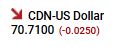
In the fixed-income market, the yield on the benchmark 10-year Government of Canada bond fell 5.14 basis points to 3.366%, reflecting renewed demand for bonds. In currency markets, the WSJ Dollar Index rose 0.20% to 96.94, while the Canadian dollar weakened 0.20% against the U.S. dollar to US$0.71.
Key Takeaways for Traders and Investors
• The TSX posted only a modest decline despite recent record highs, suggesting that the current weakness remains consistent with a healthy market consolidation rather than the start of a broader correction.
• Positive market breadth, with advancers comfortably exceeding decliners, indicates that underlying participation remained strong even as the headline index moved lower.
• Financials continued to demonstrate leadership, with most of the major Canadian banks posting gains. The sector remains an important pillar supporting the broader market.
• The sharp divergence between strong market breadth and weakness in Energy and Materials suggests that sector rotation, rather than widespread selling, was the dominant theme of the session.
• The decline in bond yields could provide support for interest-rate-sensitive sectors if the trend persists.
• Investors should continue monitoring developments in oil markets, as any sustained decline in crude prices could pressure Energy stocks, while easing inflation expectations may benefit other sectors of the market.
.
The US Markets
Thursday’s U.S. Market Indexes
U.S. equities rebounded strongly on Thursday, with all four major benchmark indexes finishing the session in positive territory and reversing much of the previous day’s weakness.
The Dow Jones Industrial Average gained 72.15 points, or 0.14%, to close at 51,564.70. The S&P 500 advanced 80.48 points, or 1.08%, ending the session at 7,500.58. The technology-heavy Nasdaq Composite climbed 496.28 points, or 1.91%, to finish at 26,517.93, while the Russell 2000 Index led the market higher, surging 61.78 points, or 2.12%, to close at 2,979.77.

The broad-based rally reflected renewed investor confidence and strong buying interest across multiple sectors. Small-cap stocks emerged as the market leaders, with the Russell 2000 outperforming all other major indexes. The strength in small-cap shares is often viewed as a positive sign for overall market sentiment, as it suggests investors are becoming more willing to assume risk.
Technology stocks also staged a notable recovery after Wednesday’s pullback. The Nasdaq Composite’s 1.91% advance more than offset the previous session’s decline, reaffirming the sector’s leadership role in the current bull market.
From a technical perspective, the outlook for U.S. equities remains constructive. Following Thursday’s gains, the Nasdaq Composite is trading comfortably above its 21-day, 50-day, and 200-day moving averages, a sign that both short-term and long-term upward trends remain intact. Similarly, the Dow Jones Industrial Average and the S&P 500 continue to trade above all three key moving averages, reinforcing the market’s underlying bullish momentum.
Key Takeaways for Traders and Investors
• Thursday’s rally restored positive momentum after the previous session’s weakness, indicating that buyers remain active on market pullbacks.
• The Russell 2000’s market-leading gain suggests improving risk appetite and broader participation beyond large-cap technology stocks.
• The Nasdaq’s strong rebound confirms continued leadership from the technology sector and highlights ongoing investor demand for growth-oriented stocks.
• All major U.S. indexes remain above their 21-day, 50-day, and 200-day moving averages, an important technical signal that the primary trend remains upward.
• The combination of strength in large-cap, technology, and small-cap stocks points to healthy market breadth and supports the bullish outlook for U.S. equities.
• Traders should monitor whether the Russell 2000 can maintain its recent leadership, as sustained small-cap strength often signals confidence in the broader economy and can support further gains across the market.
Thursday’s U.S. Market Statistics
Market breadth was decisively positive across both major U.S. exchanges on Thursday, reinforcing the strong gains posted by the major market indexes.
New York Stock Exchange (NYSE): Advancing issues comfortably outpaced declining issues on the NYSE. A total of 2,852 stocks advanced, while 1,662 declined and 390 issues finished unchanged. This produced an advancer-to-decliner ratio of 1.71-to-1, or approximately eight advancing stocks for every five declining stocks.
The NYSE recorded 286 new 52-week highs and 183 new 52-week lows, compared with 282 new highs and 131 new lows in the previous session. While the number of new highs increased modestly, the rise in new lows suggests that some pockets of weakness remain beneath the surface despite the broad market rally.
Trading activity surged, with total NYSE volume reaching 9.38 billion shares, a 56% increase from the 6.01 billion shares traded on Wednesday.
NASDAQ: Market breadth was also strong on the NASDAQ, where advancing stocks outnumbered declining stocks by nearly two-to-one. The exchange reported 3,136 advancing issues and 1,773 declining issues, resulting in an advancer-to-decliner ratio of 1.76-to-1. An additional 323 issues closed unchanged.
The NASDAQ posted 217 new 52-week highs and 225 new 52-week lows, compared with 164 new highs and 152 new lows in the prior session. The substantial increase in new highs reflects renewed buying interest, particularly among growth-oriented and technology stocks. However, the fact that new lows slightly exceeded new highs indicates that market leadership remains somewhat uneven despite the index’s strong advance.
Total NASDAQ trading volume reached 19.29 billion shares, representing a 59% increase from Wednesday’s volume of 12.12 billion shares.
Triple-Witching Expiration Drives Heavy Volume
Thursday’s unusually high trading volume was largely attributable to quarterly options expiration activity. Under normal circumstances, the third Friday of March, June, September, and December is known as Triple Witching Day, when stock options, index options, and futures contracts expire simultaneously. These events often generate elevated trading activity as investors, traders, and institutions close, roll over, or hedge positions.
Because Friday is a market holiday, much of the quarterly expiration-related activity was effectively pulled forward into Thursday’s session, contributing to the sharp increase in trading volume on both exchanges.
Key Takeaways for Traders and Investors
• Market breadth was strong across both the NYSE and NASDAQ, confirming that Thursday’s rally was supported by broad participation rather than a handful of large-cap stocks.
• Advancer-to-decliner ratios above 1.7-to-1 on both exchanges indicate that buying interest was widespread throughout the market.
• The significant increase in trading volume adds credibility to the day’s gains, as strong price advances accompanied by heavier volume are generally viewed as a constructive technical signal.
• Elevated volume was influenced by quarterly options expiration activity, so traders should be cautious about attributing all of the volume surge to fresh institutional buying.
• The rise in new 52-week lows, particularly on the NASDAQ, suggests that while the overall market trend remains bullish, leadership is still concentrated in selected sectors and stocks.
• Investors should continue monitoring market breadth and new-high/new-low data in the coming sessions. Sustained strength in breadth coupled with an expanding number of new highs would provide further confirmation of the current uptrend.
.
Thursday’s U.S. Market Wrap-Up Report
U.S. stocks rallied sharply on Thursday, reversing much of Wednesday’s sell-off as investors looked past the Federal Reserve’s more hawkish interest-rate outlook and instead focused on easing geopolitical tensions in the Middle East. Declining oil prices also provided support for equities, helping fuel broad-based gains across the major indexes.
The market’s primary focus in recent weeks has been developments surrounding negotiations between the United States and Iran. Continued progress toward a peace agreement has reduced concerns about supply disruptions and broader regional instability, contributing to lower crude oil prices and improving investor sentiment. Energy prices continued to retreat on Thursday, removing one of the key inflationary risks facing the market.
The previous session’s sell-off was largely driven by the Federal Reserve’s stronger-than-expected shift toward a tighter monetary policy stance. Market expectations for additional rate increases rose significantly following Wednesday’s FOMC meeting. However, investors appeared willing to look beyond those concerns on Thursday, returning to risk assets despite the prospect of higher interest rates later this year.
The rally was reflected across all major U.S. indexes. The Dow Jones Industrial Average gained 72.15 points, or 0.14%, to close at 51,564.70. The S&P 500 advanced 1.08% to 7,500.58, while the Nasdaq Composite climbed 1.91% to 26,517.93. Small-cap stocks led the market higher, with the Russell 2000 Index surging 2.12%, signaling improving risk appetite among investors.
Market breadth strongly supported the advance. On the New York Stock Exchange, advancing issues outnumbered declining issues by 2,852 to 1,662, while the NASDAQ reported 3,136 advancing stocks versus 1,773 decliners. Advancer-to-decliner ratios of approximately 1.7-to-1 on both exchanges indicate that buying interest was broad-based rather than concentrated in a small group of large-cap stocks.
Trading activity increased significantly. NYSE volume rose 56% to 9.38 billion shares, while NASDAQ volume climbed 59% to 19.29 billion shares. Much of the elevated activity was related to quarterly options expiration, commonly known as Triple Witching, which was effectively pulled forward to Thursday because Friday’s market holiday will close U.S. exchanges.
Sector performance was notably stronger than the previous session, when all major sectors declined. Technology led the market with a gain of 2.52%, supported by strength in semiconductor and artificial intelligence-related stocks. Consumer Discretionary advanced 1.44%, while Utilities gained 1.39%. On the downside, Basic Materials fell 0.85%, Telecommunications Services lost 0.92%, and Energy declined 1.41% as oil prices continued to weaken.
On a weekly basis, market leadership remained broad. Seven major sectors finished the shortened trading week higher. Basic Materials led with a weekly gain of 7.30%, followed by Industrials at 4.85%, Technology at 4.12%, and Financials at 3.97%.
In company-specific news, recently public Space Exploration Technologies Corp. (SPCX) declined for a second consecutive session. At one point during Thursday’s trading, the stock had nearly erased all of its post-IPO gains before recovering during the final hour of trading and closing well above its intraday lows.
Semiconductor stocks dominated the list of top performers. Sandisk Corporation surged 11.54%, while Intel Corporation jumped 11.0% after reports that Apple had agreed to work with Intel on designing and manufacturing chips in the United States. Additional strength was seen throughout the sector, with Arm Holdings (ARM) advancing 4.91% and Advanced Micro Devices (AMD) gaining 4.86%. The semiconductor group’s strong performance was a major contributor to the Nasdaq’s leadership on the day.
From a technical standpoint, the market remains firmly bullish. Following Thursday’s rally, the Nasdaq Composite, S&P 500, and Dow Jones Industrial Average all continue to trade comfortably above their 21-day, 50-day, and 200-day moving averages. These technical levels suggest that both the intermediate-term and long-term uptrends remain intact despite periodic pullbacks.
Key Takeaways for Traders and Investors
• Thursday’s rally demonstrated that investors remain willing to buy market pullbacks despite growing expectations for higher interest rates.
• Strong market breadth on both the NYSE and NASDAQ confirms that the advance was broad-based and supported by widespread participation.
• Small-cap stocks outperformed large-cap stocks, an encouraging signal that investor confidence and risk appetite remain healthy.
• Technology and semiconductor shares reasserted market leadership, helping the Nasdaq recover quickly from Wednesday’s decline.
• Falling oil prices are reducing inflation concerns and providing a tailwind for many sectors outside of Energy.
• Elevated trading volume lends credibility to the rally, although a portion of the increase was driven by quarterly options expiration activity.
• The major indexes remain above key moving averages, indicating that the primary trend remains bullish and that recent weakness continues to resemble normal consolidation within an ongoing uptrend.
• Investors should continue monitoring Federal Reserve policy expectations, bond yields, and developments in the Middle East, as these factors are likely to remain the primary drivers of market direction in the coming weeks.
.
NOTICE TO READERS
The Canadian Vanguard Stock Market is about empowering you to build and manage your wealth by yourself. There is certainly no magic in managing finances or wealth but one needs to know what to do and commit to doing what is needed. When you are ready to start the journey to Take Charge and Put Your Destiny In Your Own Hands, read The Canadian Vanguard every market day. If you need more related information, Contact Us
Our readers are strongly advised to conduct their own research into individual stocks before making a purchase decision. In addition, investors are advised that past stock performance is no guarantee of future price appreciation. Any recommendation is not a guarantee of any particular stock’s future prices, and The Canadian Vanguard accepts no responsibility or liability for investors’ or readers’ purchases.
Stocks In The News/ Stocks To Watch and Market Strategy will soon be available only to Paying Subscribers. The dollar sign “$” in the Toronto Market section in the articles only stands for Canadian dollar and in the US market section “$” stands for US dollar.
(c) This article is published by The Canadian Vanguard on June 18, 2026