







Market Rotation Continues: Small-Caps Lead While Technology Stocks Remain Under Pressure
The Canadian Vanguard Stock Market Report Thursday June 18, 2026 Edition
.
The Toronto Market
Thursday’s Toronto Market Index
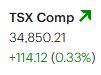
The S&P/TSX Composite Index rose 114.12 points (0.33%) to close at 34,850.21. The index opened above the previous session’s close and remained in positive territory throughout the trading day. Investor sentiment stayed constructive, with the TSX trading within an intraday range of approximately 34,800 to 35,100. The index has now moved back above its 25-day, 50-day, and 200-day moving averages, a technical development that may be viewed as supportive of the market’s recent upward momentum.
Thursday’s TSX Market Statistics
Market breadth on the TSX turned positive, with advancing issues outnumbering declining issues. There were 1,304 advancers and 897 decliners, resulting in an advancer-to-decliner ratio of 1.45:1, or approximately three advancing stocks for every two declining stocks. In addition, 1,549 issues were unchanged.
The exchange recorded 177 new 52-week highs and 79 new 52-week lows, compared with 115 new highs and 72 new lows in the previous session. The increase in new highs suggests improving underlying market strength.
Total trading volume reached 512,084,335 shares, up 6% from 483,577,180 shares traded yesterday.
After three consecutive sessions of negative market breadth, Thursday’s session marked a return to positive breadth. While trading volume increased from the previous day, investor participation remains somewhat cautious following the recent pullback. The combination of positive breadth, a higher number of new 52-week highs, and increased volume provides encouraging signs that buying interest is returning. However, investors may look for several more sessions of sustained strength before gaining confidence that a more durable market rally is underway.
Thursday’s TSX Toronto Market Wrap-Up Report
The S&P/TSX Composite Index rebounded on Thursday, gaining 114.12 points (0.33%) to close at 34,850.21. The index opened above the previous session’s close and remained in positive territory throughout the trading day, finishing back above its 25-day, 50-day and 200-day moving averages—an encouraging technical development that suggests buyers are regaining control after three consecutive declining sessions.
Trading activity also improved, with 512.1 million shares changing hands, a 6% increase from Wednesday’s volume of 483.6 million shares. Market breadth turned positive as 1,304 stocks advanced compared with 897 decliners, producing an advancer-to-decliner ratio of 1.45:1. In addition, the TSX recorded 177 new 52-week highs versus 79 new lows, a notable improvement from the previous session and another indication that underlying market strength is improving.
Sector Performance
Seven of the TSX’s ten major sectors closed higher.
Industrials led the advance, rising 0.92%, followed by Healthcare (+0.72%), Basic Materials (+0.71%), Utilities (+0.48%), and Energy (+0.47%). The Financials sector also finished modestly higher, gaining 0.30%, helping support the broader market.
The day’s weaker sectors were Telecommunication Services (-1.15%) and Information Technology (-2.04%), with technology finishing as the session’s worst performer.
Financials
Canada’s major banks posted another solid session. Bank of Montreal led the group with a 0.95% gain, followed by Toronto-Dominion Bank (+0.95%) and Bank of Nova Scotia (+0.90%). Continued strength in the banking sector remains an important pillar supporting the TSX, given its significant weighting in the index.
Company Highlights
BlackBerry Ltd. (BB) was the standout performer on the TSX, surging 19.2% on heavy volume of 11.2 million shares after reporting quarterly earnings that exceeded analysts’ expectations.
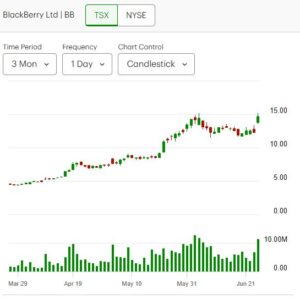
For the quarter ended May 31, BlackBerry reported adjusted earnings of $0.04 per share, up from $0.02 a year earlier and above the consensus estimate of $0.03 per share. Revenue increased 26% year-over-year to $152.9 million, comfortably exceeding analysts’ expectations of $137.2 million.
Management also raised its fiscal 2027 earnings outlook to $0.16-$0.20 per share, up from the previous guidance of $0.15-$0.19 per share, while maintaining revenue guidance of $594 million to $621 million. Investors responded positively to both the earnings beat and the improved outlook.
Meanwhile, Shopify Inc. (SHOP) gave back some of Wednesday’s gains, declining 2.58% on trading volume of 1.6 million shares, while Celestica Inc. slipped 0.69%.
Commodities and Mining
The precious and industrial metals sectors rebounded strongly after underperforming on Wednesday. Sixteen of the twenty best-performing TSX stocks were companies involved in gold, precious metals or industrial metals mining. The improvement reflects renewed investor interest in commodity-related equities and provided meaningful support to the broader market.
Market Outlook
Thursday’s session showed several constructive signs. The TSX reclaimed all three widely watched moving averages, market breadth returned to positive territory, trading volume increased, and the number of new 52-week highs expanded significantly. Together, these signals suggest that buying interest is broadening after this week’s pullback.
Although one positive session does not establish a new uptrend, the market’s ability to recover on stronger participation indicates that investors are beginning to regain confidence. Confirmation through additional sessions of positive breadth, healthy volume, and leadership from cyclical sectors would strengthen the case that the recent rally is resuming.
Key Takeaways for Traders and Investors
- Technical picture improved: The TSX closed back above its 25-day, 50-day and 200-day moving averages, restoring a bullish technical backdrop.
- Breadth strengthened: Advancers outnumbered decliners by 1.45:1, while new 52-week highs more than doubled new lows, suggesting participation broadened beyond a handful of large-cap stocks.
- Volume confirmed the move: Trading volume increased by 6%, lending greater credibility to Thursday’s advance.
- Sector rotation continued: Industrials, Financials and Basic Materials led the market, while Technology lagged. Monitoring whether this rotation persists will be important in the coming sessions.
- Commodity stocks regained leadership: Strong performance from gold and metals producers may indicate renewed interest in defensive and commodity-linked sectors.
- Watch for follow-through: Traders should look for additional sessions of positive breadth and sustained volume before concluding that the recent correction has ended. Investors may view Thursday’s action as an encouraging sign that the primary uptrend remains intact, provided market participation continues to improve.
.
The US Markets
Thursday’s U.S. Market Indexes
U.S. equities delivered a mixed performance on Thursday as investors continued rotating into small-cap and value-oriented stocks while taking profits in large-cap technology shares.
The Dow Jones Industrial Average gained 71.72 points (0.14%) to close at 51,920.62, finishing just below its record closing high of 51,999.67, set on June 16.
The S&P 500 edged lower by 0.73 points (-0.01%) to close at 7,357.49, narrowly missing another positive finish.
The Nasdaq Composite declined 118.03 points (-0.46%) to 25,358.60, extending its losing streak to four consecutive trading sessions as weakness in large-cap technology stocks continued to weigh on the index.
The standout performer was the Russell 2000 Index, which climbed 21.23 points (0.71%) to finish at a record closing high of 3,007.86, highlighting continued investor interest in smaller-cap companies.

Market Commentary
Thursday’s trading reinforced the ongoing rotation away from mega-cap technology stocks and into small-cap and cyclical companies. The Russell 2000 has emerged as the market leader in recent sessions, reflecting growing investor confidence in domestically focused companies that could benefit from a more accommodative interest-rate environment.
Meanwhile, declining bond yields have improved the outlook for interest-rate-sensitive sectors. Lower Treasury yields generally ease financing costs for smaller companies, making small-cap stocks more attractive relative to high-growth technology names whose valuations can be more sensitive to changes in interest rates.
Although the Nasdaq continued to lag, the resilience of the Dow Jones Industrial Average and the strength in the Russell 2000 suggest that the broader market remains healthy, with leadership rotating rather than deteriorating.
Key Takeaways for Traders and Investors
- Small-cap stocks remain in leadership, with the Russell 2000 reaching another record closing high.
- Market leadership continues to broaden beyond mega-cap technology, a constructive sign for the overall market.
- Lower bond yields are supporting interest-rate-sensitive sectors, particularly smaller companies that benefit from lower borrowing costs.
- The Dow Jones remains near record highs, indicating continued strength in blue-chip and value-oriented stocks.
- The Nasdaq remains under pressure, posting a fourth consecutive decline as investors rotate out of technology and into other sectors.
- Watch Treasury yields closely. Continued moderation in yields could extend the current rotation into small-cap, industrial, financial, and cyclical stocks, while a rebound in yields could alter market leadership once again.
.
Thursday’s U.S. Market Statistics
New York Stock Exchange (NYSE): Market breadth on the New York Stock Exchange (NYSE) remained positive, with advancing issues comfortably outnumbering declining issues. There were 2,658 advancing stocks, 1,896 declining stocks, and 459 unchanged issues, producing an advancer-to-decliner ratio of 1.40:1, or approximately seven advancing stocks for every five declining stocks.
The exchange recorded 342 new 52-week highs and 276 new 52-week lows, compared with 205 new highs and 226 new lows in the previous session. The sharp increase in new highs suggests improving market participation and continued buying interest across a broad range of sectors.
Total NYSE trading volume was 5.69 billion shares, 8% lower than Wednesday’s volume of 6.16 billion shares. While lighter volume indicates somewhat less investor participation, the positive market breadth suggests that buyers remained in control throughout the session.
NASDAQ: Market internals on the NASDAQ remained weaker than those of the NYSE. Declining issues slightly outnumbered advancing issues, with 2,527 decliners versus 2,354 advancers, resulting in a decliner-to-advancer ratio of 1.07:1. Another 363 issues closed unchanged.
The exchange posted 306 new 52-week highs and 351 new 52-week lows, compared with 241 new highs and 281 new lows in the previous session. Although the number of new highs improved, new lows continued to exceed new highs, reflecting ongoing weakness across portions of the technology and growth sectors.
NASDAQ trading volume totalled 10.28 billion shares, a substantial 35% decline from 15.89 billion shares traded on Wednesday. The sharp drop in trading activity, combined with negative market breadth, suggests that buying conviction in technology shares remains subdued.
The NASDAQ Composite also finished below its 50-day moving average for the fourth consecutive trading session, indicating that near-term technical momentum remains under pressure. Until the index reclaims this important technical level, traders may wish to remain selective and exercise increased caution when establishing new positions in technology stocks.
Key Takeaways for Traders and Investors
- NYSE market breadth remained constructive, with advancers outnumbering decliners by 1.40:1, indicating broad participation despite lighter trading volume.
- The increase in NYSE new 52-week highs points to improving underlying market strength and supports the recent leadership in value, industrial, financial, and small-cap stocks.
- NASDAQ internals remained comparatively weak, as decliners exceeded advancers and new 52-week lows continued to outnumber new highs.
- Technology stocks remain in a short-term corrective phase. The NASDAQ has now closed below its 50-day moving average for four consecutive sessions, suggesting that downside risks have not yet fully dissipated.
- Trading volume declined on both exchanges, particularly on the NASDAQ, where a 35% drop indicates reduced investor conviction in the technology sector.
- The current market continues to favor selective stock picking and sector rotation. Leadership remains with small-cap, industrial, financial, and commodity-related stocks, while traders should wait for stronger technical confirmation before becoming more aggressive in large-cap technology shares.
.
Thursday’s U.S. Market Wrap-Up Report
U.S. equities finished mixed on Thursday as investors continued rotating away from large-cap technology stocks and into small-cap, value, and cyclical sectors. While the Dow Jones Industrial Average gained 0.14% and the Russell 2000 climbed 0.71% to another record closing high, weakness in several mega-cap technology stocks weighed on the broader market. The S&P 500 finished virtually unchanged, slipping 0.01%, while the NASDAQ Composite fell 0.46%, extending its losing streak to four consecutive trading sessions.
The market’s leadership continues to broaden beyond the technology sector. Declining Treasury yields have improved the outlook for smaller companies that are more sensitive to financing costs, helping the Russell 2000 outperform the major U.S. indexes once again.
Sector Performance
Seven of the eleven major U.S. sectors finished higher.
Healthcare led the market with a 1.42% gain, followed by Basic Materials (+1.19%) and Industrials (+0.97%). Financials also contributed to the advance, rising 0.24%.
Technology remained under pressure, declining 0.53%, while consumer-oriented sectors lagged the broader market. Consumer Durables & Apparel fell 0.79%, and Consumer Discretionary Distribution & Retail declined 1.43%, making them the weakest-performing sectors of the day.
The sector performance reinforces the ongoing market rotation into defensive, value-oriented and cyclical industries while investors continue reducing exposure to some of the year’s strongest-performing technology stocks.
Market Breadth
Underlying market internals presented a mixed picture.
On the New York Stock Exchange (NYSE), advancing stocks outnumbered declining stocks by 1.40:1, with 2,658 advancers versus 1,896 decliners. The exchange also recorded 342 new 52-week highs, up sharply from 205 the previous session, while trading volume declined 8% from Wednesday.
The NASDAQ, however, remained weaker. Declining issues slightly exceeded advancing issues, and new 52-week lows (351) continued to outnumber new highs (306). Trading volume fell sharply by 35%, suggesting reduced buying conviction in technology and growth stocks. The NASDAQ also closed below its 50-day moving average for a fourth consecutive session, indicating that short-term technical momentum remains under pressure.
Company Highlights
Micron Technology Inc. (MU) was the day’s standout performer after reporting quarterly earnings that exceeded Wall Street’s expectations across key financial metrics. The strong results boosted sentiment throughout the semiconductor and data-storage industries.
Micron shares surged 15.74%, closing at $1,213.58 on heavy trading volume of 83 million shares.
The positive earnings report lifted several related companies:
- SanDisk Corporation (SNDK) jumped 21.97%, closing at $2,335.00, with 15 million shares traded.
- Western Digital Corp. (WDC) gained 4.90%, closing at $675.39, with 11.7 million shares changing hands.
- Seagate Technology Holdings advanced 3.23%, closing at $1,025.36, on volume of 5.6 million shares.
- Advanced Micro Devices (AMD) rose 2.47% to $532.57, with 27.1 million shares traded.
- Intel Corporation (INTC) added 0.93%, closing at $132.87, while leading the group in trading activity with 123.1 million shares exchanged.
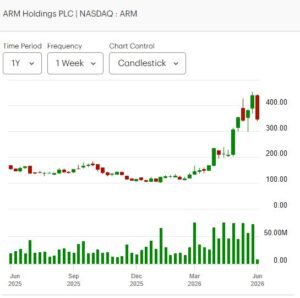
Not all semiconductor companies participated in the rally. Arm Holdings Plc. (ARM) fell 3.17% to $347.71, extending its recent pullback after posting exceptional year-to-date gains. ARM has now declined approximately 10% on Tuesday, 1.99% on Wednesday, and 3.17% on Thursday, suggesting continued profit-taking following its strong advance earlier this year.
Market Outlook
Thursday’s trading reflected a healthy rotation rather than broad market weakness. Strength in the Dow Jones, Russell 2000, Healthcare, Industrials, Financials, and Materials offset continued selling pressure in large-cap technology stocks.
The divergence between the NYSE and NASDAQ remains an important development. While the NYSE continues to exhibit improving breadth and expanding new highs, the NASDAQ remains technically weaker as investors rotate away from high-growth names.
Until the NASDAQ reclaims its 50-day moving average and market breadth improves, technology stocks may continue to experience higher volatility. Conversely, strength in small-cap, industrial, financial, and commodity-related stocks suggests that investors continue to broaden their equity exposure rather than exit the market altogether.
Key Takeaways for Traders and Investors
- Market leadership continues to rotate. Small-cap, value, healthcare, industrial and financial stocks remain the market’s strongest areas, while technology continues to consolidate.
- The Russell 2000 remains a leadership index, reaching another record closing high and signalling improving investor confidence in economically sensitive companies.
- NYSE internals remain constructive, with positive market breadth and a significant increase in new 52-week highs, supporting the broader market’s underlying strength.
- NASDAQ technicals remain cautious. The index has now closed below its 50-day moving average for four consecutive sessions, while new lows continue to exceed new highs.
- Semiconductor stocks remain selective opportunities. Strong earnings from Micron sparked broad gains across storage and chip-related companies, demonstrating that high-quality earnings can still drive substantial upside even in a challenging technology environment.
- Watch interest rates closely. Declining Treasury yields continue to support small-cap and cyclical sectors. If yields remain contained, the current market rotation could continue. A renewed rise in yields, however, may shift market leadership once again.
.
NOTICE TO READERS
The Canadian Vanguard Stock Market is about empowering you to build and manage your wealth by yourself. There is certainly no magic in managing finances or wealth but one needs to know what to do and commit to doing what is needed. When you are ready to start the journey to Take Charge and Put Your Destiny In Your Own Hands, read The Canadian Vanguard every market day. If you need more related information, Contact Us
Our readers are strongly advised to conduct their own research into individual stocks before making a purchase decision. In addition, investors are advised that past stock performance is no guarantee of future price appreciation. Any recommendation is not a guarantee of any particular stock’s future prices, and The Canadian Vanguard accepts no responsibility or liability for investors’ or readers’ purchases.
Stocks In The News/ Stocks To Watch and Market Strategy will soon be available only to Paying Subscribers. The dollar sign “$” in the Toronto Market section in the articles only stands for Canadian dollar and in the US market section “$” stands for US dollar.
(c) This article is published by The Canadian Vanguard on June 25, 2026