







Markets Retreat as Investors Continue Rotation Out of Technology and AI Stocks
The Canadian Vanguard Stock Market Report Wednesday June 24, 2026 Edition
.
The Toronto Market
Wednesday’s Toronto Market Index
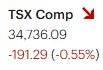
The S&P/TSX Composite Index fell 191.29 points (-0.55%) on Wednesday, closing at 34,736.09. The index opened approximately 200 points below the previous session’s close and remained in negative territory throughout the trading day.
Selling pressure intensified late in the afternoon, pushing the index to its session low of nearly 1% below the prior close. However, a sharp rebound in the final minutes of trading lifted the index significantly off its lows, resulting in a much stronger finish.
From a technical perspective, the TSX remains above both its 50-day and 200-day moving averages, indicating that the longer-term uptrend remains intact. The index finished the session near its 25-day moving average, which may serve as an important short-term support level.
Wednesday’s TSX Market Statistics
Market breadth on the TSX remained negative on Wednesday, with declining issues outnumbering advancing issues. There were 1,262 decliners compared with 923 advancers, resulting in a decliner-to-advancer ratio of 1.36 to 1, or roughly seven decliners for every five advancers. An additional 129 issues closed unchanged.
The exchange recorded 115 new 52-week highs and 72 new 52-week lows, compared with 90 new highs and 45 new lows on Tuesday. While new highs continued to outpace new lows, the increase in both categories suggests heightened stock-specific activity across the market.
Total trading volume reached 512.1 million shares, up 6% from the 483.6 million shares traded on Tuesday. Trading activity has increased steadily since the start of the week, with volume rising from 446.1 million shares on Monday to 483.6 million on Tuesday (+4%), and then to 512.1 million on Wednesday (+6%).
Although market breadth has been negative for three consecutive trading sessions, the rising volume does not appear to reflect widespread panic selling. Instead, the increase in trading activity suggests continued investor engagement and healthy market participation, even as the broader market experiences short-term weakness. This is generally a constructive sign for overall market conditions.
Wednesday’s TSX Toronto Market Wrap-Up Report
The S&P/TSX Composite Index declined 191.29 points (-0.55%) on Wednesday to close at 34,736.09, marking its second consecutive daily decline. The index opened approximately 200 points below Tuesday’s close and remained in negative territory throughout the session. Selling pressure intensified late in the afternoon, pushing the index to nearly 1% below the previous close before a sharp rally in the final minutes lifted the market well off its lows.
Despite the decline, the TSX remains above its 50-day and 200-day moving averages, preserving the longer-term bullish trend. The index closed near its 25-day moving average, which now represents an important short-term support level.
Market breadth remained negative for a third consecutive session. Declining issues totaled 1,262 compared with 923 advancing issues, resulting in a decliner-to-advancer ratio of 1.36-to-1. Although the broad market weakened, trading volume continued to expand, reaching 512.1 million shares, up 6% from Tuesday’s volume and up 15% from Monday’s volume. The steady increase in volume suggests heightened market participation rather than panic selling, an encouraging sign for investors monitoring the health of the current market pullback.
Sector performance was mixed, with six of the ten major sectors advancing. Technology was the clear leader, rising 4.27%, followed by Durable Consumer Goods & Services (+2.35%), Discretionary Consumer Goods & Services (+1.41%), Healthcare (+1.09%), Industrials (+0.90%), and Utilities (+0.64%).
The strong performance by Technology was notable given the recent rotation away from technology stocks observed in the U.S. market. Canadian technology stocks demonstrated resilience and attracted significant investor interest during Wednesday’s session.
The Financials sector, which carries the largest weighting within the TSX Composite Index, slipped 0.25%. Meanwhile, the weakest sectors were Basic Materials (-3.65%) and Energy (-1.84%). The pronounced weakness in metals and mining shares weighed heavily on the broader market and was the primary reason the index finished lower despite strength in several sectors.
The standout performer of the day was Shopify Inc. (SHOP), which surged 6.12% to close at $162.59. Shopify accounted for substantial trading activity and provided much of the leadership within the Technology sector. Market participants responded positively to reports that the company will prohibit the sale of vape products through its platform. The stock currently trades around its 25-day and 50-day moving averages but remains below its 200-day moving average. Aggressive investors may view the recent strength as an early recovery signal, while more conservative investors may prefer to wait for a decisive move above the longer-term trend line before establishing new positions.
Another notable technology name, Celestica Inc. (CLS), gained 3.49% and closed at $516.77, further highlighting the strength of the sector.
Financial stocks generally underperformed. All six major Canadian banks finished lower on the session, reflecting continued caution toward the sector. Manulife Financial Corp. declined 0.88% to close at $56.55 on volume of 4.3 million shares.
The TSX also recorded 115 new 52-week highs versus 72 new 52-week lows. While new highs continued to outnumber new lows, the increase in both figures points to elevated stock-specific volatility and active sector rotation beneath the market’s surface.
Key Takeaways for Traders and Investors
• The TSX has now declined for two consecutive sessions, but the longer-term trend remains positive as the index continues to trade above its 50-day and 200-day moving averages.
• Market breadth has been negative for three consecutive sessions, indicating underlying weakness across the broader market despite strength in selected sectors.
• Rising trading volume over the past three sessions suggests increased investor participation rather than widespread liquidation or panic selling.
• Technology stocks are showing relative strength and leadership within the Canadian market, led by Shopify and Celestica.
• Weakness in Basic Materials and Energy remains a headwind for the TSX and bears close monitoring, particularly if commodity prices continue to soften.
• Financials remain under pressure, with all major Canadian banks finishing lower on Wednesday.
• The sharp recovery from the day’s lows demonstrates that buyers remain active on market weakness, suggesting that institutional investors may still be supporting the broader market.
Overall, Wednesday’s session reflected a market undergoing sector rotation rather than one entering a broad-based correction. While market breadth remains weak, the combination of rising volume, strong technology leadership, and the late-session recovery suggests that investor confidence has not materially deteriorated.
.
The US Markets
Wednesday’s U.S. Market Indexes
U.S. equity markets delivered a mixed performance on Wednesday, with investors continuing to rotate away from large-cap technology stocks and into more cyclical and value-oriented sectors.
The Dow Jones Industrial Average gained 182.06 points (0.35%) to close at 51,848.90, while the Russell 2000 Index advanced 11.15 points (0.37%) to finish at 2,986.63. In contrast, the technology-heavy Nasdaq Composite declined 110.40 points (-0.43%) to close at 25,476.64, and the S&P 500 slipped 7.24 points (-0.10%) to end the session at 7,358.22.

Trading activity was relatively orderly throughout the day. There were no significant sell-offs or panic-driven declines, but there was also a lack of strong buying conviction. Overall, Wednesday’s session was characterized by modest gains and losses as investors continued to reposition portfolios among sectors.
Market internals revealed a clear divergence between technology stocks and the broader market. The Dow Jones Industrial Average and Russell 2000 traded in positive territory throughout the session and exhibited nearly identical intraday trading patterns. Both indexes demonstrated resilience and steady buying interest from the opening bell to the closing bell.
The Nasdaq Composite and S&P 500 followed a different path. Both indexes opened slightly above Tuesday’s close before pulling back during the first half hour of trading. They subsequently recovered and traded near session highs through midday before renewed selling pressure emerged during the afternoon. Both indexes declined below their previous closes before staging modest recoveries late in the session.
From a technical perspective, the Nasdaq delivered a significantly improved performance compared with Tuesday’s sharp decline. More importantly, Wednesday’s intraday low remained well above the recent support zone, suggesting that buyers continue to defend key technical levels.
However, the Nasdaq closed just below its 50-day moving average, which remains a short-term concern for investors. The positive aspect is that the index remains close to this technical level, meaning only a modest improvement in technology-sector performance would be required to push the Nasdaq back above its 50-day moving average and restore a stronger technical outlook.
The S&P 500 continues to display relative strength, remaining above its 50-day moving average despite Wednesday’s modest decline. This suggests that the broader market trend remains constructive even as technology stocks experience a period of consolidation.
Key Takeaways for Traders and Investors
• Market leadership continues to rotate away from mega-cap technology stocks and toward industrial, financial, value, and small-cap names.
• The Dow Jones and Russell 2000 outperformed both the Nasdaq and S&P 500, highlighting improving investor interest in economically sensitive sectors.
• The Nasdaq remains under technical pressure while trading below its 50-day moving average, but the index is close enough to reclaim this level with only modest buying support.
• The S&P 500 remains in a healthier technical position, continuing to trade above its 50-day moving average.
• Wednesday’s trading lacked signs of panic selling, suggesting investors are reallocating capital rather than exiting the market altogether.
• The fact that the Nasdaq’s intraday low remained above recent support levels is encouraging and indicates that buyers are still willing to step in on weakness.
Market Outlook
The current market environment appears to be one of sector rotation rather than broad market deterioration. Technology stocks remain under pressure after their strong advances earlier in the year, while investors are increasingly seeking opportunities in other areas of the market. As long as the S&P 500 remains above key support levels and the Nasdaq holds above its recent lows, the broader bullish trend remains intact.
Traders should continue to monitor whether the Nasdaq can regain its 50-day moving average in the coming sessions, as this would likely signal renewed momentum in the technology sector and provide additional support for the broader market.
.
Wednesday’s U.S. Market Statistics
New York Stock Exchange (NYSE): Market breadth on the NYSE was slightly negative on Wednesday, with declining issues narrowly exceeding advancing issues. There were 2,290 decliners compared with 2,227 advancers, while 458 issues closed unchanged. This produced a decliner-to-advancer ratio of approximately 1.03-to-1, indicating a relatively balanced market with only a modest bearish bias.
The NYSE recorded 205 new 52-week highs and 226 new 52-week lows, compared with 120 new highs and 189 new lows on Tuesday. Although new lows outnumbered new highs, the sharp increase in both categories suggests elevated stock-specific volatility and active sector rotation rather than broad market weakness.
Trading activity increased notably during the session. Total NYSE volume reached 6.16 billion shares, up 6% from Tuesday’s volume of 5.79 billion shares. Rising volume accompanied by only slightly negative market breadth suggests that investors remained actively engaged in the market and were selectively repositioning portfolios rather than broadly reducing equity exposure.
NASDAQ: Market breadth was also modestly negative on the NASDAQ, where declining stocks outnumbered advancing stocks by a narrow margin. The exchange recorded 2,566 decliners and 2,354 advancers, producing a decliner-to-advancer ratio of 1.09-to-1. An additional 314 issues closed unchanged.
The NASDAQ posted 241 new 52-week highs and 281 new 52-week lows. While new lows continued to exceed new highs, the gap narrowed considerably compared with recent sessions. New highs increased substantially from Tuesday’s total of 156, while new lows remained virtually unchanged at 281 versus 282 the previous day. This improvement suggests that buying interest remains present beneath the surface despite the recent weakness in technology stocks.
Total trading volume on the NASDAQ reached 15.89 billion shares, an increase of 3% from Tuesday’s 15.45 billion shares. The rise in volume reflects continued investor participation and confirms that technology and growth stocks remain an active area of focus for market participants.
Technical Perspective
The most significant development for traders remains the Nasdaq Composite’s close below its 50-day moving average. While the breach is relatively small, it represents a deterioration in the index’s short-term technical picture and warrants increased caution toward technology and growth-oriented stocks.
A close below the 50-day moving average does not necessarily signal the beginning of a major correction. However, it does suggest that upside momentum has weakened and that investors should become more selective when initiating new technology positions. Traders may wish to monitor whether the Nasdaq can quickly reclaim its 50-day moving average in the coming sessions. A successful recovery would likely restore confidence in the sector, while additional weakness could trigger further profit-taking among technology stocks.
Key Takeaways for Traders and Investors
• Market breadth was only modestly negative on both the NYSE and NASDAQ, indicating that selling pressure was relatively contained.
• Trading volume increased on both exchanges, reflecting active portfolio repositioning rather than panic selling.
• New 52-week highs increased substantially on both exchanges, suggesting that pockets of market strength remain intact despite broader market consolidation.
• The Nasdaq’s close below its 50-day moving average is a cautionary signal for technology investors and growth-stock traders.
• The rise in both volume and new highs suggests the market is experiencing sector rotation rather than broad-based liquidation.
• Investors should remain selective, focusing on stocks demonstrating relative strength while closely monitoring whether the Nasdaq can regain its 50-day moving average.
Market Outlook: Wednesday’s statistics point to a market that remains fundamentally healthy but is undergoing an important transition. Market participation remains strong, trading volume is rising, and many stocks continue to achieve new 52-week highs. However, the weakness in technology shares and the Nasdaq’s move below its 50-day moving average suggest that leadership is shifting away from some of the market’s strongest-performing sectors.
For now, the data supports a cautious but constructive outlook. Investors should respect the short-term weakness in technology while recognizing that broader market conditions do not yet indicate widespread risk aversion or a significant deterioration in investor sentiment.
Wednesday’s U.S. Market Wrap-Up Report
U.S. equity markets delivered a mixed performance on Wednesday as investors continued rotating capital away from large-cap technology stocks and into more defensive and value-oriented sectors. While the technology-heavy Nasdaq Composite and the S&P 500 finished modestly lower, the Dow Jones Industrial Average and the Russell 2000 posted gains, with the Russell 2000 emerging as the strongest-performing major index of the day.
The Dow Jones Industrial Average rose 182.06 points (0.35%) to close at 51,848.90, while the Russell 2000 advanced 11.15 points (0.37%) to 2,986.63. The S&P 500 slipped 7.24 points (-0.10%) to 7,358.22, and the Nasdaq Composite fell 110.40 points (-0.43%) to 25,476.64.
Market conditions continued to normalize following the elevated volatility experienced during the geopolitical tensions in the Middle East earlier this year. Wednesday’s trading was characterized by modest gains and losses rather than broad-based directional moves, suggesting that investors remain engaged but selective.
Market breadth was only slightly negative. On the New York Stock Exchange, decliners outnumbered advancers by a narrow margin of 2,290 to 2,227. The Nasdaq displayed similar conditions, with 2,566 declining stocks versus 2,354 advancing stocks. The relatively balanced breadth indicates that selling pressure remains contained despite weakness in several high-profile technology names.
Trading activity increased on both exchanges. NYSE volume rose 6% to 6.16 billion shares, while Nasdaq volume increased 3% to 15.89 billion shares. Rising volume accompanied by only modestly negative breadth suggests portfolio repositioning and sector rotation rather than panic selling.
Sector performance reflected investors’ preference for defensive and economically stable areas of the market. Utilities led all sectors with a gain of 1.04%, followed by Healthcare (+0.96%) and Durable Consumer Goods & Services (+0.70%).
Technology declined 0.50%, continuing the recent pullback in growth-oriented stocks. Financials also weakened, losing 0.87%, while Basic Materials fell 1.13%. Energy was the weakest-performing sector, declining 2.21% and finishing as the market’s laggard.
A major theme throughout Wednesday’s session was the continued weakness among semiconductor and chip-related stocks. However, unlike Tuesday’s broad-based selling, Wednesday’s declines were more selective and less severe.
Among semiconductor stocks, Arm Holdings Plc declined 1.99%, AMD slipped 0.15%, and Intel Corporation lost 0.28%. Arm’s performance was noteworthy because the stock had fallen approximately 10% on Tuesday and was down as much as 4% intraday Wednesday before recovering significantly into the close.
Storage and memory-related technology stocks also faced pressure. Western Digital Corporation fell 3.93%, while Seagate Technology declined 4.28%. In contrast, Micron Technology demonstrated relative strength, finishing down only 0.37% ahead of its highly anticipated earnings release.
The most significant market-moving event of the day occurred after the closing bell when Micron Technology reported quarterly earnings that exceeded analyst expectations across key financial metrics. Investors responded enthusiastically, sending Micron shares approximately 14% higher in after-hours trading.
Micron’s earnings report could prove to be a pivotal catalyst for the broader technology sector and the Nasdaq Composite. The report suggests that demand trends within artificial intelligence, high-performance computing, and memory markets remain robust despite recent concerns surrounding technology valuations.
From a technical perspective, the Nasdaq remains the key index to watch. Although the index delivered a much-improved performance relative to Tuesday’s sharp decline, it still closed slightly below its 50-day moving average. This represents a short-term caution signal for traders and investors focused on technology stocks.
However, the Nasdaq’s intraday low remained comfortably above recent support levels, and the index is only marginally below its 50-day moving average. If investors react positively to Micron’s earnings report and renewed confidence emerges across semiconductor and AI-related stocks, the Nasdaq could quickly reclaim this important technical level.
Meanwhile, the S&P 500 continues to hold above its own 50-day moving average, indicating that the broader market remains in a healthier technical position than the technology sector.
Key Takeaways for Traders and Investors
• The Russell 2000 and Dow Jones outperformed, signaling continued investor interest in small-cap, value-oriented, and economically sensitive stocks.
• Market breadth was only modestly negative despite weakness in technology shares, suggesting that selling pressure remains controlled.
• Rising trading volume on both the NYSE and Nasdaq indicates active portfolio repositioning rather than widespread risk aversion.
• Defensive sectors such as Utilities and Healthcare attracted buying interest, while Energy and Technology lagged.
• Semiconductor stocks remain under pressure, but Wednesday’s declines were significantly less severe than Tuesday’s broad sell-off.
• Micron Technology’s stronger-than-expected earnings report may become an important catalyst for technology stocks and the Nasdaq Composite.
• The Nasdaq remains below its 50-day moving average, warranting caution among growth-stock investors, but only modest buying strength would be required to reclaim this level.
• The S&P 500 remains above its 50-day moving average, suggesting the broader market uptrend remains intact.
Market Outlook: Wednesday’s market action reinforces the view that the U.S. market is experiencing sector rotation rather than broad deterioration. Investors continue shifting capital away from some of the year’s strongest-performing technology stocks while maintaining exposure to defensive, value, and small-cap sectors.
The next major test for the market will likely come from investor reaction to Micron’s earnings results. A positive follow-through in semiconductor and AI-related stocks could help lift the Nasdaq back above its 50-day moving average and potentially restore leadership to the technology sector. Until then, traders should remain selective, emphasizing relative strength while closely monitoring whether the Nasdaq can regain key technical support in the coming sessions.
.
NOTICE TO READERS
The Canadian Vanguard Stock Market is about empowering you to build and manage your wealth by yourself. There is certainly no magic in managing finances or wealth but one needs to know what to do and commit to doing what is needed. When you are ready to start the journey to Take Charge and Put Your Destiny In Your Own Hands, read The Canadian Vanguard every market day. If you need more related information, Contact Us
Our readers are strongly advised to conduct their own research into individual stocks before making a purchase decision. In addition, investors are advised that past stock performance is no guarantee of future price appreciation. Any recommendation is not a guarantee of any particular stock’s future prices, and The Canadian Vanguard accepts no responsibility or liability for investors’ or readers’ purchases.
Stocks In The News/ Stocks To Watch and Market Strategy will soon be available only to Paying Subscribers. The dollar sign “$” in the Toronto Market section in the articles only stands for Canadian dollar and in the US market section “$” stands for US dollar.
(c) This article is published by The Canadian Vanguard on June 24, 2026