


Soft Jobs Report Fuels Strong, Broad-Based Market Rally
The Canadian Vanguard Stock Market Report weekend, October 2 – 4, 2026, Edition
.
The Toronto Market
Friday’s Toronto Market Index
The S&P/TSX Composite Index rose 347.89 points, or 0.99%, to close at 35,502.65.
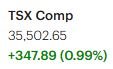


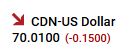
The TSX reversed its recent downward trend on Friday, posting a strong gain of nearly 1% after four consecutive sessions of declines. Friday’s advance was strong enough to erase the losses from the previous three sessions. Market breadth was positive and robust, with broad-based buying supporting the index. The TSX opened strongly and maintained its upward momentum throughout the session, closing near the day’s highs and recording its strongest performance of the week.
Despite Friday’s rally, the TSX remains below both its 25-day and 50-day moving averages. However, the index continues to trade comfortably above its 200-day moving average, indicating that the longer-term trend remains relatively constructive.
Friday’s TSX Market Statistics
At the TSX, advancing issues (advancers) significantly outnumbered declining issues (decliners). Specifically, there were 1,560 advancers and 650 decliners, with 135 issues unchanged. This produced a raw advancer-to-decliner ratio of approximately 2.40 to 1, or about 12 advancers for every five decliners.
The exchange recorded 110 new 52-week highs and 87 new 52-week lows, compared with 37 new 52-week highs and 201 new 52-week lows on Thursday. Market breadth was strongly positive on Friday, ending a stretch of four consecutive sessions of weak market breadth.
The ratio of new 52-week highs to new 52-week lows also improved significantly, with new highs outnumbering new lows for the first time in approximately two weeks. These market internals provided encouraging signs of improvement on Friday. However, as we have frequently pointed out, a single market session should not be used as the basis for drawing conclusions about the market’s overall trend.
Market internals had weakened repeatedly over the past several sessions, but Friday’s improvement could be significant if it proves to be the beginning of a new trend. Particularly encouraging was the sharp decline in the number of new 52-week lows, which fell by approximately 57% from Thursday’s level.
Total volume on the TSX reached 416,508,460 shares, compared with 413,324,869 shares traded on Thursday. Trading volume was therefore essentially unchanged from the previous session.
Overall, Friday’s market internals showed a meaningful improvement in breadth and in the relationship between new 52-week highs and lows. Nevertheless, investors should avoid drawing long-term conclusions from a single session. Friday’s performance could represent the early stages of a new positive trend, but confirmation from subsequent sessions will be necessary.
For now, traders and investors should remain alert for evidence of a sustained improvement in market internals while continuing to exercise some caution until a clearer trend becomes established.
Friday’s Toronto TSX Market Wrap-Up Report
The Toronto Stock Exchange delivered its strongest session of the week on Friday, with the S&P/TSX Composite Index advancing 347.89 points, or 0.99%, to close at 35,502.65. The gain ended a four-session losing streak and represented a significant reversal of the recent downward trend.
Market participation was notably stronger. Advancing issues substantially outnumbered declining issues, with 1,560 advancers versus 650 decliners and 135 issues unchanged. New 52-week highs also outnumbered new 52-week lows, with 110 new highs compared with 87 new lows. This was a meaningful improvement from Thursday, when the exchange recorded only 37 new highs against 201 new lows.
The improvement in market breadth and the sharp decline in the number of new 52-week lows are encouraging signs that the market internals may be beginning to stabilize after several sessions of deterioration. However, traders and investors should be careful not to interpret one strong session as confirmation of a new market trend. Further improvement over the next several sessions will be important.
Eight of the major TSX sectors finished higher on Friday, led by Basic Materials, which gained 1.53%. Industrials advanced 1.45%, Technology rose 1.23%, Energy gained 0.96%, and Financials added 0.61%. Mining and resource-related stocks were among the principal drivers of Friday’s advance.
Telecommunications slipped 0.12%, while Healthcare was the session’s weakest major sector, falling 0.87%.
Despite Friday’s strong performance, the TSX remains below both its 25-day and 50-day moving averages. The index, however, continues to trade well above its 200-day moving average. This leaves the short- and intermediate-term picture somewhat mixed, while the longer-term trend remains considerably more constructive.
Canadian Banks Rebound
Canadian bank stocks participated in Friday’s market recovery after several sessions of relative underperformance.
Canadian Imperial Bank of Commerce (CM) was the strongest performer among the major bank stocks mentioned here, rising 1.14% to close at $158.27 on volume of approximately 2.39 million shares.
Bank of Nova Scotia (BNS) gained 0.71% to close at $129.73, with approximately 5.9 million shares traded.
Bank of Montreal (BMO), however, bucked the broader banking-sector recovery, slipping 0.16% to close at $236.25 on approximately 2.81 million shares.
The broader financial sector’s 0.61% gain is nevertheless worth watching, particularly if financial stocks continue to participate in any further recovery in the TSX.
Shopify Continues to Move Higher
Shopify Inc. (SHOP) continued its recent upward momentum on Friday, advancing 1.77% on approximately 2.52 million shares traded.
The stock has now gained for five consecutive sessions. More importantly, the advance has not yet pushed the stock into what appears to be an excessively extended position. This leaves room for additional upside if momentum continues, although traders should remain disciplined and avoid chasing the stock after an unusually strong move.
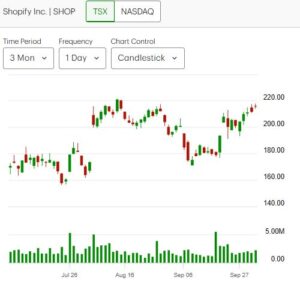
A stock can continue rising after becoming extended, but the risk-reward relationship generally becomes less attractive as the price moves substantially above its normal trading range or key technical levels. Traders considering new positions should therefore pay attention not only to momentum but also to entry price and potential downside risk.
Stocks to Watch
Bird Construction Inc. and Aecon Group Inc. remain stocks worth keeping on the watchlist, particularly if the broader industrial and infrastructure-related groups continue to attract buying interest.
Precision Drilling has also become interesting from a trend perspective. The stock had been trending lower since September 2 but reversed direction three sessions ago and has since shown signs of establishing a short-term uptrend. Traders should watch to see whether this reversal develops into a sustained move or simply represents a temporary bounce within a broader consolidation.
Market Internals: An Encouraging Change
Perhaps the most important feature of Friday’s session was not simply the 0.99% gain in the TSX, but the improvement in the underlying market internals.
The number of advancers was more than twice the number of decliners, while new 52-week highs exceeded new 52-week lows for the first time in approximately two weeks. Even more encouraging, new 52-week lows fell sharply from Thursday’s level, declining by approximately 57%.
These changes suggest that the deterioration in market breadth seen during the previous several sessions may be losing momentum.
Nevertheless, one session does not establish a trend. The key question for traders and investors now is whether Friday’s improvement will be followed by additional sessions of strong breadth, expanding new highs, declining new lows, and continued participation across the major sectors.
Total TSX trading volume was approximately 416.5 million shares, essentially unchanged from the 413.3 million shares traded on Thursday. The strong price advance therefore occurred without a major increase in overall volume.
Key Takeaways for Traders and Investors
- Friday was an important technical improvement. The TSX broke a four-session losing streak and posted its strongest performance of the week.
- Market breadth improved substantially. Advancers significantly outnumbered decliners, reversing the weak breadth seen during the previous four sessions.
- New-high/new-low statistics improved. New 52-week highs exceeded new 52-week lows, while new lows declined sharply from Thursday’s level.
- The improvement needs confirmation. Traders should look for continued strength in market breadth and internals before concluding that a sustainable new uptrend has begun.
- The moving-average picture remains mixed. The TSX is still below its 25-day and 50-day moving averages but remains comfortably above its 200-day moving average.
- Financials and resource-related stocks deserve attention. Both groups contributed to Friday’s advance and could provide important clues about whether the broader recovery can continue.
- Shopify remains on the watchlist. Five consecutive advancing sessions are encouraging, but traders should avoid chasing the stock if it becomes technically extended.
- Precision Drilling is showing a potential trend reversal. The recent change in direction is worth monitoring for confirmation.
- Caution remains appropriate. Friday’s session was encouraging, but traders and investors should allow subsequent market action to confirm whether this is the beginning of a new upward trend or simply a strong one-day rebound.
Bottom Line
Friday provided the TSX with a much-needed improvement in both price action and market internals. The combination of a nearly 1% index gain, strong market breadth, a sharp reduction in new 52-week lows, and new highs once again exceeding new lows represents a meaningful improvement over the weakness seen during the previous several sessions.
The next few trading sessions will be important. If Friday’s improvement is followed by continued broad-based buying and further strengthening of the market internals, the probability of a more durable recovery will increase. Until that confirmation arrives, however, traders and investors should remain selective and maintain a degree of caution.
.
The US Markets
Friday’s U.S. Market Indexes
U.S. equities staged a strong rebound on Friday, with all four major indexes finishing higher and recovering significantly from the weakness experienced earlier in the week.
The Dow Jones Industrial Average rose 250.40 points, or 0.49%, to close at 51,176.96. The S&P 500 gained 56.97 points, or 0.73%, finishing at 7,722.72. The Nasdaq Composite was the strongest performer, advancing 319.27 points, or 1.19%, to close at 27,190.86. The Russell 2000 also performed well, rising 26.27 points, or 0.94%, to finish at 2,832.89.

Friday was clearly a positive session for the U.S. market, with the Nasdaq leading the advance. The strong performance helped the major indexes recover from the weakness seen earlier in the week. However, despite Friday’s substantial gains, the weekly results remained mixed. The Nasdaq finished the week up approximately 0.50%, while the S&P 500 declined about 0.30% for the week.
The market’s Friday advance was supported by a softer-than-expected jobs report, which appeared to ease concerns about the labor market and potentially provided investors with a more favorable interest-rate outlook. The 10-year Treasury note yield fell by approximately four basis points, while oil prices were slightly lower.
Technical Picture
The technical picture remains mixed across the major indexes.
The Nasdaq Composite continues to show the strongest technical position. Following Friday’s advance, the index is trading well above its 25-day, 50-day, and 200-day moving averages. This indicates that the Nasdaq remains in a strong technical position despite some weakness earlier in the week.
The S&P 500 is trading below its 25-day moving average but remains above both its 50-day and 200-day moving averages. This suggests some short-term weakness but a more constructive intermediate- and longer-term trend.
The Dow Jones Industrial Average remains below both its 25-day and 50-day moving averages. It is still trading slightly above its 200-day moving average, but the gap between the index and its 200-day moving average continues to narrow. This is an area that traders should monitor closely because a decisive break below the 200-day moving average would represent a meaningful deterioration in the Dow’s longer-term technical picture.
The Russell 2000 remains the weakest of the four major indexes from a moving-average perspective. It continues to trade well below its 25-day and 50-day moving averages while remaining only slightly above its 200-day moving average. Small-cap stocks therefore continue to warrant caution, particularly if the index loses its 200-day moving average.
Key Takeaways for Traders and Investors
-
Friday was a strong recovery session. All four major U.S. indexes advanced, with the Nasdaq leading the market higher.
-
The Nasdaq remains technically strongest. It is trading above its 25-day, 50-day, and 200-day moving averages.
-
The S&P 500 remains constructive longer term. Although it is below its 25-day moving average, it remains above its 50-day and 200-day moving averages.
-
The Dow requires closer monitoring. It remains below its 25-day and 50-day moving averages, and its cushion above the 200-day moving average continues to shrink.
-
Small caps remain vulnerable. The Russell 2000 is below both its 25-day and 50-day moving averages and is only slightly above its 200-day moving average.
-
Friday’s strength does not completely erase the week’s weakness. The Nasdaq finished the week only modestly higher, while the S&P 500 remained down for the week.
-
The next several sessions will be important. Traders should watch whether Friday’s rebound develops into sustained buying or proves to be only a short-term recovery.
Bottom Line
Friday’s market action was encouraging, particularly because all four major indexes participated in the advance. The Nasdaq’s 1.19% gain and position well above its major moving averages remain especially positive. However, the technical picture is not uniformly strong. The Dow and Russell 2000 are approaching important longer-term support around their 200-day moving averages, while the S&P 500 remains below its 25-day moving average.
For now, traders should view Friday’s advance as a positive improvement rather than definitive confirmation of a new market uptrend. Continued strength in the coming sessions, particularly if accompanied by improving breadth and participation, would provide stronger evidence that Friday’s rebound is becoming a more durable market recovery.
Friday’s U.S. Market Statistics
New York Stock Exchange (NYSE): Market breadth on the New York Stock Exchange improved on Friday, with advancing issues outnumbering declining issues. There were 1,680 advancers, 1,079 decliners, and 76 unchanged issues, producing an advancer-to-decliner ratio of approximately 1.56 to 1—or roughly six advancers for every four decliners.
The NYSE recorded 36 new 52-week highs and 134 new 52-week lows, compared with 97 new highs and 744 new lows on Thursday. While the number of new highs declined by approximately 63% from Thursday, the much more significant development was the sharp reduction in new 52-week lows. New lows fell from 744 to 134, a decline of approximately 82%.
Although new 52-week lows continued to substantially outnumber new highs, the ratio improved considerably. New highs represented approximately 27% of new lows on Friday, compared with only about 13% on Thursday. This represents a meaningful improvement in the internal condition of the NYSE, even though the overall new-high/new-low picture remains weak.
Total NYSE trading volume reached approximately 5.38 billion shares, about 10% below Thursday’s 5.97 billion shares. Trading activity was nevertheless close to the recent 50-day average range.
Overall, NYSE market breadth was positive on Friday, and the dramatic decline in new 52-week lows was encouraging. However, the market internals remain weakened because new lows continue to substantially outnumber new highs. Traders and investors should therefore interpret Friday’s improvement as a positive development, but not yet as confirmation that the market internals have fully recovered.
NASDAQ: The Nasdaq also recorded positive market breadth on Friday. There were 2,851 advancing issues versus 2,087 declining issues, with 195 issues unchanged. This produced an advancer-to-decliner ratio of approximately 1.36 to 1, indicating a reasonably broad participation in Friday’s advance.
The Nasdaq recorded 129 new 52-week highs and 288 new 52-week lows, compared with 68 new highs and 528 new lows on Thursday.
The improvement in the Nasdaq’s new-high/new-low statistics was particularly encouraging. New 52-week highs increased by approximately 90% from Thursday, while new 52-week lows declined by approximately 45%. The ratio of new highs to new lows therefore improved substantially.
Despite this improvement, new lows still more than doubled new highs. The Nasdaq’s internal indicators consequently remain weakened, although they are showing clearer signs of improvement than in recent sessions.
The persistence of substantially more new 52-week lows than new highs remains a concern. However, the direction of the change is encouraging: new highs are increasing while new lows are declining. If this trend continues over the next several sessions, it would provide stronger evidence that Nasdaq market internals are beginning to recover.
Total Nasdaq trading volume was approximately 8.01 billion shares, about 5% higher than Thursday’s 7.61 billion shares.
.
Market Internals: Improvement, but Not Yet a Confirmation
Friday’s market internals presented a mixed but improving picture.
The most encouraging development was the sharp reduction in new 52-week lows on both exchanges. On the NYSE, new lows fell by more than 80%, while Nasdaq new lows declined by approximately 45%. At the same time, Nasdaq new highs increased substantially.
Market breadth was also positive on both exchanges, with advancing issues outnumbering declining issues.
However, the overall internal picture remains weakened because new 52-week lows continue to exceed new 52-week highs by a considerable margin on both exchanges. This means that, despite Friday’s improvement, the market has not yet produced sufficient evidence to conclude that the deterioration in market internals has been reversed.
Another important consideration is that Friday’s strong advance in the Nasdaq occurred alongside a retreat in Treasury yields. Traders should therefore determine whether the improvement can persist if yields stabilize or begin moving higher again.
Key Takeaways for Traders and Investors
- Breadth improved on both exchanges. Advancers outnumbered decliners on both the NYSE and Nasdaq.
- New 52-week lows dropped sharply. This was perhaps the most encouraging development in Friday’s market internals.
- Nasdaq internals showed particularly meaningful improvement. New highs increased by approximately 90%, while new lows declined by about 45%.
- The NYSE remains weaker internally. New lows still substantially outnumber new highs despite the sharp improvement from Thursday.
- The internal recovery needs confirmation. Several consecutive sessions of improving breadth, rising new highs, and declining new lows would provide much stronger evidence of a sustainable improvement.
- Friday’s Nasdaq rally should be viewed in the context of Treasury yields. The retreat in yields helped support growth and technology stocks, so traders should watch the relationship between yields and the Nasdaq closely.
- Volume did not provide a uniformly strong confirmation. NYSE volume declined approximately 10%, while Nasdaq volume increased about 5%.
- Caution remains appropriate. The market is showing signs of improvement, but the internal indicators have not yet returned to a strong or healthy condition.
Bottom Line
Friday’s market statistics were better than Thursday’s but not yet strong enough to signal a confirmed change in market trend. The combination of positive breadth, a dramatic decline in new 52-week lows, and a substantial increase in Nasdaq new highs is encouraging.
The most important issue now is whether this improvement continues. If new lows continue to decline, new highs begin to expand, and advancing issues continue to dominate declining issues, the market’s internal condition could improve considerably.
For now, traders and investors should recognize the improvement without becoming overly aggressive. The market may be attempting to establish a new upward direction, but several more sessions of confirmation are needed before the recent weakness can be considered decisively reversed.
Friday’s U.S. Market Wrap-Up Report
U.S. stocks staged a strong rebound on Friday, with all four major indexes advancing as investors responded positively to a weaker-than-expected jobs report. The report appeared to ease some concerns about the labor market and helped push Treasury yields lower, providing additional support for equities, particularly growth and technology stocks.
The Dow Jones Industrial Average rose 0.49%, the S&P 500 gained 0.73%, the Nasdaq Composite advanced 1.19%, and the Russell 2000 climbed 0.94%. The Nasdaq was the strongest performer among the four major indexes.
The market’s breadth was also positive. Advancing stocks outnumbered declining stocks on both the NYSE and Nasdaq, providing broader participation in Friday’s advance. Nine of the major sectors finished higher, a notably broad performance that has not been seen for several weeks.
Sector Performance
Industrials led the sector advance, gaining 2.06%. Basic Materials followed with a 1.25% gain, while Technology advanced 1.13%. Financials rose 0.30%, and Consumer Durables & Services gained 0.13%.
Healthcare was essentially unchanged, slipping just 0.01%, making it the only major sector to finish lower.
The broad participation across sectors was encouraging because Friday’s advance was not limited exclusively to the technology stocks that have frequently driven the market in recent periods. Continued participation from cyclical sectors such as Industrials and Basic Materials could be important if the market’s rebound develops into a more sustainable advance.
Market Internals Improve, but Remain Weak
One of the more encouraging developments was the improvement in the market’s internal indicators.
On the NYSE, 1,680 stocks advanced compared with 1,079 decliners. New 52-week lows fell dramatically from 744 on Thursday to 134 on Friday. Although new lows continued to outnumber new highs, the sharp reduction was a significant improvement.
The Nasdaq also showed improving internals. There were 2,851 advancers versus 2,087 decliners, while new 52-week highs increased from 68 to 129 and new 52-week lows declined from 528 to 288.
These figures suggest that the deterioration in market internals may be losing momentum. However, the internal indicators remain weakened because new 52-week lows still substantially outnumber new highs on both exchanges.
Traders should therefore avoid interpreting Friday’s improvement as confirmation of a new market uptrend. Several more sessions of improving breadth, increasing new highs, and declining new lows would provide stronger evidence that the market’s internal condition is genuinely improving.
Tesla Leads Selected Company Movers
Tesla (TSLA) was one of Friday’s notable individual performers, gaining 4.69% to close at $370.59 on approximately 55.3 million shares traded.
The stock moved higher after Tesla’s earnings report, which reportedly exceeded analysts’ expectations despite weaker sales. The company also announced layoffs. The strong price reaction suggests that investors focused more heavily on the earnings result and the company’s outlook than on the weaker sales figure.
Traders should nevertheless watch Tesla’s follow-through in subsequent sessions rather than assuming that one strong reaction establishes a new sustained trend.
Disk-Drive Stocks Under Pressure
Disk-drive manufacturers were among the notable losers on Friday. Seagate Technology and Western Digital each fell approximately 10% following reports that Toshiba plans to significantly increase production of hard drives used in data centers.
The reported production expansion raises concerns about increased competition and potential pressure on pricing for established disk-drive manufacturers.
This is a good example of why traders should pay attention not only to company-specific earnings but also to changes in industry capacity, competition, and supply expectations.
Cybersecurity Stocks Remain Strong
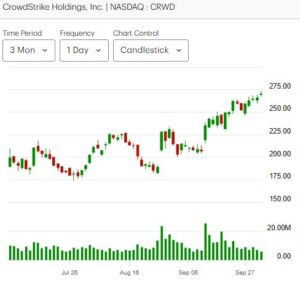
Cybersecurity stocks continued to perform well, with CrowdStrike Holdings (CRWD) and Palo Alto Networks (PANW) maintaining their upward trends.
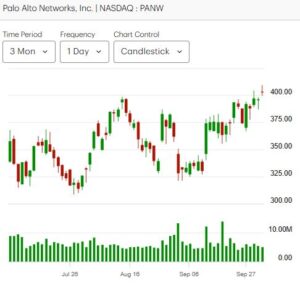
CrowdStrike, in particular, has been showing persistent strength and is approaching a more extended position. While strong momentum can persist, traders should be careful about chasing stocks after extended advances. A strong stock can remain strong, but the risk-reward profile of a new entry generally becomes less attractive as the price moves farther from its normal trading range.
Technical Picture of the Major Indexes
The technical picture remains mixed despite Friday’s strong rebound.
The Nasdaq Composite remains the strongest of the major indexes, trading well above its 25-day, 50-day, and 200-day moving averages.
The S&P 500 remains below its 25-day moving average but above its 50-day and 200-day moving averages. This suggests some short-term weakness within a more constructive intermediate- and longer-term structure.
The Dow Jones remains below both its 25-day and 50-day moving averages and is only slightly above its 200-day moving average. The shrinking distance between the Dow and its 200-day moving average warrants close attention.
The Russell 2000 remains below its 25-day and 50-day moving averages and is only slightly above its 200-day moving average. Small-cap stocks therefore continue to show relative technical weakness.
Key Takeaways for Traders and Investors
- Friday was a strong recovery session. All four major indexes advanced, with the Nasdaq leading the market higher.
- Market breadth improved. Advancers outnumbered decliners on both the NYSE and Nasdaq.
- Market internals improved significantly but remain weak. The sharp decline in new 52-week lows is encouraging, but new lows still substantially exceed new highs.
- Sector participation was unusually broad. Industrials, Basic Materials, and Technology led the advance, while only Healthcare declined.
- The Nasdaq remains technically strongest. It continues to trade above its 25-day, 50-day, and 200-day moving averages.
- The Dow and Russell 2000 remain areas of concern. Both are only slightly above their 200-day moving averages, making that level particularly important to watch.
- Tesla deserves continued attention. Friday’s strong post-earnings move was impressive, but traders should look for confirmation rather than chase the initial reaction.
- Cybersecurity stocks remain strong. CrowdStrike and Palo Alto Networks continue to show momentum, although traders should be alert to potential extension.
- Disk-drive stocks face new competitive concerns. The reported expansion of Toshiba’s data-center hard-drive production could continue to influence Seagate and Western Digital.
- Friday’s rally needs confirmation. Improving breadth and declining new lows over the next several sessions would make the case for a more durable recovery considerably stronger.
Bottom Line
Friday was an encouraging session for U.S. equities. The combination of strong gains across all four major indexes, broad sector participation, positive market breadth, and a sharp reduction in new 52-week lows suggests that some of the deterioration seen earlier in the week may be reversing.
However, the market internals have improved rather than fully recovered. New 52-week lows remain substantially higher than new highs, and several major indexes—including the Dow and Russell 2000—remain in technically vulnerable positions relative to their moving averages.
For traders and investors, the appropriate approach is therefore to recognize Friday’s strength without becoming overly aggressive. The market may be attempting to establish a new upward move, but the next several sessions should provide the confirmation needed to determine whether Friday was the beginning of a sustainable recovery or simply a strong rebound within a still-uncertain market.
.
NOTICE TO READERS
The Canadian Vanguard Stock Market is about empowering you to build and manage your wealth by yourself. There is certainly no magic in managing finances or wealth but one needs to know what to do and commit to doing what is needed. When you are ready to start the journey to Take Charge and Put Your Destiny In Your Own Hands, start with reading The Canadian Vanguard every market day. If and when you need more related information or to advertise your business products or services in The Canadian Vanguard, Contact Us
Our readers are strongly advised to conduct their own research into individual stocks before making a purchase decision. In addition, investors are advised that past stock performance is no guarantee of future price appreciation. Any recommendation is not a guarantee of any particular stock’s future prices, and The Canadian Vanguard accepts no responsibility or liability for investors’ or readers’ purchases.
Stocks In The News/ Stocks To Watch and Market Strategy will soon be available only to Paying Subscribers. The dollar sign “$” in the Toronto Market section in the articles only stands for Canadian dollar and in the US market section “$” stands for US dollar.
(c) This article is published by The Canadian Vanguard on October 3, 2026