






Wall Street Roars Back! NVIDIA Surges 31.48%, NASDAQ Jumps 6.51% – But Is the Recovery Sustainable?
The Canadian Vanguard Stock Market Report – Monday November 23, 2026 Edition
.
The Toronto Market
Monday’s Toronto Market
TSX Composite Index – A Powerful Rebound, but Technical Damage Remains
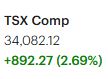
The S&P/TSX Composite Index staged an impressive recovery on Monday, advancing 892.97 points, or 2.69%, to close at 34,082.12. The strong advance effectively reversed much of the damage inflicted by Friday’s broad-based market weakness and provided some much-needed relief to Canadian equity investors.

The recovery was supported by strength across the resource, energy, and financial sectors, which collectively exert considerable influence on the performance of the TSX. Their strong contribution highlights the importance of these sectors in determining the overall direction of the Canadian equity market.
However, Monday’s impressive performance should not be mistaken for a meaningful reversal of the broader market deterioration.
From a technical perspective, the TSX remains in a vulnerable position. The recent market weakness has pushed the index below its 21-day, 50-day, and 200-day moving averages. This is a significant deterioration in its technical profile, suggesting that the market has considerable work ahead before it can re-establish a convincing bullish trend.
The 21-day moving average will be an important near-term level to monitor, while the 50-day and 200-day moving averages represent increasingly important benchmarks for assessing whether the broader trend is beginning to recover. Until the index can reclaim these levels and establish sustained upward momentum, investors should remain cautious about interpreting short-term rallies as evidence of a durable market recovery.
Another concerning development is the TSX’s recent loss of relative strength. For much of last year and into the early part of this year, the Canadian market was among the better-performing major equity markets. More recently, however, its performance has weakened considerably, with the index increasingly displaying characteristics of the underperformance seen in the NASDAQ.
The deterioration is also becoming increasingly evident in the TSX’s technical chart, which is showing signs of structural weakness. This shift in market leadership deserves attention, particularly among investors who had previously viewed Canadian equities as a relatively attractive destination for capital.
Investment Strategy and Market Outlook
Monday’s rally is certainly encouraging, but one strong trading session does not repair several weeks of technical deterioration. The market needs to demonstrate sustained buying interest, regain its key moving averages, and establish a pattern of higher highs and higher lows before a more constructive outlook can be justified.
For the time being, a cautious investment posture appears warranted. Investors should avoid becoming overly aggressive following a sharp one-day rebound and should pay close attention to whether the buying momentum can be sustained over the coming sessions.
Bottom Line: The TSX delivered an impressive technical rebound on Monday, but its broader chart remains damaged. Until the index successfully reclaims its major moving averages and demonstrates improving relative strength, the recovery should be viewed as a potential relief rally rather than confirmation of a new bullish phase.
Monday’s TSX Market Statistics
Market Breadth Improves Significantly, but Underlying Market Internals Remain Weak
Market Breadth – A Strong Positive Reading
The Toronto Stock Exchange recorded a significant improvement in market breadth on Monday, with advancing issues substantially outnumbering declining issues. Specifically, there were 1,761 advancing stocks compared with 403 declining stocks, producing an advancer-to-decliner ratio of 4.37 to 1. In other words, approximately four stocks advanced for every stock that declined. An additional 94 issues remained unchanged.
This represents a decidedly positive breadth reading and confirms that Monday’s market recovery was relatively broad-based rather than being driven exclusively by a handful of heavily weighted stocks.
52-Week Highs and Lows – A Modest Improvement in Market Internals
The TSX recorded 12 new 52-week highs and 51 new 52-week lows on Monday. This compares with 21 new highs and 497 new lows on Friday.
The number of new 52-week highs declined by approximately 43% from Friday, while the number of new 52-week lows plunged by approximately 90%. Although this represents a substantial reduction in downside pressure, the overall picture remains less encouraging than the headline market performance might suggest.
One particularly useful measure is the ratio of new 52-week highs to new 52-week lows. On Monday, this ratio improved to approximately 23.5%, or 0.23 to 1, compared with just 4.2%, or approximately 0.04 to 1, on Friday.
Despite this considerable improvement, new 52-week lows continued to outnumber new highs by more than four to one. This indicates that the market’s underlying internal structure remains weakened.
The improvement in these statistics suggests that some stabilization may be developing beneath the surface. However, it is still too early to conclude that the deterioration in market internals has been reversed. The market continues to exhibit signs of underlying weakness, and this condition could persist for some time.
Trading Volume – Friday’s Extraordinary Activity Recedes
Total trading volume on the TSX reached 322,950,362 shares on Monday, representing a decline of approximately 62% from Friday’s exceptionally heavy volume of 856,613,425 shares.
Friday’s unusually elevated trading activity appears to have been influenced by substantial institutional liquidation, which likely contributed to the extraordinary volume recorded during that session.
Monday’s considerably lower volume is therefore not entirely unexpected. Nevertheless, it will be important to monitor whether subsequent advances are accompanied by stronger trading participation. A sustained recovery supported by expanding volume would provide greater confidence in the market’s ability to regain its technical strength.
Investment Strategy and Market Assessment
Monday’s market statistics present a mixed but somewhat improved picture. The strong advancer-to-decliner ratio demonstrates broad participation in the market rebound, while the dramatic reduction in new 52-week lows suggests that the intensity of selling pressure has eased considerably.
However, the continued imbalance between new highs and new lows indicates that the underlying market structure remains fragile. Furthermore, the sharp reduction in trading volume raises questions about the strength of institutional participation behind Monday’s recovery.
Bottom Line: Monday delivered a substantial improvement in market breadth and a welcome reduction in downside pressure. However, the TSX’s underlying market internals remain weakened. Investors should distinguish between a short-term improvement in market statistics and a genuine recovery in the broader market trend. Until the number of new highs begins to consistently exceed new lows and trading participation strengthens, a cautious investment approach remains appropriate.
.
Monday’s TSX Market Wrap-Up Report
A Powerful Market Rebound, but Is It the Beginning of a Sustainable Recovery?
The Toronto Stock Exchange staged an impressive comeback on Monday, with the S&P/TSX Composite Index advancing 892.97 points, or 2.69%, to close at 34,082.12. The rebound provided considerable relief following the severe market sell-off experienced on Friday and helped restore some confidence among Canadian equity investors.
However, beneath the impressive headline performance, the market presented a more complicated picture. Sector performances were uneven, several major resource and technology-related groups remained under considerable pressure, and the broader technical structure of the TSX continues to show signs of deterioration.
Let’s examine the important developments from Monday’s trading session.
Sector Performance – A Recovery with Significant Exceptions
Despite the strong performance of the overall market, only eight of the 20 TSX sectors finished Monday in positive territory. Communications led the advancing sectors with an impressive gain of 11.39%. Health Technology and Commercial Services followed, advancing 8.30% and 7.29%, respectively.
Utilities gained 4.65%, while Transportation and Consumer Non-Durables advanced 2.61% and 1.41%, respectively.
On the downside, Consumer Services declined 1.24%, while Finance lost 2.60%. The weakness was considerably more pronounced in some of the resource and technology-related sectors. Non-Energy Minerals fell 10.00%, Electronic Technology declined 12.66%, and Energy Minerals plunged 16.94%, making it the worst-performing sector of the day.
The divergence in sector performance is noteworthy. Although the TSX Composite Index enjoyed a substantial rebound, the recovery was far from universal. Some sectors experienced impressive gains, while others continued to suffer significant losses.
This suggests that Monday’s rally should not automatically be interpreted as evidence that the broader market has returned to a healthy upward trajectory.
Individual Stock Performances – Shopify and Several Major Stocks Rebound
Among the major Canadian companies, Shopify Inc. (SHOP), one of the heavyweight constituents of the TSX, advanced 8.96% on Monday. The stock closed at $192.96, with approximately 2.1 million shares traded.
Aritzia Inc. (ATZ) also enjoyed a strong session, gaining 6.48% to close at $144.74, with trading volume of approximately 795,300 shares.
Even gold producers participated in the recovery. Agnico Eagle Mines (AEM) advanced 6.14%, closing at $229.98, with approximately 994,900 shares traded.
Bombardier Inc. (BBD.B), however, continued to underperform relative to the broader market. The stock managed a gain of just 1.17%. This relatively modest performance is particularly noticeable when compared with the much stronger advances recorded by several other prominent Canadian stocks.
The market’s current environment, including continuing concerns surrounding US tariffs, may be contributing to uncertainty around companies with significant exposure to international trade. Bombardier’s recent share-price behaviour warrants continued attention, as its relative weakness could be an indication that investors remain cautious about its near-term prospects.
Overall, Monday was a session in which many stocks recorded substantial gains. However, the considerable divergence in individual stock performance suggests that investors should continue to distinguish between stocks participating meaningfully in the recovery and those struggling to regain momentum.
Canada’s Big Six Banks – A Welcome Change in Direction
One of the more encouraging developments on Monday was the performance of Canada’s major banks.
The banking sector has experienced some disappointing trading sessions recently, with all six of Canada’s largest banks showing signs of weakness. Monday, however, brought a welcome change in direction, as all six major banks advanced by more than 2.25%.
Among the reported performances:
- Canadian Imperial Bank of Commerce (CM): Advanced 2.80% to close at $151.48, with approximately 1.8 million shares traded.
- Royal Bank of Canada (RY): Gained 2.75% to close at $270.29, with approximately 4.8 million shares traded.
- Bank of Montreal (BMO): Advanced 2.68% to close at $230.50, with approximately 1.7 million shares traded.
The simultaneous recovery across Canada’s major banks is encouraging, particularly because financial stocks carry considerable weight in the TSX Composite Index.
Nevertheless, one strong session does not necessarily signal that the banking sector has completed its correction. We will be watching closely to determine whether Monday’s performance represents the beginning of a more sustainable recovery or simply a temporary rebound following recent selling pressure.
For investors holding Canadian bank stocks, the next several trading sessions should provide a better indication of whether buying interest is returning to the sector.
Market Internals – A Significant Improvement, but the Damage Remains
Monday’s market statistics provided some encouraging evidence that selling pressure had eased.
Advancing stocks substantially outnumbered declining stocks. There were 1,761 advancing issues compared with 403 declining issues, producing an impressive advancer-to-decliner ratio of 4.37 to 1. An additional 94 issues remained unchanged.
This was a decidedly positive breadth reading and demonstrated that Monday’s recovery extended well beyond a handful of heavily weighted TSX constituents.
The new 52-week highs and lows statistics, however, presented a less convincing picture.
The exchange recorded 12 new 52-week highs and 51 new 52-week lows on Monday, compared with 21 new highs and 497 new lows on Friday.
Although the number of new 52-week lows declined dramatically, new lows continued to outnumber new highs by more than four to one. The ratio of new highs to new lows improved to approximately 23.5%, compared with just 4.2% on Friday.
This represents a substantial improvement, but it is important to recognize that the market continues to have more stocks making new lows than new highs.
In other words, the immediate selling pressure has eased, but the underlying market structure remains weakened.
Trading volume also declined considerably. Total TSX volume reached approximately 322.95 million shares on Monday, compared with an extraordinary 856.61 million shares on Friday, representing a decline of approximately 62%.
Friday’s exceptionally heavy trading activity appears to have been influenced by substantial institutional liquidation. Monday’s lower volume is therefore not entirely surprising.
Nevertheless, traders should monitor whether subsequent advances attract stronger trading participation. A recovery supported by improving breadth and expanding volume would provide considerably more confidence than a rally driven primarily by short-covering or temporary bargain hunting.
Market Round-Up – Relief Rally or the Beginning of a New Uptrend?
Last week’s trading sessions were particularly damaging for equity investors. The major market indexes suffered substantial losses on Thursday and Friday, with Friday’s sell-off inflicting considerable damage on individual stocks and investment portfolios.
Monday brought an impressive reversal, with the TSX Composite Index gaining nearly 900 points.
The market’s recovery followed developments surrounding NVIDIA’s leadership, which reportedly improved sentiment toward the artificial intelligence industry. Given NVIDIA’s importance to the global technology sector and the broader AI investment theme, developments involving its leadership can have a significant influence on investor confidence.
However, investors should be careful not to attribute the entire market recovery to a single development. Market rebounds following severe sell-offs can also be driven by bargain hunting, short-covering and institutional repositioning.
More importantly, Monday’s performance does not erase the technical damage accumulated over the previous two weeks.
The TSX is currently trading below its 21-day, 50-day and 200-day moving averages. These are important technical reference points, and the index will need to reclaim these levels to demonstrate that its broader upward trend is being restored.
Furthermore, the TSX, which had been among the stronger-performing major market indexes for much of last year and early this year, has recently experienced a noticeable deterioration in relative strength.
The combination of weakening relative performance, a damaged technical chart and persistently unfavourable new-high/new-low statistics suggests that investors should not become overly optimistic following Monday’s rebound.
Key Takeaways for Traders and Investors
Monday’s impressive recovery offers some encouraging signals, but there are several important considerations for market participants.
1. Do not confuse a powerful rebound with a confirmed trend reversal.
A 2.69% advance is certainly impressive. However, traders should wait for confirmation that the recovery can be sustained over subsequent trading sessions. One strong session does not necessarily establish a new bullish trend.
2. Watch the major moving averages.
The TSX remains below its 21-day, 50-day and 200-day moving averages. Reclaiming these technical benchmarks should be an important consideration when assessing whether the market is repairing its damaged technical structure.
3. Pay attention to market breadth and new highs versus new lows.
Monday’s 4.37-to-1 advancer-to-decliner ratio was encouraging. However, the fact that new 52-week lows continued to exceed new highs suggests that the underlying market remains vulnerable. Traders should monitor whether this relationship improves consistently.
4. Monitor the banking sector.
The simultaneous recovery of Canada’s Big Six banks is a positive development. Given their substantial influence on the TSX, sustained strength in this sector could provide meaningful support to the broader Canadian market.
5. Be selective and manage risk.
The considerable differences in individual stock performance demonstrate why stock selection remains important. Traders should avoid chasing stocks simply because they have experienced substantial one-day gains. Investors should also remain attentive to position sizing, downside risk and portfolio exposure.
Final Assessment
Monday was undoubtedly a welcome day for Canadian equity investors. The TSX delivered a powerful rebound, market breadth improved substantially, the major banks recovered, and several prominent stocks recorded impressive gains.
Nevertheless, the underlying evidence suggests that the market has not yet completed the process of repairing the damage inflicted during the recent sell-off.
The continued predominance of new 52-week lows, the weakness in several important sectors, and the TSX’s position below its major moving averages are reasons for caution.
Our position remains one of cautious optimism, rather than outright bullishness.
The market deserves an opportunity to demonstrate that Monday’s performance represents the beginning of a sustainable recovery. Until that confirmation emerges, traders and investors would be well advised to exercise patience, remain selective, and avoid taking excessive risks.
The next several trading sessions could be particularly important in determining whether Monday’s powerful rebound develops into a genuine market recovery or turns out to be another temporary relief rally.
.
The US Markets
Monday’s US Market Indexes
Wall Street Roars Back – A Powerful Rebound, but Has the Market Turned the Corner?
The US equity markets staged a spectacular recovery on Monday, with all four major market indexes recording gains of 3% or more. The rebound provided a welcome reprieve following Friday’s severe market sell-off, which had inflicted substantial damage across the major indexes and individual stock portfolios.
The Dow Jones Industrial Average advanced 1,447.98 points, or 3.01%, to close at 49,595.31. The S&P 500 gained 326.78 points, or 4.73%, finishing the session at 7,237.17. The NASDAQ Composite delivered the strongest performance, surging 1,471.82 points, or 6.51%, to close at 24,089.56. Meanwhile, the Russell 2000 advanced 87.87 points, or 3.40%, to finish at 2,669.66.

Monday’s performance was particularly impressive because the NASDAQ gained more than twice as much as the Dow in percentage terms. Technology and growth stocks, which had experienced substantial selling pressure during the recent market decline, staged a particularly strong recovery.
A Welcome Relief Following Friday’s Severe Sell-Off
Monday’s market action was a refreshing change from the difficult trading sessions experienced last week.
Friday’s severe sell-off left considerable damage across the major market indexes, individual stocks and investment portfolios. The intensity of the selling also raised the possibility that many stocks had become technically oversold, creating conditions for a significant relief rally.
Monday’s performance appears consistent with such a rebound, as investors returned to the market and bought stocks that had experienced substantial price declines.
In fact, the magnitude of Monday’s advances was impressive even when compared with Friday’s losses in absolute point terms. The recovery demonstrated that substantial buying interest remains in the market, particularly among technology and growth-oriented stocks.
However, investors should distinguish between an oversold-market recovery and a genuine change in market direction.
A powerful one-day advance can reverse much of the damage caused by a preceding sell-off without necessarily establishing a new upward trend. The important question is whether Monday’s buying momentum will continue over the next several trading sessions.
We will need to see further evidence before concluding that the worst of the recent market weakness is behind us.
NASDAQ Composite – A Spectacular Recovery, but Significant Technical Repairs Are Still Needed
The NASDAQ was undoubtedly the standout performer on Monday, surging 6.51% and recovering a substantial portion of its recent losses.
Nevertheless, despite this impressive advance, the index’s technical structure remains damaged.
Based on the moving-average levels in our analysis, the NASDAQ closed approximately 1,000 points below both its 21-day and 200-day moving averages and roughly 1,500 points below its 50-day moving average.
This positioning is particularly interesting because the 21-day and 200-day moving averages are currently almost coinciding, while the 50-day moving average remains considerably higher.
In practical terms, the NASDAQ has significant technical ground to recover before it can be considered to have restored a healthy upward trend.
The index will need to regain these moving averages and demonstrate sustained upward momentum. Simply approaching these levels will not be sufficient; the market will need to establish that it can remain above them.
We have previously noted that the NASDAQ’s technical chart requires considerable repair following the recent deterioration. Monday’s performance is certainly encouraging and provides some hope that the recovery process may have begun.
However, traders should remain patient. The next several trading sessions should help determine whether Monday’s powerful advance represents the beginning of a sustainable recovery or merely a temporary relief rally.
Russell 2000 – The Small-Cap Market Remains Technically Vulnerable
The Russell 2000 also participated in Monday’s recovery, advancing 3.40%. However, its underlying technical condition remains concerning.
The index continues to trade below its 21-day, 50-day and 200-day moving averages. This indicates that weakness is not confined to the short-term trend but has extended into the intermediate- and longer-term technical structure.
Of particular concern is the bearish crossover between the 50-day and 200-day moving averages that developed several trading sessions ago.
This formation is commonly referred to as a Death Cross. It occurs when the 50-day moving average falls below the 200-day moving average and is generally interpreted as a bearish technical signal.
The significance of this formation is that it suggests the recent short-term market weakness may have developed into a broader intermediate-term downtrend.
Monday’s strong rebound is certainly welcome, but it does not automatically reverse the implications of this bearish crossover.
The Russell 2000 will need to regain its major moving averages and eventually reverse the bearish crossover before its technical outlook can be considered meaningfully improved.
For traders participating in small-cap stocks, this remains an area requiring particular caution. Small-cap stocks can be especially vulnerable during periods of deteriorating market sentiment, and traders should be mindful of the elevated risks associated with a weakened underlying index.
Investment Strategy and Market Outlook
Monday’s market performance was impressive across the board. The Dow, S&P 500, NASDAQ and Russell 2000 all advanced by more than 3%, demonstrating that the recovery was not restricted to a single market segment.
The NASDAQ’s 6.51% gain was especially encouraging, as it suggests that investors were willing to return to some of the market’s most heavily sold growth and technology stocks.
Nevertheless, the technical picture remains challenging.
The NASDAQ is still below its major moving averages, while the Russell 2000 remains in a technically vulnerable position following its bearish moving-average crossover.
These developments suggest that investors should avoid interpreting Monday’s performance as confirmation that a new bull phase has begun.
Instead, the market should be given time to demonstrate whether the recovery can be sustained.
Key Takeaways for Traders and Investors
1. Do not chase Monday’s rally without confirmation.
A 6.51% advance in the NASDAQ is impressive, but traders should be careful about chasing stocks after such a powerful rebound. Some stocks may have recovered too quickly in the short term, creating the possibility of another pullback.
2. Monitor the NASDAQ’s moving averages.
The NASDAQ needs to reclaim its 21-day, 50-day and 200-day moving averages to repair its technical structure. These levels should remain important reference points when evaluating the sustainability of the recovery.
3. Exercise additional caution with small-cap stocks.
The Russell 2000 remains below all three major moving averages and has developed a Death Cross formation. Until its technical structure improves, small-cap trading deserves a more conservative approach.
4. Look for confirmation through sustained buying participation.
One strong session is encouraging, but several consecutive sessions of positive performance, improving market breadth and healthy trading volume would provide stronger evidence that investor confidence is returning.
5. Maintain disciplined risk management.
The recent volatility demonstrates how quickly market conditions can change. Traders and investors should remain attentive to position sizing, portfolio exposure and downside risk rather than becoming overly aggressive following a single strong session.
Final Assessment – A Powerful Rebound, but the Market Still Has Work to Do
Monday was an exceptionally encouraging session for US equity investors. The major indexes recovered sharply, technology stocks led the advance, and the Russell 2000 also participated in the broad market recovery.
After the severe selling pressure experienced on Friday, Monday’s performance was a welcome development.
However, the damage inflicted during the recent market decline cannot be considered repaired after just one trading session.
The NASDAQ still has substantial technical ground to recover, and the Russell 2000 continues to exhibit bearish characteristics, including its Death Cross formation.
Our assessment is that Monday’s performance represents an encouraging first step toward market stabilization, but confirmation of a sustainable upward trend is still required.
For traders, patience and selectivity remain important. For longer-term investors, this is a time to assess opportunities carefully rather than assume that the market has already established a durable bottom.
The next several trading sessions will be particularly important. They should provide a clearer indication of whether Monday’s spectacular recovery marks the beginning of a new upward trend or simply another temporary interruption in the broader market correction.
Monday’s US Market Statistics
Market Breadth Rebounds Sharply – Underlying Market Internals Show Signs of Improvement
Monday’s market statistics provided some encouraging evidence that the severe selling pressure experienced during the previous trading sessions may finally be easing. Both the New York Stock Exchange (NYSE) and NASDAQ recorded substantially positive market breadth, while the number of new 52-week lows declined dramatically compared with Friday.
The improvement was particularly impressive on the NYSE, where advancing stocks outnumbered declining stocks by more than five to one. The NASDAQ also recorded a strong positive advancer-to-decliner ratio, suggesting that Monday’s recovery extended across a broad range of listed companies.
Nevertheless, despite the substantial improvement, the new 52-week highs and lows statistics indicate that the underlying market internals have not yet fully recovered. Let’s examine the details.
New York Stock Exchange (NYSE) – A Significant Reversal in Market Breadth
The NYSE recorded a decidedly positive market breadth reading on Monday. There were 2,313 advancing issues compared with 425 declining issues, producing an advancer-to-decliner ratio of 5.44 to 1. In other words, approximately eleven stocks advanced for every two stocks that declined. An additional 71 issues remained unchanged.
This is a particularly encouraging development because it brings an end to seven consecutive trading sessions of negative market breadth.
The magnitude of Monday’s positive breadth suggests that the recovery was broad-based, with substantial participation from stocks across the exchange. This is precisely the type of market behaviour traders and investors want to see following an extended period of weakness.
However, the new 52-week highs and lows statistics provide a more cautious perspective.
The NYSE recorded 21 new 52-week highs and 134 new 52-week lows on Monday, compared with 17 new highs and 594 new lows on Friday.
The number of new 52-week highs increased by approximately 24%, while the number of new 52-week lows declined by approximately 77%.
This is a substantial improvement and suggests that the intensity of selling pressure has eased considerably.
The ratio of new 52-week highs to new 52-week lows improved to approximately 0.16 to 1, compared with just 0.03 to 1 on Friday. Although the ratio remains below the desirable level of 1.00 to 1, the improvement is significant.
It is important to remember that new 52-week lows continued to outnumber new highs. Therefore, despite Monday’s impressive recovery, the broader market internals have not yet returned to a healthy condition.
NYSE Trading Volume
Total trading volume on the NYSE reached 5,707,032,898 shares on Monday, approximately 16% lower than Friday’s volume of 6,804,244,377 shares.
The lower volume is worth monitoring. While Monday’s market advance was accompanied by substantial buying interest, traders should look for continued participation in subsequent sessions. A sustained recovery supported by healthy trading volume would provide additional confidence in the market’s ability to reverse its recent weakness.
NASDAQ – Market Breadth Turns Positive, but New Lows Remain a Concern
The NASDAQ also delivered an encouraging market breadth reading on Monday.
There were 4,066 advancing stocks compared with 1,006 declining stocks, producing an advancer-to-decliner ratio of 4.04 to 1. An additional 180 issues remained unchanged.
This means that approximately four stocks advanced for every stock that declined.
Monday’s positive breadth represents a welcome change following five consecutive sessions of negative market breadth. It suggests that buying interest returned across a substantial number of NASDAQ-listed stocks.
However, the new 52-week highs and lows statistics continue to raise some concerns.
The NASDAQ recorded 81 new 52-week highs and 420 new 52-week lows on Monday, compared with 67 new highs and 1,370 new lows on Friday.
The number of new 52-week highs increased by approximately 21%, while the number of new 52-week lows declined by approximately 69%.
This is an impressive improvement, particularly considering the extraordinary number of stocks that had been registering new lows during Friday’s severe sell-off.
The ratio of new 52-week highs to new 52-week lows improved to approximately 0.19 to 1, compared with just 0.05 to 1 on Friday.
Nevertheless, the number of stocks making new 52-week lows remained considerably higher than the number making new highs.
This is an important distinction. Although Monday’s positive market breadth confirms that advancing stocks substantially outnumbered declining stocks, the new-high/new-low statistics suggest that the longer-term internal damage has not yet been repaired.
For a more convincing market recovery, we would like to see the number of new 52-week highs increase consistently and eventually exceed the number of new 52-week lows.
NASDAQ Trading Volume
Total NASDAQ trading volume reached 11,819,123,254 shares on Monday, approximately 8% below Friday’s volume of 12,888,136,103 shares.
The decline in volume was relatively modest compared with the NYSE. Nevertheless, it will be important to monitor whether subsequent advances attract stronger trading participation.
Overall Market Assessment – The Bulls Regained Control, but Confirmation Is Still Needed
Monday’s market statistics represent a significant improvement over Friday’s exceptionally weak readings.
The NYSE recorded a 5.44-to-1 advancer-to-decliner ratio, while the NASDAQ posted a similarly impressive 4.04-to-1 ratio. These figures demonstrate that Monday’s recovery was supported by broad participation rather than being driven exclusively by a few heavyweight stocks.
Another encouraging development was the dramatic reduction in the number of new 52-week lows on both exchanges.
On the NYSE, new lows declined from 594 to 134, while on the NASDAQ they fell from 1,370 to 420.
These are substantial improvements and suggest that the intensity of the recent selling pressure has diminished considerably.
The market’s price performance was equally impressive. The Dow Jones Industrial Average, for example, advanced 1,447.98 points on Monday, compared with Friday’s decline of 949.73 points. Monday’s gain was approximately 52% greater than Friday’s loss in absolute point terms.
The S&P 500 and NASDAQ also staged substantial recoveries.
However, we should not confuse a powerful one-day recovery with a confirmed reversal of the broader market downtrend.
The continued predominance of new 52-week lows over new highs on both exchanges indicates that the market’s internal structure remains weakened. This is particularly important for NASDAQ investors, given the recent deterioration in technology and growth stocks.
The market needs to demonstrate that Monday’s improvement can be sustained. Ideally, we would like to see several consecutive sessions of positive breadth, declining numbers of new lows, expanding numbers of new highs and stronger buying participation.
Key Takeaways for Traders and Investors
1. Monday’s positive market breadth is a significant development.
The NYSE and NASDAQ both recorded strongly positive advancer-to-decliner ratios. This is an encouraging indication that buying interest has returned across a broad range of stocks.
2. Watch the new 52-week highs and lows closely.
Although the number of new lows declined dramatically, new lows continued to exceed new highs on both exchanges. A sustained reversal in this relationship would provide stronger evidence of improving market health.
3. NASDAQ still requires considerable internal repair.
Despite Monday’s impressive index advance, the number of NASDAQ stocks making new lows remained substantially higher than the number making new highs. Traders should continue to exercise selectivity when considering technology and growth stocks.
4. Look for emerging market leaders.
This is an excellent time for traders and investors to identify stocks demonstrating relative strength while the broader market attempts to recover. Stocks that are holding up well, showing improving technical patterns and attracting meaningful buying interest deserve consideration for inclusion on watchlists, provided they meet the investor’s other selection criteria.
5. Avoid becoming overly aggressive after one strong session.
Monday’s performance was encouraging, but the market needs additional confirmation. Traders should remain disciplined, manage their exposure and avoid assuming that the recent correction has already ended.
Final Assessment
Monday was a very encouraging session for US equity markets. The bulls returned in considerable strength, market breadth improved dramatically, and the number of stocks registering new 52-week lows declined sharply.
The termination of seven consecutive sessions of negative NYSE market breadth and the improvement in NASDAQ breadth are particularly noteworthy developments.
Nevertheless, the market’s internal indicators remain less than satisfactory. New 52-week lows continue to outnumber new highs on both exchanges, suggesting that the recovery process has some distance to travel.
Our assessment is that Monday represents a meaningful improvement in market conditions and a potentially important first step toward reversing the recent market weakness. However, confirmation of a sustainable recovery is still required.
Traders and investors should pay close attention to the next several trading sessions. If Monday’s positive breadth readings persist, new 52-week lows continue to decline, and new highs begin to expand, the market may be approaching an important turning point.
For now, patience, selectivity and disciplined risk management remain the appropriate investment strategy.
The bulls have made an impressive return. The question is whether they can maintain control.
.
.
NOTICE TO READERS
The Canadian Vanguard Stock Market is about empowering you to build and manage your wealth by yourself. There is certainly no magic in managing finances or wealth but one needs to know what to do and commit to doing what is needed. When you are ready to start the journey to Take Charge and Put Your Destiny In Your Own Hands, start with reading The Canadian Vanguard every market day. If and when you need more related information or to advertise your business products or services in The Canadian Vanguard, Contact Us
Our readers are strongly advised to conduct their own research into individual stocks before making a purchase decision. In addition, investors are advised that past stock performance is no guarantee of future price appreciation. Any recommendation is not a guarantee of any particular stock’s future prices, and The Canadian Vanguard accepts no responsibility or liability for investors’ or readers’ purchases.
The dollar sign “$” in the Toronto Market section in the articles only stands for Canadian dollar and in the US market section “$” stands for US dollar.
(c) This article is published by The Canadian Vanguard on November 23, 2026