





Auto Union and Ford Open Bargaining Amid Looming US Tariff Threats
It’s a contract negotiation unlike any other.
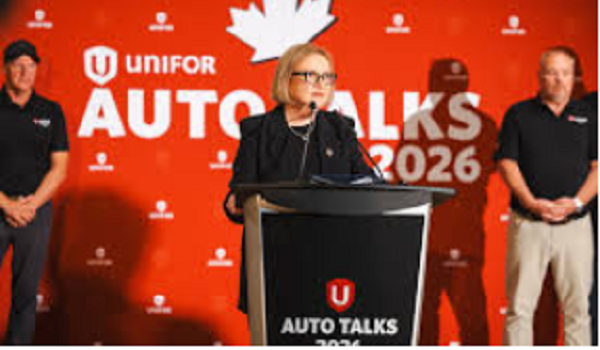
At a downtown hotel Monday, the country’s biggest private sector union kicked off contract talks with Ford Canada, amid a trade war sparked by Donald Trump’s tariffs, White House threats to crush Canada’s auto manufacturing industry, and dwindling market share for the Detroit Three auto makers.
In a press conference after the formal start of contract talks, Unifor national president Lana Payne acknowledged the enormity of the task lying ahead as she and her negotiating team attempt to reach a three-year deal with Ford by July 10.
“We face an unprecedented set of challenges here as we embark on these auto negotiations,” said Payne. “The most powerful leader in the world has repeatedly said that he is coming for our auto sector in Canada and our jobs.”

With the renegotiation — or potential elimination — of the Canada-U.S.-Mexico agreement on trade also looming, neither side in the talks knows exactly what the economics of the industry will look like in a year or two, Payne said.
The risk of delaying contract talks until CUSMA is renewed, however, is outweighed by the reality that auto manufacturing jobs are already getting hammered, Payne said.
“The risk is greater if we’re not tackling these problems now. We’ve been 18 months having semiregular discussions with automakers on any number of things that could be driven by the tariffs,” said Payne. “We need to do what we can and what we do best, and that’s collective bargaining to try and at least bring stability to the people that we represent, to the workplaces where they work, and to the communities that depend on these plans.”
In an emailed statement, Ford Canada’s head of HR said the company was hopeful of reaching a deal.
“We look forward to constructive, good-faith discussions to reach a fair agreement with the goal of providing stability for our workforce while securing the long-term competitiveness of our Canadian manufacturing operations,” said Meredith Keenan, Ford Canada’s vice president of human resources.
Unifor announced earlier this month that it had selected Ford as the target for “pattern” bargaining.

Typically in pattern bargaining, the first company is the one the union figures will negotiate the most worker-friendly contract, in hopes it sets a precedent for talks with the other two companies.
And while Ford is in relatively healthy financial shape compared to Stellantis and GM — and has also invested several billion dollars in its Canadian manufacturing footprint — the trade war means that Unifor is unlikely to get a lucrative new deal with hefty pay hikes, said auto industry analyst Robert Karwel.
“Last time the situation was pretty clear: It was immediately post-COVID, everything got more expensive. It was all about the wages. Demand for the cars was strong,” said Karwel, head of automotive research for J.D. Power Canada. “This time around it’s a different game. The single biggest problem we have is CUSMA renegotiation. Our entire industry is designed around a singular premise: We build cars and we can send them to our neighbours in the U.S. That’s the sword of Damoclese hanging over this.”
That means, said Karwel, that Unifor is likely looking to emphasize job protection and production guarantees, rather than hefty wage increases. The company, meanwhile, is likely looking for as long a deal as possible, with as much flexibility as possible.
University of Toronto labour studies professor Rafael Gomez suggested the union could try and aim for a shorter deal in order to wait out the next U.S. presidential election, but warned that the populist rhetoric of luring manufacturing jobs back to the U.S. could outlast the current administration.
“Do they take a short term deal to get through the last few years of Trump? That’s a possibility,” said Gomez, director of U of T’s Centre for Industrial Relations and Human Resources. “But America First is here now, and it’s looking more bipartisan. You have to remember that for a lot of years, it was the Democrats who took a harder line on manufacturing jobs.”

Trump has mused repeatedly — as recently last week — about ripping up CUSMA.
Last October, U.S. Commerce Secretary Howard Lutnick told a conference on Canada-U.S. trade that Canada should accept that its auto manufacturing days are numbered.
“Car assembly is going to be in America, and there is nothing Canada can do about it. The question is, what is Canada going to do instead?” one source quoted Lutnick as saying at the conference,” which was held under the ‘Chatham House Rule’ that bars reporters and media coverage.
With files from Robert Benzie
This article was first reported by The Star
This article was first reported by The Star