





Tomato Spike: Trade Tensions and Bad Weather Send Salad Staple Prices Soaring
Canadian consumers are paying substantially more for fresh tomatoes, which have surged in price because poor growing conditions and U.S. tariffs on the Mexican industry have hampered supply across the continent.
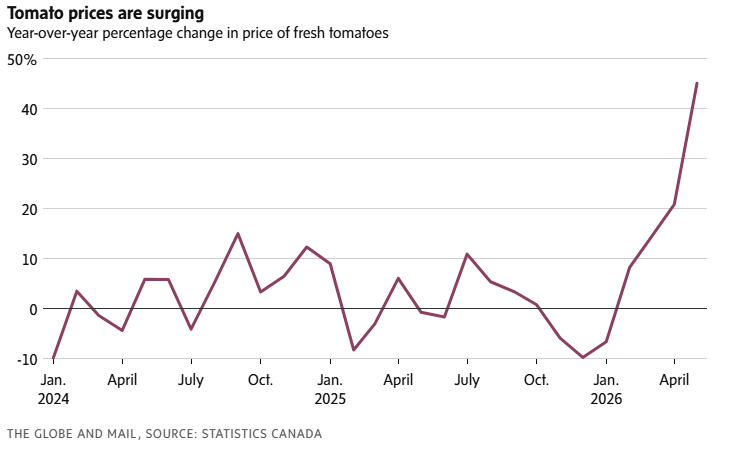
The price of fresh tomatoes in Canada has jumped by 45.2 per cent over the year to May, Statistics Canada said Monday in its Consumer Price Index report. The average retail cost for a kilogram of tomatoes was $6.18 in April, up from $4.52 a year earlier, according to a separate Statscan survey.
Grocery prices have risen by 4.3 per cent over the past year, the 16th consecutive month that they’ve exceeded the headline rate of inflation, which was 3.2 per cent in May. Fresh vegetable prices have jumped by 9 per cent, with broccoli, cauliflower and lettuce also contributing to the increase.

But tomatoes stand out as a source of sticker shock.
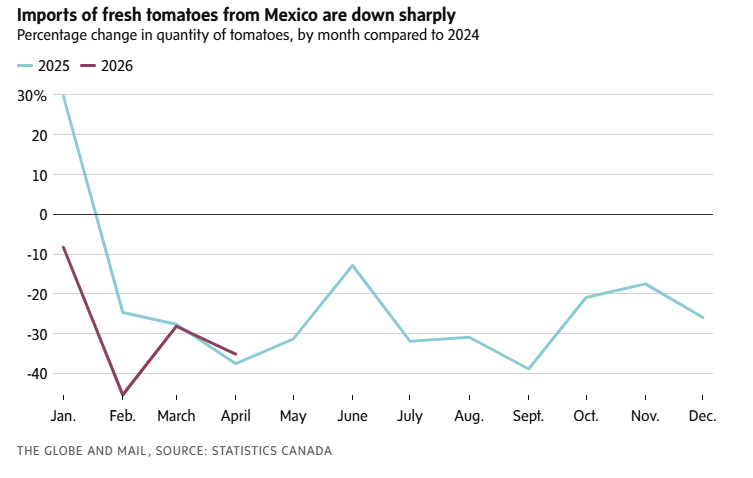
Canada imported $422-million of tomatoes last year, overwhelmingly from the U.S. and Mexico, both of which have faced poor growing conditions. Figures show that Canadian imports of Mexican tomatoes started to plunge in 2025.
But factors other than growing conditions have also contributed to continent-wide price hikes.
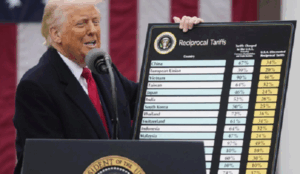
In July, 2025, the Trump administration ended a 30-year trade deal between the U.S. and Mexico at the behest of tomato growers in Florida.
The Tomato Suspension Agreement had established a floor price for Mexican imports. With the end of the agreement, most fresh Mexican tomatoes exported to the U.S. are subject to a 17-per-cent tariff which, when combined with weather challenges, have cut down Mexican production by 9 per cent, according to the U.S. Department of Agriculture.
It has also stoked price volatility across the entire North American tomato trade, especially as the renewal of the USMCA trade deal approaches its July 1 deadline.
“The current administration has created so much tension between the three countries and so much uncertainty in a market that was somewhat integrated that it’s putting upward pressure on food prices,” said Andrew Muhammad, professor of agricultural and resource economics at the University of Tennessee.
A U.S. Department of Agriculture (USDA) report from this month also noted that the appreciation of the Mexican peso in 2025 and early 2026 has squeezed profit margins.
But a significant factor was U.S. President Donald Trump’s termination of the Tomato Suspension Agreement.
It came into force when the U.S., Mexico and Canada negotiated the North American free-trade agreement, and it was designed to help growers in the U.S. stay competitive with Mexico, where labour was cheaper.

But it didn’t work.
When NAFTA came into effect in the mid-1990s, the U.S. produced about 70 per cent of the tomatoes it consumed. By the 2020s, this trade balance had inverted, Prof. Muhammad said. The U.S. now imports 70 per cent of the tomatoes it consumes.
Florida’s tomato growers have long argued that their lost market share is because Mexican importers skirted around the price floor, said Andrew Rudman, senior associate for the Latin American program at the Washington-based Center for Strategic and International Studies.
And for the last three decades the interest group has lobbied to have the suspension agreement terminated in favour of tariffs. In April, 2025, they got what they wanted when Mr. Trump announced that the agreement would end in July and be replaced by tariffs.
This tariff is trickling down to consumers, said Luis Ribera, an agricultural economist at Texas A&M University. He is currently authoring a report on the economic costs of the tomato tariffs. But the 17-per-cent tariff is not the complete story, he added.
The tomato industry is facing a high degree of uncertainty that goes beyond this single policy. The White House has demonstrated that the demands of special interests in Florida have weight, and the USMCA is days away from its review.
Given this uncertainty, prices will fluctuate and growers have and will make different choices about what crops to plant, he said.
The U.S. Department of Agriculture forecasts that the planted area allocated to tomatoes will be 38,000 hectares in 2026, 11 per cent less than in 2025.
This will diminish the tomatoes sent for export, said the report, especially given how tight supplies are affecting Mexican consumers. According to the Mexican National Institute of Statistics and Geography, 20 states across the country are facing year-over-year price increases of 100 per cent. The remaining states report surges of 68 per cent to 97 per cent.

The USDA report predicts tomato exports will drop by 7 per cent in the 2026 crop year to combat the supply shortage and tariffs. And while 7,500 tonnes of tomatoes were rerouted to Canada in 2025 to avoid the tariffs, these exports only account for 1 per cent of the total volume send to the U.S. market.
The question is what other crops will be hit next, Prof. Ribera said. Tomato growers are not the only Florida farmers to have lost market share to Mexican competitors. For example, the U.S. is importing an increasing volume of berries and avocados. And these stakeholders are also pushing for protectionist measures.
Should Mr. Trump take aim at these products in the USMCA negotiation, said Prof. Ribera, consumers across North America will pay for the consequences of uncertainty and disconnected trade on more than product.
This article was first reported by The Globe and Mail