





Carney: Canada Stalls Trade Talks Until U.S. Tone Shifts
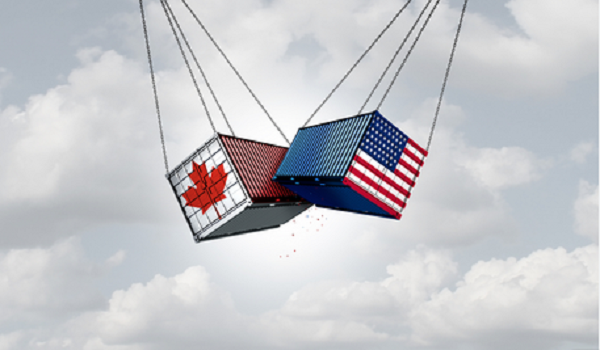
Prime Minister Mark Carney says the U.S. must change its attitude toward trade talks before Canada will return to the negotiating table, signalling that there are no immediate plans for further bargaining as the two sides dig in for escalating economic warfare.
Mr. Carney on Monday said that, during negotiations, it became clear the Americans “want to destroy our major industries” and “that is one of the major reasons that led us to say no – it was a bad deal.”
The Prime Minister ended the talks on Friday night shortly before the deadline for an agreement. U.S. President Donald Trump imposed new, 50-per-cent tariffs on roughly $28-billion worth of Canadian goods, which Mr. Carney has vowed to match with levies of his own on Sept. 8.
Now, he said, it is up to the U.S. to restart talks.
“When the Americans go to the negotiation table first, with the right attitude toward our industries and a true partnership, of course we’ll come to the negotiating table,” Mr. Carney told reporters at the Davie shipyard in Lévis, Que., where he was announcing the construction of new icebreakers. “But an attitude at the negotiation table that Canada is a subsidiary of the United States … that’s not something we’re going to accept.”

Two government sources with knowledge of the negotiations confirmed that there is currently no plan to ask Mr. Trump for more talks. The Globe and Mail is not identifying the sources in order to learn details of the government’s strategy.
The rupture leaves Canada as one of the few major U.S. trading partners, along with China and Mexico, not to have signed one of the President’s lopsided trade deals.
On Monday, Mr. Trump threatened even more tariffs in a few months’ time and engaged in a war of words with Ontario Premier Doug Ford. In a Truth Social post, the President said he would double auto tariffs from 25 per cent to 50 per cent as of Jan. 1, 2027, and have them also apply to auto parts, which have so far been exempted.
Finance Minister François-Philippe Champagne and a troop of other cabinet ministers are scheduled to unveil the government’s plan to support Canadian businesses hit by the tariffs on Tuesday.
In addition to Mr. Trump’s new tariffs, Canada has been subject since last year to his levies on autos, steel, aluminum and forestry products. The latter are stacked on even older duties on softwood lumber from the President’s first term.
As The Globe has reported, Mr. Carney last week was willing to accept some of Mr. Trump’s sectoral tariffs – as well as concede on a list of U.S. trade demands – in exchange for the President lowering those levies and not imposing the new ones.
But after striking a preliminary agreement along those lines last Tuesday, the Prime Minister has said, the U.S. made several last-minute, deal-breaking demands. These would have threatened Canada’s sovereign ability to make trade agreements with other countries, attacked its auto industry and rolled back cultural policies protecting Canadian content, including French-language content specifically.
Ottawa also made new demands after the tentative deal was reached last Tuesday, The Globe has reported.
One of the government sources on Monday described just how down-to-the-wire talks went on Friday. Less than 90 minutes before the midnight deadline, Canada’s chief negotiator Janice Charette and her staff left U.S. Trade Representative Jamieson Greer’s office near the White House to return to the Canadian embassy.
There, Ms. Charette conferred with Canada-U.S. Trade Minister Dominic LeBlanc, ambassador Mark Wiseman and Marc-André Blanchard, Mr. Carney’s chief of staff. A van waited downstairs to take Ms. Charette and the negotiators back to Mr. Greer’s office for more talks. Then, the source said, the call came from the Prime Minister: Canada was done negotiating.
The government official said that, in numerous places, the proposed text of the deal that U.S. negotiators presented Canada with was different than what had been agreed to last Tuesday.
For instance, the two sides had broadly agreed that Canada would have “most favoured nation” clauses in the deal that would ensure that if the U.S. gave more tariff relief to another country, Ottawa would get the same. But Washington took that language out of its proposed final deal.
The source said American negotiators also increasingly hardened their demands that the U.S. be able to dictate Canadian trade policy – which Canada saw as an infringement on its sovereignty.
The Americans, for example, demanded that Ottawa be obliged to impose the same levies on key products from third countries as Washington did. Such products included steel, aluminum and goods derived from those metals. Then, U.S. negotiators began demanding the ability to constrain Canada from signing free-trade deals with other countries. The two sides were negotiating this last point when the talks ended.
This last point could have stopped Mr. Carney’s attempts to land trade agreements with India, the Association of Southeast Asian Nations and others as he seeks to diversify Canada’s economy away from the U.S. market.
The Prime Minister has pointed to other last-minute U.S. demands that tanked the deal: excluding trucks from auto tariff relief and ending Canadian rules that make U.S. streaming services such as Netflix and Amazon Prime surface Canadian content, including content in French, for users in Canada.
In his post on Truth Social on Monday, Mr. Trump wrote: “Canada has been ripping off the United States of America for years. Not sustainable, and NOT ANYMORE!”
The lengthy timeline for implementation ensures the levies will not be in place ahead of the U.S. November midterms, where Mr. Trump’s Republicans are already facing voter anger over high consumer prices partly caused by the President’s war on Iran.
The Ontario Premier, for his part, said on talk radio that the President can “kiss my ass” and suggested Canada should cut off the U.S.’s supplies of oil, gas, electricity, potash and uranium.
The President fired back with a threat to cut off Canadian energy that flows through the U.S. He described Mr. Ford as “the less charismatic, intelligent, and overall unimpressive brother of the late, great, Rob Ford,” the former Toronto mayor.
Mr. Ford also confirmed that, before the deal collapsed on Friday, he told Mr. Carney that he would not back it. “The day, and the night, I did tell him I can’t support it,” he told reporters in Hamilton.
The support of Mr. Ford and other premiers was key. One concession Canada had to make to get a deal was to have provinces end their bans on U.S. alcohol and drop retaliatory Buy Canadian procurement rules.
Two other sources with knowledge of the discussions said Mr. Ford told Mr. Carney on Friday that he would not comply with these requests because the steel and auto terms the U.S. was offering were too punitive.
On autos, the U.S. would have reduced tariffs from 25 per cent to 15 per cent and exempted the value of American content, but it refused to also exempt Canadian content. On steel, the tariff would have been cut from 50 per cent to 25 per cent for the first four million tonnes exported per year, while anything above that would have remained at the higher tariff.
One U.S. source with knowledge of the negotiating dynamic pointed to two long-running factors that complicated talks.
The first was continuing tension between Mr. Greer and U.S. Commerce Secretary Howard Lutnick. While Mr. Greer and his team pushed repeatedly over the past 10 months for flexibility on steel and aluminum tariffs in order to land trade deals with Canada and Mexico, Mr. Lutnick held firm against giving ground, the source said. The steel industry, the source noted, holds a great deal of sway inside the Trump administration. When a steel magnate makes noise, the issue is dealt with promptly.
Mr. Greer is in charge of negotiating trade deals, but Mr. Lutnick oversees the administration of the tariffs.
The Globe has reported that Mr. Lutnick’s interventions in favour of a harsher deal for Canada helped scuttle the agreement.
A different source said that Mr. LeBlanc has told Canadian industry leaders that negotiators had a deal with Mr. Greer, but it fell apart when he had to get approval for it from others in the administration. One of the government sources said Canadian negotiators felt Mr. Greer was a professional who was dealing with them in good faith but others in the administration may not have been.

The second factor, the U.S. source said, was that Canada only began offering meaningful concessions over the past month, after Mr. Trump threatened his latest tariffs.
Before that, Canadian officials would arrive abruptly in Washington to outline demands on tariff relief while offering little in return, the source said. This happened four or five times to the increasing frustration of Mr. Greer and his team. It meant that talks over the past month started with little groundwork in place to reach a deal on short notice.
On Monday, Mr. Champagne said Ottawa’s tariff support package will primarily help small- and medium-sized businesses. He told reporters in Montreal that the support will be focused on British Columbia, Ontario and Quebec, the three provinces that are expected to be hardest-hit by the new U.S. tariffs.
Vice-President JD Vance, meanwhile, on Monday accused Canada of derailing trade talks with “unreasonable, last-minute demands,” but did not specify what these were.
He also tied the negotiations to national security.
“We have to remember, Canada is a state – sorry, Freudian slip, that was actually an accident,” he said at a rally in Maine. “Canada is a country that has underinvested in its military, that quite literally would get invaded by a foreign country were it not for the umbrella of protection provided by the United States of America.”
With reports from Eric-Andrew Gee in Lévis, Que., and Jeff Gray in Hamilton
This article was first reported by The Globe and Mail