






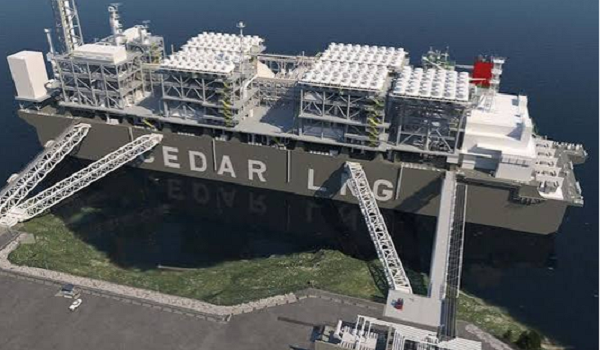
Cedar LNG Secures BC Regulatory Nod to Expand Future Output Capacity
As Canada’s liquefied natural gas industry expands, British Columbia’s environmental regulator has approved Cedar LNG’s request to increase its future production capacity by 25 per cent.
Cedar started construction in 2024 and is scheduled to begin supercooling natural gas into liquid form in late 2028, with exports to be shipped from the Haisla Nation’s traditional territory in Kitimat, B.C. to Asia.
The BC Environmental Assessment Office recently authorized the Haisla-led project to boost liquefaction capacity to 3.75 million tonnes a year of LNG, up from the previously approved amount of three million tonnes annually.

The Haisla own 50.1 per cent of Cedar, while Calgary-based Pembina Pipeline Corp. holds 49.9 per cent.
Shell PLC-led LNG Canada became the country’s first export terminal for the fuel when it began shipping from Kitimat to Asia in mid-2025. The federal government has been seeking to make the country an energy superpower and reduce economic dependence on the United States.
The Coastal GasLink pipeline, operated by TC Energy Corp., is currently supplying the LNG Canada megaproject in Kitimat and also will be used for Cedar.
The 670-kilometre pipeline transports natural gas from northeast B.C. to Kitimat. Cedar’s increased portion works out to roughly 500 million cubic feet a day, compared with the previous plans for 400 million cubic feet a day.
Cedar has estimated that its export facilities, which are under construction, will require US$3.4-billion in capital spending.
LNG Canada is considering building a Phase 2 expansion that would double capacity to as much as 30 million tonnes a year.
Groups such as Stand.earth, the David Suzuki Foundation and the Canadian Association of Physicians for the Environment (CAPE) are among the critics urging the provincial and federal governments to put the brakes on LNG development on the West Coast and fracking for natural gas in northeast B.C.
They have warned about the environmental and health effects of LNG Canada’s excessive flaring of natural gas. Flaring involves the controlled burning of natural gas.
“The lack of oversight and accountability in Kitimat sets a dangerous precedent,” CAPE said in a recent statement.

The largest sources of industrial emissions in Kitimat are from LNG Canada and Rio Tinto PLC’s aluminum smelter.
B.C.’s environmental regulator acknowledged concerns raised about cumulative air quality in the Kitimat airshed in the July 9 report, which approved Cedar’s expanded capacity.
Cedar said the boost in liquefaction capacity would stem from efficiencies in its operations and not mean additional greenhouse gas emissions. The project will use electricity from BC Hydro for powering electric motors that drive compressors for the liquefaction process.
The provincial Environmental Assessment Office also authorized Cedar to house up to 80 workers aboard a floating production vessel when it starts operations in late 2028. The production unit is being built in South Korea for Cedar, which is constructing various other infrastructure in Kitimat.
The District of Kitimat has said it would be a benefit to the community “to have the Cedar workers utilize existing housing stock and services, rather than having them reside” on the floating production vessel, according to the provincial environmental regulator’s report.
But Cedar emphasized that having workers living on the vessel will “optimize the safe and efficient operation of the project.”
The other LNG project currently under construction in B.C. is Woodfibre LNG, located at an industrial site near Squamish.
Energy proposals in B.C. include Ksi Lisims LNG at Pearse Island, which is with the Major Projects Office, and FortisBC’s expansion plan at its domestic Tilbury LNG site in Delta, which is undergoing a review by the provincial environmental regulator.

With Woodfibre slated to finish construction in late 2027 and Cedar in late 2028, Canada would have three LNG terminals exporting to Asia by early 2029.
By contrast, nine U.S. LNG export terminals have opened since 2016. Another three U.S. export facilities are slated to be operating by 2028, notably Calcasieu Pass 2 LNG’s Phase 2 in Louisiana and two in Texas – Port Arthur LNG and Rio Grande LNG.
A report released last week by the International Gas Union listed the U.S., Qatar and Australia as the world’s top LNG exporters in 2025, while China, Japan and South Korea were the leading importers of the fuel.
This article was first reported by The Globe and Mail