






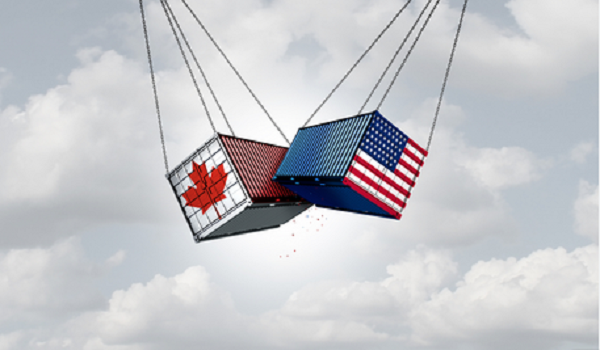
Looming Tariffs Threaten to Derail Canada-U.S. Trade Negotiations
Canada’s top trade negotiator has warned her American counterparts that if the White House imposes new tariffs on Aug. 19, the move would represent a “cliff” that risks halting negotiations with the U.S.
According to five sources briefed on the discussions, Janice Charette delivered the message in a meeting last week with United States Trade Representative Jamieson Greer.
Four of the sources said Ms. Charette cautioned the Americans on the public mood in Canada should President Donald Trump make good on his threat to impose the new tariffs.

The sources said she warned the officials that Ottawa would not be able to rein in or control the public or premiers’ reactions and the federal government will have lost the room to negotiate with the Americans.
The Globe and Mail is not identifying the sources, who were not authorized to disclose details of their private briefings on the sensitive trade talks
Mr. Trump has said he will impose 50-per-cent tariffs on $20-billion worth of Canadian goods on Aug. 19. The punitive tariffs apply to a range of goods, including ones that are supposed to be protected by the countries’ free trade pact.
Three of the sources said Ms. Charette also told Mr. Greer that if the tariffs are imposed, the government would be forced by the public to retaliate.
The sources said Mr. Greer acknowledged Ms. Charette’s message and recognized the political pressures the new tariffs would cause in Canada.
A Canadian retaliation would almost certainly provoke a counter-retaliation by Mr. Trump, ratcheting up the bruising trade war even further, one of the sources said, such that Ms. Charette impressed on Mr. Greer that now was the window to reach a deal.
U.S. officials are optimistic that a deal can be reached by Aug. 19, the source said, but they are worried about the ability to sell the pact in Canada.
The new tariffs would be particularly damaging for industries in Ontario, B.C. and Quebec. They would follow Mr. Trump’s previous tariffs on autos, steel, aluminum and forestry products, making them especially punishing.
Ms. Charette has been in Washington for several weeks as she and Canada-U.S. Trade Minister Dominic LeBlanc try to negotiate a deal to avoid the new levies and get the previous ones reduced. Mr. LeBlanc returned to the U.S. capital again on Tuesday for a third meeting in as many weeks with Ms. Charette and Mr. Greer – Mr. Trump’s top trade negotiator.
Ms. Charette spent the weekend hunkered down at the Canadian embassy working with a small army of trade negotiators and experts.
The sources said Ms. Charette is a well-respected and shrewd negotiator who chooses her words carefully. Two of them noted the importance of the use of the word “cliff” in her description of the Aug. 19 tariffs because it’s a term she has used in the past to frame the level of seriousness around trade talks.
Notably, in April she downplayed the significance of a July 1 review date for the Canada-U.S.-Mexico Agreement, saying it was a “checkpoint” and not a “cliff.”
Another one of the sources said Ms. Charette is well received by the Americans in part because of her candour and directness.

Mr. LeBlanc’s office declined to comment on the record on Ms. Charette’s comments and Ms. Charette did not respond to The Globe and Mail.
A Canadian official reiterated Prime Minister Mark Carney’s words from last month, that all options are on the table for retaliation.
The Globe is not identifying the official in order to learn the government’s perspective on the trade talks.
As The Globe previously reported, the two sides are aiming for an “interim” agreement in which Canada would agree to a long list of U.S. demands in exchange for some relief on Mr. Trump’s tariffs.
In addition to the latest tariff threat, the U.S. President has already imposed tariffs of 50 per cent on steel and aluminum, 25 per cent on autos, 10 per cent on lumber and 25 per cent on wooden furniture under Section 232 of the Trade Expansion Act of 1962.
The Aug. 19 deadline for the additional tariffs has lit a fire under negotiations, which had previously dragged for months, and activity has accelerated briskly since then.
In the current talks, the U.S. is demanding that Canada accept export quotas on steel and aluminum, remove retaliatory tariffs on U.S. products, such as autos, return American alcohol to store shelves, remove provincial procurement restrictions, and agree to Washington’s interpretation of how dairy quotas should be allocated.
In exchange, the two sides have discussed the U.S. lowering the 232 tariffs on steel and aluminum but leaving some level of tariff in place. Canada is also pushing for tariff relief for the auto and forestry sectors.
One of Mr. Trump’s top demands is for the ban that most premiers have imposed on American alcohol to be lifted. But premiers, in particular from Ontario, Quebec and B.C. have made it clear that they will be the ones to decide when that happens and they have insisted that the 232 tariffs in particular be resolved first.
On Tuesday, one provincial government source said American alcohol would only return to the shelves if there is significant and meaningful progress on the 232 tariffs on steel, aluminum, autos and lumber. The source said there is no way premiers will fold on the alcohol ban simply in exchange for more talks.
The Globe is not identifying the source who was not authorized to discuss the matter publicly.
Sources with knowledge of the talks who spoke with The Globe have said that, although the contours of a deal have been taking shape, nothing has been agreed to and Mr. Trump has not signed off on anything. Two sources said that a deal would almost certainly have to be presented to Mr. Trump for his sign-off by Monday if the pact were to be agreed by Aug. 19.
Mr. LeBlanc was supposed to return to the U.S. capital on Monday but his plane was turned back to Montreal due to weather. He is leading the talks while the Prime Minister is in Italy on vacation this week. Mr. Carney is expected to return on Aug. 17 and his office said he remains in contact with his officials on the trade negotiations.

The very fact of such sustained negotiations between Canadian and American officials is notable, said Brian Clow, a former deputy chief of staff and advisor on Canada-U.S. relations to then prime minister Justin Trudeau. He now advises companies on cross-border issues and broader geopolitical risks.
“It means there’s a real chance for a deal,” Mr. Clow said, but he cautioned that it doesn’t guarantee one. With one week to go before the Aug. 19 deadline, he said there is very little time to work through technical and complex policies and get the provinces on side.
“The frenzied pace doesn’t necessarily mean a deal will come together,” he cautioned, pointing to the fits and starts with which trade negotiations happened in the first Trump administration.
This article was first reported by The Globe and Mail