







Renewed Geopolitical Tensions Lift Oil Prices and Weigh on Global Markets
The Canadian Vanguard Stock Market Report Monday July 13, 2026 Edition
.
The Toronto Market
Monday’s Toronto Market Index
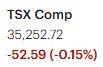
The S&P/TSX Composite Index declined 52.59 points, or 0.15%, on Monday to close at 35,252.72. The index opened above Friday’s closing level but quickly surrendered its early gains within the first 30 minutes of trading. It then remained in negative territory for the balance of the session, reflecting a cautious investor sentiment.

Market activity was largely influenced by escalating geopolitical tensions in the Middle East. Investors reacted to the U.S. military strikes on Iran and Iran’s subsequent retaliatory actions over the weekend. As trading commenced on Monday, developments suggested that the conflict was intensifying rather than easing, prompting a modest shift toward risk aversion across equity markets.
Despite the day’s pullback, the TSX continues to exhibit constructive technical momentum. The index remains comfortably above its 25-day, 50-day, and 200-day moving averages, indicating that the broader intermediate- and long-term uptrend remains intact. While geopolitical uncertainty may contribute to increased market volatility in the near term, the underlying technical picture for Canadian equities continues to be supportive.
Monday’s TSX Market Statistics
Market breadth was negative on Monday, reflecting broad-based weakness across the Toronto Stock Exchange. Declining issues outpaced advancing issues by a margin of nearly 2-to-1, with 1,484 stocks declining compared with 748 advancing, while 125 issues closed unchanged.
The TSX recorded 142 new 52-week highs and 40 new 52-week lows, compared with 134 new highs and 23 new lows on Friday. Although the number of new lows increased, the ratio of new highs to new lows remained within its recent range, suggesting that underlying market leadership continues to favour stocks reaching new highs despite the broader market weakness.
Trading activity strengthened as total share volume reached 405.8 million shares, up approximately 20% from Friday’s 337.8 million shares. Friday’s trading volume was unusually light, likely reflecting investor caution ahead of the weekend after the U.S. President warned on Thursday of potential military action against Iran. With geopolitical developments unfolding over the weekend, trading volumes returned to more typical levels on Monday as investors repositioned portfolios in response to the heightened uncertainty.
Overall, Monday’s trading reflected a risk-off tone driven by geopolitical concerns, with negative market breadth offsetting an otherwise constructive longer-term technical backdrop.
.
Monday’s Toronto TSX Market Wrap-Up Report
The S&P/TSX Composite Index declined 52.59 points, or 0.15%, on Monday to close at 35,252.72. After opening above Friday’s close, the index surrendered its early gains within the first 30 minutes of trading and remained in negative territory for the remainder of the session. Despite the modest decline, the TSX continues to trade comfortably above its 25-day, 50-day, and 200-day moving averages, indicating that the broader intermediate- and long-term uptrend remains intact.
Investor sentiment was dominated by escalating geopolitical tensions in the Middle East following the U.S. military strikes on Iran and Iran’s retaliatory response over the weekend. As markets opened on Monday, investors faced growing concerns that the conflict could broaden, increasing the likelihood of disruptions to global energy supplies.
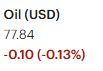
One of the immediate consequences of the heightened tensions has been a sharp increase in crude oil prices, driven by concerns over potential disruptions to oil shipments through the Strait of Hormuz. The Canadian equity market was relatively resilient compared with several other North American exchanges because of its significant weighting in oil and gas producers. Strength in energy stocks helped offset weakness in other sectors, limiting the overall decline in the TSX.
Trading activity returned to more typical levels after Friday’s subdued session. Total share volume reached 405.8 million shares, a 20% increase from Friday’s volume, which had itself been approximately 13% below Thursday’s level. Friday’s lighter trading likely reflected investor caution ahead of the weekend amid growing geopolitical uncertainty. Monday’s increase in activity suggests investors returned to reposition portfolios in response to weekend developments.
Although the TSX finished lower, sector performance was mixed and, in several areas, surprisingly resilient. Six of the ten major sectors posted gains during the session.
The Energy sector was the day’s strongest performer, advancing 2.27% as higher oil prices boosted the outlook for Canadian energy producers. Consumer Durable Goods & Services gained 0.96%, while Telecommunications Services added 0.62%, continuing a recent improvement after a prolonged period of underperformance.
Financials, the largest sector within the TSX by market capitalization, declined 0.40%, acting as one of the primary drags on the index. Basic Materials was the weakest-performing sector, falling 2.80%, as weakness in metals and mining shares more than offset gains elsewhere.
Market breadth reflected the cautious tone. Declining issues outnumbered advancing issues by nearly 2-to-1, with 1,484 stocks declining, 748 advancing, and 125 closing unchanged. The TSX also recorded 142 new 52-week highs and 40 new 52-week lows. While the number of new lows increased from Friday, the new high-to-new low ratio remained within its recent range, suggesting that longer-term market leadership remains constructive despite the day’s pullback.
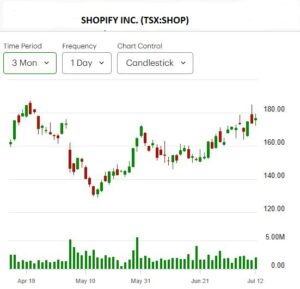
Within the Technology sector, Shopify Inc. (SHOP) was a notable outperformer. The sector gained 1.47%, supported primarily by Shopify’s 1.76% advance. Given Shopify’s substantial weighting within the TSX Technology Index, its performance had a meaningful impact on the sector’s overall gain. Investor sentiment was aided by reports that the company plans to expand the integration of AI-driven shopping and product recommendation capabilities into its e-commerce platform.
Canada’s banking sector experienced a softer session. Five of the six major Canadian banks closed lower, with Bank of Nova Scotia (BNS) standing out as the only member of the group to finish in positive territory, gaining 0.33%.
Key Takeaways for Traders and Investors
- The TSX showed relative resilience. Despite elevated geopolitical risk and a broadly risk-off environment, the TSX declined only 0.15%, outperforming several North American equity markets due to strength in energy shares.
- Energy remains the market leader. Higher crude oil prices continue to support Canadian energy producers. As long as geopolitical tensions persist and oil prices remain elevated, the Energy sector could continue to provide leadership for the TSX.
- Market breadth weakened, but technical conditions remain constructive. Nearly two stocks declined for every stock that advanced, indicating broad selling pressure. However, the TSX continues to trade above its 25-day, 50-day, and 200-day moving averages, and the healthy number of new 52-week highs suggests the longer-term trend remains positive.
- Financials warrant close monitoring. Weakness in Canada’s largest sector limited the index’s performance. A sustained recovery in Financials would likely provide additional support for the broader market.
- Expect elevated volatility. Geopolitical developments in the Middle East are likely to remain the primary short-term catalyst for equity markets, particularly through their influence on oil prices, inflation expectations, and overall investor risk appetite.
Bottom Line: Monday’s trading reflected a market balancing geopolitical uncertainty against the supportive impact of rising energy prices. While investors adopted a more defensive posture, the TSX’s sector composition helped cushion the impact of global risk aversion. Unless geopolitical tensions escalate materially or broaden further, the underlying technical picture for Canadian equities remains constructive despite the day’s modest pullback.
.
The US Markets
Monday’s U.S. Market Indexes
U.S. equities closed broadly lower on Monday as investors adopted a more cautious stance amid escalating geopolitical tensions in the Middle East. The risk-off sentiment weighed particularly heavily on growth-oriented technology stocks, resulting in broad declines across all four major U.S. equity benchmarks.
The Dow Jones Industrial Average fell 138.37 points, or 0.26%, to close at 52,498.64. The S&P 500 declined 60.05 points, or 0.79%, to finish at 7,515.34. The technology-heavy Nasdaq Composite recorded the day’s steepest loss, falling 408.43 points, or 1.55%, to close at 25,873.18. The Russell 2000 Index, which tracks small-cap companies, lost 24.64 points, or 0.83%, to end the session at 2,953.17.

Monday’s decline reversed Friday’s generally positive performance, when the Russell 2000 was the only major U.S. index to finish lower. With Monday’s decline, the Russell 2000 has now posted back-to-back losing sessions, reflecting continued weakness in the small-cap segment of the market.
The Nasdaq Composite was the session’s weakest-performing major index, as investors reduced exposure to higher-growth technology stocks. The combination of elevated geopolitical uncertainty and rising energy prices typically dampens risk appetite, leading investors to rotate away from growth-oriented sectors toward more defensive investments. The Nasdaq has struggled to establish sustained upward momentum since late May, and Monday’s decline leaves the index hovering around its 25-day moving average while remaining above its 50-day and 200-day moving averages.
From a technical perspective, the broader market remains in a constructive position despite Monday’s pullback. Both the Dow Jones Industrial Average and the S&P 500 continue to trade comfortably above their 25-day, 50-day, and 200-day moving averages, indicating that their intermediate- and long-term uptrends remain intact.
Key Takeaways for Traders and Investors
- Geopolitical risk drove market sentiment. Escalating tensions in the Middle East encouraged a broad risk-off trade, leading investors to reduce exposure to equities, particularly higher-valuation growth stocks.
- Technology stocks bore the brunt of the selling. The Nasdaq’s 1.55% decline significantly underperformed the broader market, highlighting investors’ preference for defensive positioning during periods of heightened uncertainty.
- The primary uptrend remains intact. Although Monday’s decline interrupted recent market momentum, the Dow Jones and S&P 500 continue to trade above their key moving averages, suggesting the longer-term bullish trend has not yet been compromised.
- Watch the Nasdaq closely. The index is now testing support near its 25-day moving average. Whether it can hold this level may provide an important signal regarding investor appetite for growth stocks in the days ahead.
Bottom Line: Monday’s weakness reflected a shift toward risk aversion rather than a broad deterioration in market fundamentals. While geopolitical developments are likely to remain the dominant short-term market driver, the technical outlook for the broader U.S. equity market remains constructive unless key support levels begin to fail.
Monday’s U.S. Market Statistics
New York Stock Exchange (NYSE): Market breadth on the New York Stock Exchange was negative on Monday, with declining issues outnumbering advancing issues by approximately 1.6-to-1. The exchange recorded 2,789 declining stocks, 1,703 advancing stocks, and 449 issues that closed unchanged.
The NYSE posted 153 new 52-week highs and 193 new 52-week lows, compared with 72 new highs and 32 new lows on Friday. The sharp increase in both new highs and new lows reflects a broader expansion in market participation as trading activity returned to more typical levels following Friday’s lighter session. Although new lows exceeded new highs, the number of stocks reaching new annual highs recovered to a level more consistent with recent trading activity.
Total NYSE trading volume reached 4.81 billion shares, an increase of approximately 16% from Friday’s 4.14 billion shares. Friday’s lower volume likely reflected investor caution ahead of the weekend amid rising geopolitical uncertainty. Monday’s higher volume suggests that investors returned to the market to adjust portfolio positions following developments over the weekend.
Overall, the NYSE exhibited negative market breadth, indicating that selling pressure was broadly distributed across the exchange. However, the rebound in new 52-week highs suggests that longer-term leadership remains present despite the day’s broad-based weakness.
Nasdaq Stock Market: Market breadth on the Nasdaq was also decisively negative, with declining stocks outnumbering advancing stocks by slightly more than 2-to-1. The exchange recorded 3,284 declining issues, 1,613 advancing issues, and 405 unchanged issues.
Negative breadth has now persisted for three consecutive trading sessions, suggesting that the recent weakness has become more widespread rather than being confined to a handful of large-cap technology stocks. The Nasdaq appears to be undergoing a short-term pullback after an extended advance.
The exchange recorded 93 new 52-week highs and 226 new 52-week lows, compared with 98 new highs and 98 new lows on Friday. The resulting ratio of approximately one new high for every 2.4 new lows reflects a noticeable deterioration in underlying market internals and suggests that selling pressure has broadened across the Nasdaq.
Trading activity remained relatively steady, with total Nasdaq volume reaching 7.47 billion shares, approximately 2% above Friday’s 7.32 billion shares. The modest increase indicates that Monday’s decline occurred on slightly higher participation, although trading volumes were not elevated enough to indicate widespread institutional liquidation.
Key Takeaways for Traders and Investors
- Market breadth weakened across both exchanges. Declining stocks significantly outnumbered advancing stocks on both the NYSE and Nasdaq, confirming that Monday’s weakness was broad-based rather than concentrated in only a few sectors.
- Nasdaq internals deteriorated further. Three consecutive sessions of negative breadth, combined with substantially more new lows than new highs, indicate that the technology-heavy Nasdaq is experiencing a meaningful short-term pullback.
- Trading volume returned to more typical levels. Higher volume on the NYSE suggests investors were actively repositioning portfolios following the weekend’s geopolitical developments, while Nasdaq volume increased only modestly.
- Longer-term market leadership has not disappeared. Although market internals weakened, the NYSE continued to produce a healthy number of new 52-week highs, suggesting that selected areas of the market remain in established uptrends.
Bottom Line: Monday’s market statistics confirmed that the decline in U.S. equities was broad-based, with negative market breadth across both major exchanges. While the Nasdaq showed greater technical deterioration than the NYSE, neither exchange exhibited the exceptionally heavy selling volume typically associated with panic-driven market declines. For now, the statistics are consistent with a risk-off pullback rather than a significant change in the longer-term market trend.
.
Monday’s U.S. Market Wrap-Up Report
U.S. equity markets retreated sharply on Monday as investors responded to escalating geopolitical tensions in the Middle East. The renewed military conflict shifted market sentiment toward a risk-off posture, prompting investors to reduce exposure to higher-risk assets, particularly technology and other growth-oriented sectors.
All four major U.S. equity indexes closed lower. The Nasdaq Composite led the decline, falling 1.55%, while the S&P 500 lost 0.79%, the Russell 2000 declined 0.83%, and the Dow Jones Industrial Average slipped 0.26%. The Nasdaq’s underperformance reflected continued weakness in growth stocks, while the Dow demonstrated greater resilience as investors rotated toward more defensive large-cap companies.
From a technical perspective, the broader market remains in a constructive position despite Monday’s weakness. The Dow Jones Industrial Average and the S&P 500 continue to trade comfortably above their 25-day, 50-day, and 200-day moving averages, suggesting that the longer-term uptrend remains intact. The Nasdaq, however, has struggled to regain momentum since late May and is now testing support near its 25-day moving average.
Market internals confirmed that selling pressure was broad-based. On the New York Stock Exchange, declining issues outnumbered advancing issues by approximately 1.6-to-1, while on the Nasdaq decliners exceeded advancers by slightly more than 2-to-1. Nasdaq market breadth has now been negative for three consecutive sessions, indicating that the recent weakness has become increasingly widespread rather than being confined to a handful of large-cap technology stocks.
Trading activity increased as investors repositioned portfolios following the weekend’s geopolitical developments. NYSE trading volume rose approximately 16% from Friday, while Nasdaq volume increased modestly by 2%. Although participation increased, trading volumes were not elevated enough to suggest widespread institutional liquidation or panic selling.
Sector performance reflected a clear shift toward areas expected to benefit from higher energy prices. Only three of the eleven major S&P sectors closed higher.
Energy led the market with a gain of 2.87%, supported by rising crude oil prices and concerns over potential supply disruptions through the Strait of Hormuz. Telecommunications Services advanced 0.71%, while Consumer Durable Goods & Services gained 0.44%. Financials declined only 0.12%, outperforming the broader market despite finishing lower. Technology was the weakest-performing sector, falling 1.91%, followed by Industrials, down 1.20%, and Basic Materials, down 1.16%.
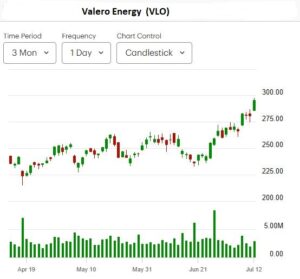
The strongest individual performers were concentrated in the energy industry. Investors rotated into upstream oil producers and downstream refiners as higher crude oil prices improved earnings expectations for the sector. Valero Energy (VLO) gained 5.38%, Phillips 66 (PSX) advanced 5.27%, and Marathon Petroleum (MPC) rose 4.63%. Fertilizer producers also benefited from expectations of higher energy-related input prices, with CF Industries advancing 3.42%.
Several defensive growth industries also attracted buying interest. Biotechnology shares were mixed but generally stronger, with AnaptysBio Inc. (ANAB) gaining 5.15%. Cybersecurity stocks outperformed the broader technology sector as investors continued to view the industry as possessing relatively defensive growth characteristics. Palo Alto Networks (PANW) rose 1.35%, while Fortinet Inc. (FTNT) gained 1.97%.
By contrast, semiconductor, memory, AI infrastructure, and high-beta technology stocks experienced significant selling pressure. Astera Labs (ALAB) declined 12.33%, Sandisk Corp. (SNDK) fell 12.63%, AppLovin Corp. (APP) lost 12.65%, Marvell Technology (MRVL) dropped 7.75%, and Celestica Inc. declined 4.08%. Among the largest technology companies, Apple Inc. (AAPL) gained 0.63%, while IBM advanced 0.93%, demonstrating the relative resilience of mature, cash-generating technology businesses.
Key Takeaways for Traders and Investors
- Markets have entered a news-driven environment. Geopolitical developments are currently exerting a stronger influence on short-term price action than economic data or corporate fundamentals. Investors should expect headline-driven volatility to remain elevated.
- Energy has become the market leader. Rising crude oil prices supported strong gains across energy producers and refiners. Continued strength in oil prices could provide additional support for the sector if geopolitical tensions persist.
- Technology remains under pressure. The Nasdaq significantly underperformed the broader market, with speculative growth, semiconductor, and AI-related stocks experiencing the largest declines. The Nasdaq’s ability to hold its 25-day moving average will be an important technical indicator in the coming sessions.
- Large-cap defensive stocks demonstrated relative resilience. The Dow Jones materially outperformed the Nasdaq, suggesting investors are rotating toward companies with stable earnings, stronger cash flows, and lower volatility.
- Market internals warrant close monitoring. Negative market breadth across both the NYSE and Nasdaq confirms that Monday’s selling was broad-based. However, trading volumes did not reach levels typically associated with panic-driven selling, indicating that investors are repositioning portfolios rather than exiting equities indiscriminately.
Bottom Line
Monday’s trading reflected a classic risk-off session driven by geopolitical uncertainty rather than a deterioration in underlying economic fundamentals. While elevated tensions in the Middle East are likely to remain the dominant short-term market catalyst, the broader technical backdrop for U.S. equities remains constructive, particularly for the Dow Jones Industrial Average and the S&P 500. Until greater clarity emerges on the geopolitical front, investors should expect increased market volatility, continued sector rotation, and heightened sensitivity to news headlines.
.
NOTICE TO READERS
The Canadian Vanguard Stock Market is about empowering you to build and manage your wealth by yourself. There is certainly no magic in managing finances or wealth but one needs to know what to do and commit to doing what is needed. When you are ready to start the journey to Take Charge and Put Your Destiny In Your Own Hands, start with reading The Canadian Vanguard every market day. If and when you need more related information or to advertise your business products or services in The Canadian Vanguard, Contact Us
Our readers are strongly advised to conduct their own research into individual stocks before making a purchase decision. In addition, investors are advised that past stock performance is no guarantee of future price appreciation. Any recommendation is not a guarantee of any particular stock’s future prices, and The Canadian Vanguard accepts no responsibility or liability for investors’ or readers’ purchases.
Stocks In The News/ Stocks To Watch and Market Strategy will soon be available only to Paying Subscribers. The dollar sign “$” in the Toronto Market section in the articles only stands for Canadian dollar and in the US market section “$” stands for US dollar.
(c) This article is published by The Canadian Vanguard on July 137, 2026