




The ‘Liberation Day’ Tariff: Canada Escapes the Worst of New U.S. Trade Penalties
Canada is mostly unaffected by a new U.S. tariff ostensibly targeting goods made with slave labour, business leaders, lawyers and economists say.
Late Thursday, U.S. Trade Representative Jamieson Greer announced that dozens of countries, including Canada, are getting hit with a new tariff because they either don’t have any system to bar goods with slave labour, or aren’t applying anti-slave labour rules effectively.
Canada, Mexico and the United Kingdom are among the countries getting hit with a 10 per cent tariff, while other nations are seeing a 12.5 per cent levy.
But notably for Canada, the new tariff maintains an exemption for goods which qualify under the rules of origin from the Canada-U.S.-Mexico Agreement on trade.

Greer had signalled many details of the new tariff in June, when he announced the conclusion of an investigation into slave labour in international supply chains.
That means that the vast majority of Canadian goods won’t be hit with the new levy, said Matthew Holmes, head of government policy at the Canadian Chamber of Commerce.
“It’s a very small fraction of our products which cannot be CUSMA-compliant,” said Holmes. “By and large we’re in pretty decent shape with regards to this one.”
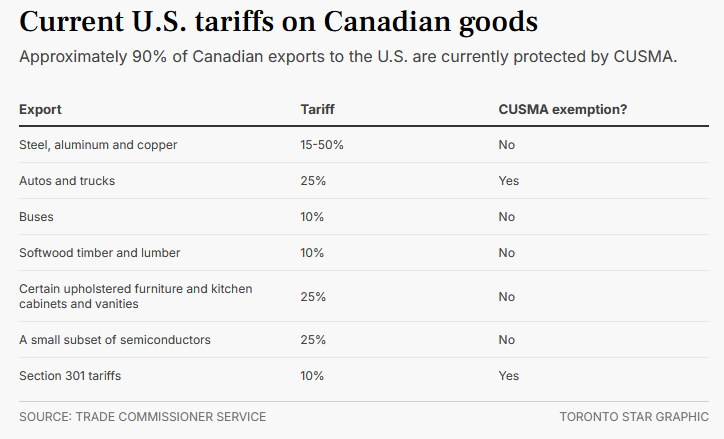
Roughly 90 per cent of Canadian goods exported to the U.S. qualify as CUSMA-compliant, Holmes estimated.
But Holmes and other trade experts on both sides of the border suggested that slave labour, while abhorrent, was merely a pretext for the latest tariff.
Greer’s investigation was announced in March, just days after the U.S. Supreme Court struck down Donald Trump’s so-called Liberation Day tariffs against dozens of countries around the world.
And the new tariff comes into effect as a temporary tariff replacing the Liberation Day tariffs expires.
“They’re just finding a way to get around the court to recreate Liberation Day,” said Holmes. “He just has a bullheaded commitment to global tariffs.”
The Trump administration launched trade investigations earlier this year through Section 301 of the Trade Act of 1974 after the U.S. Supreme Court in February struck down the tariff tool used for the “Liberation Day” and fentanyl-related duties.
‘The exemption list was built around American supply needs’
To temporarily replace his tariffs, Trump used Section 122 of the Trade Act of 1974 for a 10 per cent global duty. That statute was set to expire Friday unless Congress voted to extend it — the same time the new 301 tariffs will now go into effect.
That timing is telling, argued veteran international trade lawyer Barry Appleton.
“The timing speaks for itself. The duties took effect at 12:01 this morning, the day the Section 122 authority expired by its own terms. Not a day earlier. Not a day later,” said Appleton, co-director of the Center for International Law at New York University, and a fellow at the University of Waterloo’s Balsillie School of International Affairs.
A list of exemptions to the Section 301 tariff also shows that eradicating slave labour from supply chains isn’t the main goal, Appleton argued.
“The exemption list was built around American supply needs — coffee, sugar, avocados, pig iron, semiconductor equipment — not around where forced labour risk actually sits,” Appleton said.
Still, Appleton added, Canada’s own record on slave labour isn’t exactly spotless.

“Canada’s enforcement of its own prohibition has been thin, and Canada cannot say with certainty how thin, because Canada has never published figures it has the statutory authority to publish,” Appleton said.
The Trump administration’s justification is a ‘sham’
The head of the Canadian Federation of Independent Business blasted the new measures.
“Look, this is effectively a renaming of the Liberation Day tariffs, and now they’re linking it to another flimsy justification,” said CFIB CEO Dan Kelly.
Scott Lincicome of the Washington-based Cato Institute says forced labour needs to be stamped out, but the Trump administration’s justification is a “sham.”
In an analysis published Thursday, Lincicome wrote the findings of the trade investigations were clearly predetermined and the “remedy is both ridiculously blunt and wildly out of proportion.”
With files from The Canadian Press
This article was first reported by The Star