







Gold Surge Boosts Miners as Small Caps and Dow Lag
The Canadian Vanguard Stock Market Report – Wednesday January 28, 2026 Edition.
.
The Toronto Market
Wednesday’s Toronto Market Overview
The S&P/TSX Composite Index advanced 79.67 points, or 0.24%, to close at 33,176.07. Gold prices rose during the day, and the TSX opened in positive territory before slipping below the previous day’s closing value after the first hour. The index then oscillated around that level until shortly after 2 p.m., when it began to edge higher and moved back into positive territory.
The 2 p.m. mark coincided with the U.S. Federal Reserve’s announcement following its scheduled FOMC meeting. The Fed decided to maintain interest rates at their current level. Earlier in the day, the Bank of Canada had also announced that Canadian interest rates would remain unchanged.
Overall, it was a day with no interest rate surprises—an outcome that was likely welcomed by traders and investors.


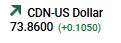
TSX Market Statistics
Market breadth on the TSX was negative, with declining issues outpacing advancing issues. A total of 1,209 securities declined versus 931 advancers, resulting in a decliner-to-advancer ratio of 1.30:1, while 163 issues finished unchanged.
Despite weaker breadth, internal momentum remained constructive, as the exchange recorded 256 new 52-week highs and 51 new 52-week lows. This compares with 218 new highs and 35 new lows in the prior session, indicating continued strength among leading stocks.
Total trading volume reached 601.9 million shares, representing a 14% increase from the previous session’s volume of 525.1 million shares, suggesting elevated investor participation.
Market Internals: Tactical Takeaways
The negative advance–decline ratio points to broad-based profit-taking, particularly among smaller-cap and mid-cap names. However, the sharp increase in new 52-week highs suggests leadership remains intact, with capital continuing to concentrate in a narrower group of higher-quality, large-cap, and momentum-driven stocks.
This divergence between market breadth and new highs is often observed during late-stage advances or consolidation phases, where investors rotate selectively rather than exit the market entirely. In this context, the data imply underlying resilience rather than systemic weakness.
The 14% increase in trading volume reinforces this view, as elevated activity alongside a modest index gain suggests active portfolio repositioning rather than indiscriminate selling. From a tactical standpoint, the environment favors selective exposure and relative-strength strategies, while caution may be warranted toward weaker or more crowded segments of the market.
Toronto Market Wrap-Up Report
Gold prices continued to advance in after-hours trading as Asian markets opened, a move that could provide near-term support for precious metals equities in the next regular trading session. If the strength in gold persists, gold and precious-metal miners are likely to remain in focus.
Gold and precious-metal producers led the Toronto market on Wednesday. The Basic Materials sector posted the strongest performance, gaining 2.16%, followed by Energy, up 0.53%, and Technology, which edged higher by 0.06%. These were the only sectors to finish the session in positive territory.
On the downside, Healthcare declined 0.73%, Financials fell 0.83%, and Consumer Discretionary—a proxy for retail stocks—was the weakest performer, down 1.42%.
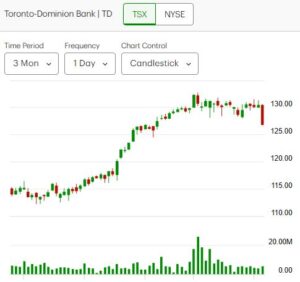
Within Financials, all of Canada’s Big Six banks ended the session lower with the exception of Bank of Montreal (TSX: BMO), which rose 0.75%, or $1.41, to close at $188.81 on volume of 6.7 million shares. Toronto-Dominion Bank (TSX: TD) was the weakest among the group, declining 2.70%, or $3.52, to close at $126.90, with 5.6 million shares traded.
In the Technology sector, Shopify gained 0.95%, or $1.77, on volume of 1.6 million shares. Celestica Inc. (TSX: CLS) advanced 3.29%, or $14.86, during regular trading on volume of 878,000 shares, making it one of the session’s stronger performers. However, CLS traded lower in the after-hours market, down 5.07%, or $17.52, following the release of the company’s earnings report after the market close. After-hours price action may not necessarily be indicative of the stock’s performance during the next regular session.
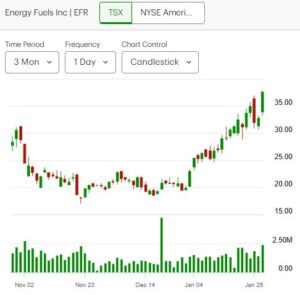
Within the Energy space, Cameco Corporation (TSX: CCO) and Energy Fuels Inc. (TSX: EFR) remain names of interest. Growing demand from large-scale data centers is intensifying the need for reliable, low-emission power sources, with nuclear energy—and to a lesser extent LNG-fired generation—well positioned to meet this demand. Energy Fuels remains a small-capitalization company at this stage but offers leveraged exposure to the nuclear fuel theme.
.
The US Markets
U.S. Equity Market Overview
U.S. equity markets closed mixed, with index-level moves remaining modest. The Dow Jones Industrial Average added 12.19 points, or 0.02%, to finish at 49,015.60. The S&P 500 edged down 0.57 points, or 0.01%, closing at 6,978.03, while the Nasdaq Composite outperformed, gaining 40.35 points, or 0.17%, to end the session at 23,857.45.
Small-cap stocks underperformed, with the Russell 2000 declining 13.15 points, or 0.49%, to close at 2,653.55.
The S&P 500 briefly traded above the 7,000 level intraday but failed to hold the breakout, retreating back into negative territory relative to the prior close. Notably, there was limited buying interest to support a renewed attempt at that psychological resistance level as the session progressed.
Overall market action was characterized by low volatility and narrow trading ranges, with no significant upside or downside momentum across major indices. The Nasdaq led on a relative basis, while continued weakness in the Russell 2000 suggests small-cap equities may be entering a consolidation phase, potentially forming a flat base after their recent advance.

Wednesday’s U.S. Market Statistics
New York Stock Exchange (NYSE)
Market breadth on the NYSE was negative, with declining issues outnumbering advancing issues. The session saw 2,538 decliners versus 1,851 advancers, resulting in a decliner-to-advancer ratio of 1.40:1, while 392 issues finished unchanged.
The exchange recorded 593 new 52-week highs and 97 new 52-week lows, compared with 693 new highs and 95 new lows in the prior session, indicating a modest moderation in upside momentum.
Total NYSE trading volume reached 5.61 billion shares, representing a 4% increase from 5.40 billion shares traded in the previous session.
NASDAQ
Market breadth was also negative on the NASDAQ, with decliners exceeding advancers. A total of 3,068 issues declined compared with 1,729 advancers, producing a decliner-to-advancer ratio of 1.77:1, while 290 issues were unchanged.
The exchange posted 321 new 52-week highs and 144 new 52-week lows, versus 339 new highs and 157 new lows recorded yesterday, suggesting continued but selective leadership among growth-oriented names.
NASDAQ trading volume totaled 8.48 billion shares, up 2% from the prior session’s volume of 8.28 billion shares.
Market Internals Interpretation
The contrast between NYSE and NASDAQ internals highlights a continued divergence between large-cap and growth-oriented leadership. While both exchanges posted negative breadth, the NASDAQ’s relatively resilient new-high/new-low profile suggests that investor interest remains concentrated in select growth and technology names. In contrast, weaker breadth and a pullback in new highs on the NYSE point to more pronounced rotation and profit-taking across traditional large-cap and cyclical sectors. Overall, the data are consistent with a market environment characterized by selective risk-taking rather than broad-based participation.
U.S. Market Wrap-Up Report
Sector Performance
On Wednesday, Telecommunications Services (+1.04%), Basic Materials (+0.99%), and Energy (+0.70%) were the top-performing sectors. Overall, half of the U.S. equity sectors finished the session higher. On the downside, Healthcare (-1.20%) and Consumer Discretionary/Retail were the weakest performers, while Financials posted moderate losses.
Basic Materials has been a consistent outperformer over the past several weeks, largely driven by strength in precious and industrial metals stocks. Many of these names are trading near extended levels, reflecting elevated valuations. Investor interest may persist due to the “fear of missing out” (FOMO) effect, but caution is advised: traditional investment discipline—buy low, sell high—remains a prudent approach. Positions in extended names should be actively monitored, with clear exit strategies in case market momentum reverses.
Technology and Semiconductors
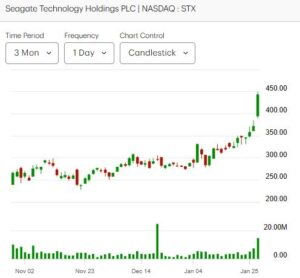
Semiconductor, disk-drive, and chip manufacturers were among the session’s standout performers. Seagate Technology Holdings Plc (STX) was a blowout performer, surging 19.14%, or $71.17, to close at $442.93 on volume of 14.7 million shares, well above its 50-day average of 3.8 million shares. The move followed the company’s earnings report released Tuesday evening.
Other disk-drive manufacturers, including Western Digital Corporation (WDC) and Sandisk Corporation (SNDK), are scheduled to release earnings after market close on Thursday, January 29.
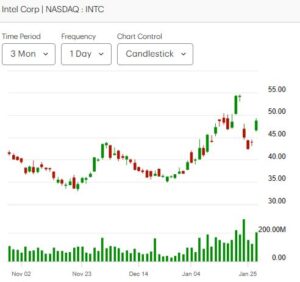
Intel Corp (INTC), another key semiconductor name, also outperformed, showing signs of a potential longer-term recovery. The stock’s recent performance indicates renewed investor interest and positions it as a name to monitor within the sector.
Market Internals Interpretation
The contrast between NYSE and NASDAQ internals highlights a continued divergence between large-cap and growth-oriented leadership. While both exchanges recorded negative breadth, the NASDAQ’s relatively resilient new-high/new-low profile indicates investor focus remains concentrated in select growth and technology names. In contrast, weaker breadth and a pullback in new highs on the NYSE suggest rotation and profit-taking among traditional large-cap and cyclical sectors. Overall, market internals are consistent with an environment characterized by selective risk-taking rather than broad-based participation.
NOTICE TO READERS
The Canadian Vanguard Stock Market is about empowering you to build and manage wealth by yourself. There is certainly no magic in managing finances or wealth but one needs to know what to do and commit to doing what is needed. When you are ready to start the journey to Put Your Destiny In Your Own Hands, read The Canadian Vanguard every market day. If you need more information please Contact Us
Our readers are strongly advised to conduct their own research into individual stocks before making a purchase decision. In addition, investors are advised that past stock performance is no guarantee of future price appreciation. Any recommendation is not a guarantee of any particular stock’s future prices, and The Canadian Vanguard accepts no responsibility or liability for investors’ or readers’ purchases.
Stocks In The News/ Stocks To Watch and Market Strategy will soon be available but only to Paying Subscribers.
(c) This article is published by The Canadian Vanguard on January 28, 2026