






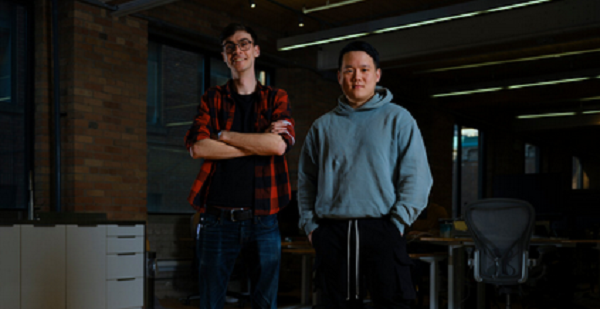
Cohere-Aleph Alpha Merger Creates European-Canadian AI Heavyweight.
Canada’s Cohere Inc. and Aleph Alpha GmbH in Germany announced a merger Friday to create an artificial-intelligence company that can better counterbalance the American technology giants that dominate the industry today.
The combined entity will have its global headquarters in Toronto and its European headquarters in Berlin.
“We are uniting under the Cohere brand to create a global and independent AI powerhouse,” Cohere chief executive officer and co-founder Aidan Gomez said in an interview. The deal enjoys support from the Canadian and German governments, and representatives of each government are set to attend the formal announcement in Germany on Friday morning.
Financial terms were not disclosed. The deal is also subject to approval by Aleph Alpha’s shareholders.
While both players are framing the arrangement as a merger, the combined company will bear the Cohere name and Mr. Gomez will remain as CEO. He declined to comment on the makeup of the rest of the executive team and where specifically the combined entity will be domiciled.
Read More On Our Daily Stock Market Reports – Markets Lower as U.S.–Iran Talks Remain Stalled
“I don’t think I can give that level of detail, but I can say Cohere is going to remain Canadian headquartered and owned,” he said.

The deal will give Cohere more access to the European market, where companies, governments and public institutions are looking to alternatives to American tech as part of a broader digital sovereignty push to ensure more control over crucial systems.
Cohere also said that the Schwarz Group, a German conglomerate, will invest US$600-million in financing as part of an upcoming funding round. Valued at roughly US$7-billion as of last September, Cohere has raised some US$1.6-billion to date from Radical Ventures, Inovia Capital, the Healthcare of Ontario Pension Plan, PSP Investments, Nvidia Corp. and others.
“We need alternatives to the hyperscalers and the hegemons,” federal AI Minister Evan Solomon said in an interview. “This is exactly the kind of deal we hope to create the conditions for.” While Mr. Solomon has worked with his counterparts in Germany to strike agreements on collaborating more closely on technology, he stressed the deal is a commercial transaction.
Cohere and Aleph Alpha share a few similarities. Both were founded in 2019 to build large language models, which power generative AI applications, with a focus on privacy, security and customer control over data – key considerations for businesses, regulated industries and governments looking to adopt AI.
But building LLMs is difficult, costly and requires world-class talent, which is why there are only a few companies doing so today. Aleph Alpha, for example, later sidelined training its own LLMs to focus on helping corporate and government customers implement the technology through a platform it developed called PhariaAI. The company last raised US$500-million in November, 2023, including from industrial giants SAP SE and Bosch, and Schwarz Group.
Aleph Alpha has also experienced management upheaval recently. Founder Jonas Andrulis left the company last year, and in February, 2026, Ilhan Scheer was appointed co-CEO alongside Reto Sporri.
Cohere is still building LLMs and works closely with customers to adopt the technology. It has more than 500 employees compared with 200 at Aleph Alpha, and has scored Royal Bank of Canada, BCE Inc., Fujitsu and LG CNS as customers.
The company has become crucially important for Canada’s AI ambitions, too, especially as the federal government vies to shore up sovereign capabilities. Ottawa announced up to $240-million in 2024 for Cohere to train AI models in Canada and signed a non-binding deal last year to explore the use of AI in the public service. Innovation, Science and Economic Development will get access to the company’s North platform, which can assist public servants with a variety of office-work-related tasks.
Schwarz Group, meanwhile, could shape up to be an important provider of the computing infrastructure necessary to build and power AI applications. While it’s best known as a retail giant with 14,200 stores under the Lidl and Kaufland brands, it has more recently expanded into technology through its Schwarz Digits arm.

The company operates four data centres in Europe and is building an €11-billion (about $17.6-billion) facility in Germany that will be completed by the end of 2027. The company’s goal is to become a hyperscaler, the term for cloud computing giants such as Microsoft Corp., Amazon.com Inc., Google and Oracle Corp., all of which are American.
“I hope they’ll be a close partner,” Mr. Gomez said, adding that the company is evaluating Schwarz’s cloud platform. “We’re excited about it, but we’ll continue to use whatever the best compute available to us is.”
The combined entity would still be smaller than competitors such as OpenAI and Anthropic, but Mr. Gomez has long contended that Cohere is more capital efficient. “We’re never going to spend the most money. That’s not how we compete. But we will create the most scalable and secure technology in the category,” he said.
OpenAI and Anthropic are both reportedly planning initial public offerings, while Mr. Gomez said in October that Cohere was hoping to prepare an IPO “soon.” He was more circumspect this week. “It’s always something we’ve been looking at,” he said, “but we’re not racing to be first.”
This article was first reported by The Globe and Mail