






Heavy Technology Rotation Pushes Nasdaq Below Key Support Level
.
The Toronto Market
The Toronto Market Index
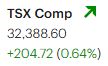
The S&P/TSX Composite Index rose 204.72 points, or 0.64%, to close at 32,388.60. The index extended its rebound for a second consecutive session following Friday’s sharp sell-off. It climbed strongly during the first hour of trading, then declined steadily to below the previous session’s close before reversing course and rallying more than 200 points to finish the day at 32,388.60. Trading volume increased by 12% compared with the prior session.
Monday’s TSX Market Statistics
On the TSX, declining issues outnumbered advancing issues. Specifically, there were 1,119 decliners and 1,074 advancers, resulting in a decliner-to-advancer ratio of 1.04 to 1, with 139 issues unchanged.
There were 172 new 52-week highs and 128 new 52-week lows, compared with 274 new highs and 89 new lows recorded in the previous session.
Total trading volume on the TSX reached 569,047,453 shares, representing a 20% decline from the 715,089,704 shares traded in the prior session.
Analytical TSX Market Wrap
The S&P/TSX Composite Index extended its rebound for a second session, gaining 204.72 points, or 0.64%, to close at 32,388.60. Despite intraday volatility and a mid-session pullback below the prior close, the market finished strongly, suggesting renewed buying interest after Friday’s sharp sell-off. However, lighter volume at 569 million shares, down 20% from the previous session, indicates the rally was driven more by selective rotation than broad risk-on participation.
Market breadth was modestly negative, with decliners narrowly outpacing advancers (1,119 versus 1,074), reinforcing the view that gains were concentrated rather than widespread. New 52-week highs declined to 172 from 274 in the prior session, while new lows increased to 128, signaling some continued internal market stress beneath the headline index advance.
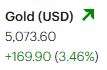
Commodity strength was the dominant theme. Gold and silver prices rebounded sharply, reversing the prior session’s weakness and lifting precious-metal mining stocks. This drove Basic Materials to lead all TSX sectors, highlighting renewed investor demand for inflation-sensitive and defensive commodity exposure.
Sector performance reflected ongoing rotation. Investors reduced exposure to Technology, which lagged the market and posted the steepest sector decline, while reallocating capital toward retail-related and cyclical names. Seven of ten sectors finished higher, but losses in Financials, Industrials, and Technology underscore a cautious tone. Overall, the session points to selective positioning rather than a broad-based risk rally, with investors favoring tangible asset exposure and trimming growth-sensitive technology holdings.
.
The US Markets
U.S. Market Indexes
U.S. equity markets ended mostly lower, reflecting broad risk aversion and continued pressure on growth stocks. The Dow Jones Industrial Average fell 166.67 points, or 0.34%, to close at 49,240.99. The S&P 500 declined 58.63 points, or 0.84%, to 6,917.81, while the Nasdaq Composite underperformed, dropping 336.92 points, or 1.43%, to finish at 23,255.19.
In contrast, the Russell 2000 gained 8.54 points, or 0.31%, closing at 2,648.50, making it the best-performing major index on the day. The Dow initially moved higher but sold off sharply before stabilizing and closing well above the session low, suggesting dip-buying in select large-cap names.
Overall market action was weak, with losses concentrated in large-cap growth and technology stocks. The relative resilience of the Russell 2000 indicates a modest rotation toward domestically focused and value-oriented equities, though the limited upside and subdued participation point to a cautious and defensive trading environment rather than a sustained risk-on shift.

Monday’s U.S. Market Statistics
NYSE
Market breadth on the NYSE was modestly positive, with advancers narrowly outpacing decliners. There were 2,338 advancing issues versus 2,173 decliners, with 373 unchanged, producing an advancer-to-decliner ratio of 1.07 to 1. Despite the positive breadth, internal momentum remained muted. New 52-week highs and lows were unchanged from the prior session, at 165 highs and 73 lows, suggesting a lack of follow-through buying interest.
Total NYSE trading volume rose to 7.13 billion shares, an increase of approximately 22% from the prior session, indicating higher turnover despite the cautious price action.
NASDAQ
NASDAQ internals were notably weaker, reflecting continued pressure on growth and technology stocks. Decliners outnumbered advancers by a ratio of 1.40 to 1, with 2,804 declining issues versus 2,007 advancers and 309 unchanged.
New 52-week lows expanded sharply to 429, up from 299 in the prior session, while new highs increased to 310 from 221. The rise in both highs and lows points to increasing dispersion and heightened volatility within the technology-heavy index.
NASDAQ trading volume climbed 16% to 10.57 billion shares, signaling active selling and repositioning rather than broad accumulation.
U.S. Market Wrap-Up Report
U.S. equity markets reflected pronounced sector rotation and elevated dispersion beneath broadly weaker index performance. Market internals highlighted this divergence, with NYSE breadth modestly positive, while NASDAQ internals deteriorated sharply, underscoring continued pressure on growth and technology stocks. Rising NASDAQ volume and a sharp increase in new 52-week lows point to active distribution rather than consolidation within the technology complex.
Sector performance confirmed the rotation away from technology. Basic Materials led the market, gaining 1.74%, supported by strength in gold and silver prices, which lifted precious-metal mining stocks to the top of the performance tables. Durable Consumer Goods & Services, Energy, and Industrials followed closely, reflecting selective interest in cyclical and commodity-linked exposures. Financials and Industrials ended the session lower, while Technology was the clear laggard, falling 2.16%.
Company-specific action reinforced the defensive shift. Palantir (PLTR) rebounded after weeks of declines, but semiconductor stocks suffered widespread double-digit percentage losses, weighing heavily on the NASDAQ. Micron Technology (MU) closed lower despite ongoing tightness in computer memory supply, signaling that valuation and risk reduction outweighed favorable fundamentals. Software manufacturers extended their recent downtrend, adding to technology sector weakness.
Market Takeaway
The session was characterized by aggressive rotation out of technology and growth-oriented equities toward commodities and select cyclicals. Weak NASDAQ breadth, expanding new lows, and rising volume suggest continued caution and risk management by investors, with market leadership shifting toward tangible assets and away from high-multiple technology names.
NOTICE TO READERS
The Canadian Vanguard Stock Market is about empowering you to build and manage wealth by yourself. There is certainly no magic in managing finances or wealth but one needs to know what to do and commit to doing what is needed. When you are ready to start the journey to Put Your Destiny In Your Own Hands, read The Canadian Vanguard every market day. If you need more information please Contact Us
Our readers are strongly advised to conduct their own research into individual stocks before making a purchase decision. In addition, investors are advised that past stock performance is no guarantee of future price appreciation. Any recommendation is not a guarantee of any particular stock’s future prices, and The Canadian Vanguard accepts no responsibility or liability for investors’ or readers’ purchases.
Stocks In The News/ Stocks To Watch and Market Strategy will soon be available but only to Paying Subscribers.
(c) This article is published by The Canadian Vanguard on February 3, 2026