






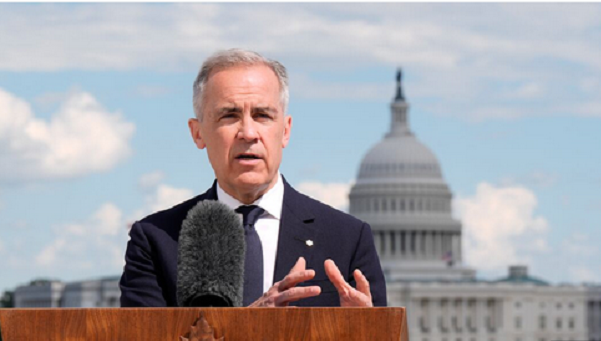
Ahead of Trade Talks, Mark Carney Pitches Renewed Canada-U.S. Alliance
Prime Minister Mark Carney called for “a new partnership” between Canada and the United States on Thursday, as Ottawa looks to get back to the negotiating table ahead of a crucial review of the continental trade agreement.
In a high-profile speech at the Economic Club of New York, Mr. Carney spoke of the “mutual strength” that comes from the two countries’ integrated manufacturing supply chains and energy sectors. And he said Canada was open to more co-operation inside a “Fortress North America” on industries that are currently subject to hefty U.S. tariffs, including automobiles, steel and aluminum.
“Canada strong will help make America great again,” he said. “Examples of where that’s true are legion, where we should work together and compete with the world together. And to those ends, we have made specific, practical proposals to the U.S. administration.”
The remarks struck a more conciliatory tone after months in which Mr. Carney has warned that further economic integration with the U.S. is a weakness. And they follow a speech earlier this month in Toronto where Mr. Carney suggested that Canada was open to “deeper integration” with the U.S. in key industries.
The New York speech was delivered at a critical moment for the Canada-U.S. relationship. The formal review date for the United States-Mexico-Canada trade agreement is less than five weeks away and talks between Ottawa and Washington have effectively stalled.

U.S. negotiators are meeting their counterparts in Mexico City this week for the first formal round of USMCA negotiations – notably without Canada at the table. The countries have scheduled two more rounds of bilateral talks over the next month.
The three countries must meet on July 1 to decide whether to extend the agreement for 16 years or move to a period of annual reviews for 10 years, after which the deal will expire if no extension is reached. Any of the parties can withdraw from the treaty with six months’ notice.
All three countries have said they expect negotiations to continue beyond July 1.
While in New York, Mr. Carney met with executives from BlackRock, Morgan Stanley, Apollo and several other U.S. companies. He also attended a business roundtable meeting that included JP Morgan Chase CEO Jamie Dimon and Netflix CEO Ted Sarandos.
Mr. Carney’s Thursday speech walked a fine line, suggesting a willingness to work more closely with the U.S. in certain sectors, while arguing that Canada needs to enhance its “strategic autonomy.”
This tension between integration and diversification remains the key predicament for Canada heading into the USMCA talks.
Washington has said it is looking to boost U.S. content in continental supply chains by tightening rules of origin for cars and other industrial goods. It also wants Canada and Mexico to align more with its tariffs on China
At the same time, it has offered no guarantees that it will lower sectoral tariffs on steel, aluminum, automobiles and wood products. President Donald Trump has said repeatedly that the U.S. should not be buying cars from Canada.
A “true partnership,” Mr. Carney said, would be one “that reimagines co-operation in specific sectors that are deeply challenged by global competition.”
During his second term, Mr. Trump has taken a contradictory approach to the USMCA – a deal he made during his first term in office. He has exempted many Canadian and Mexican goods from tariffs if they meet USMCA rules but also placed sectoral tariffs on both countries in contravention of the agreement.
Most of Mr. Carney’s speech focused on promoting the government’s moves to diversify its trade, expand its natural-resources sector and spend more on defence.

“We’re realizing our full potential as an energy superpower,” he said, pointing to efforts to expand liquefied natural gas exports, build a new oil pipeline to the West Coast, double the size of the electricity grid and open up critical minerals mines.
At times, he also echoed his provocative World Economic Forum speech in Davos in January, which attracted attention internationally – including from the White House.
In those earlier remarks, he called on the world’s middle powers to work together “to build a new order” that embodies shared values. Without naming specific countries, the speech raised concern with global “hegemons” working to monetize their relationships.
On Thursday in New York, the Prime Minister repeated that “the world is undergoing a rupture.” And he picked up on some of the same themes, pointing out that Canada is working to expand trade with the European Union, Asia and South America.
“One of our core objectives of these partnerships, yes, it’s access to markets, but it’s also to increase our strategic autonomy,” he said. “Because we all live in a world where integration has been weaponized.”
Several of Ottawa’s attempts to carve out its own path on trade and defence have put it squarely at odds with the United States.
That includes Mr. Carney’s decision earlier in the year to break with Washington on Chinese electric-vehicle tariffs and to invite Chinese investment into the Canadian auto sector – something that goes against long-standing U.S. concerns about competition from Chinese automakers in North America.
Ottawa has also delayed a decision to finalize its purchase of 88 F-35 fighter jets from U.S.-based Lockheed Martin Corp. And on Wednesday, it said it was moving forward with negotiations to buy Swedish-made Saab early-warning aircraft technology instead of versions from U.S. suppliers.
Earlier this month, the U.S. government announced that it was freezing a joint defence board with Canada. A Pentagon official attributed the move to delays on the F-35 contract decision and a lack of clarity on Canada’s military spending plans.
Conservative Leader Pierre Poilievre criticized Mr. Carney’s speech Thursday, saying the Prime Minister’s comments about the United States are filled with “highly contradictory” buzzwords.
“On the one hand, he says that we are in the middle of a rupture with the United States. While on the other, he says he wants to make America, in his words, great again,” Mr. Poilievre said in the House of Commons.
“His elbows were again flapping up and down in the rhetorical chicken dance, as he cannot seem to decide if integration with the U.S. is a strength or a weakness.”

In Ottawa on Thursday, Ontario Premier Doug Ford said he’s concerned that Canada is absent as Mexico and the U.S. start trade talks this week.
“We need to get to the table. We need to make sure we have certainty, not just here, but in the United States. I talk to a lot of governors, a lot of senators, they want certainty right now,” he said.
The path forward for trade negotiations remains opaque. Washington’s top trade negotiator has said that he wants to maintain the “pillars” of the trilateral agreement, with some changes, but also layer new bilateral deals on top to address separate issues with Canada and Mexico.
Trade experts expect discussions about bilateral irritants, such as Canada’s dairy quotas or online streaming rules, to happen alongside trilateral discussions about rules of origin and tariff co-ordination.
With reports from Laura Stone in Toronto and Pippa Norman in Ottawa.
This article was first reported by The Globe and Mail