





JPMorgan Posts Profit Growth Fueled by Strong Trading and Investment Banking
JPMorgan Chase (JPM.N), reported a record second-quarter profit on Tuesday, as a wave of big-ticket IPOs and dealmaking helped drive investment banking fees to their highest levels since 2021, while its trading desk capitalized on volatile markets.
Revenue rose across all business units at the bank. Investment banking rode a sharp rebound in the U.S. IPO market, led by Elon Musk’s SpaceX, which roared into the market with the largest listing in history. JPMorgan was among the lead underwriters on the deal.
“This strength is being supported by several tailwinds, including AI-driven capital investment, fiscal stimulus and the benefits of more efficient regulation,” JPMorgan CEO Jamie Dimon said in a statement.
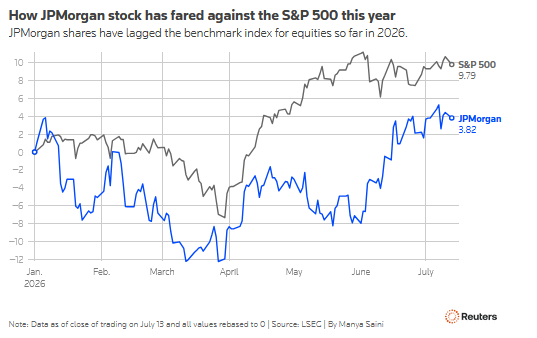
Shares of JPMorgan, however, fell 2% in volatile premarket trading after the bank raised its forecast for 2026 expenses to $107.5 billion from $105 billion.

The largest U.S. lender posted a profit of $21.2 billion, or $7.70 per share, in the three months ended June 30, compared with $14.99 billion, or $5.24 per share, a year earlier.
Profit was boosted by a $4.6 billion gain tied to its stake in Visa. Markets revenue, which houses trading operations, surged 35% over the prior year.
On an adjusted basis, its profit of $6.14 per share beat expectations of $5.85, according to estimates compiled by LSEG.
“The report is fine … It’s landing on a day when the tape is pretty sloppy,” said Art Hogan, chief market strategist at B Riley Wealth.
INTEREST INCOME FORECAST GETS A BUMP
Net interest income, excluding markets, rose 4% from a year earlier to $23.7 billion in the quarter, while average loans climbed 10%.
It raised its 2026 forecast for interest income to $96.5 billion, excluding markets, from $95 billion. Interest income, including markets, is expected to rise to $105.5 billion this year, compared with $103 billion earlier.
Although banks have continued to describe consumers as resilient, the health of lower-income borrowers remains a key focus as higher interest rates and still-elevated living costs pressure household finances.
Dimon said several risks are in focus, including geopolitical tensions and wars, sticky inflation, large global fiscal deficits and elevated asset prices.
The results of large lenders such as JPMorgan Chase and Bank of America (BAC.N) are seen as a barometer of the U.S. economy, as they offer insight into consumer spending, borrowing and business activity.
Investors are also closely watching succession planning at JPMorgan. Dimon plans to remain CEO for at least three more years, Reuters reported last month, citing a source.
The bank’s leadership reshuffle in June elevated Doug Petno and Troy Rohrbaugh to co-presidents and marked the retirement of Marianne Lake, long viewed by Wall Street as a leading contender to succeed Dimon.
Revenue at the consumer and community banking business – now under the stewardship of Rohrbaugh – climbed 8% in the second quarter.
DEALMAKING BOOM
JPMorgan’s investment banking fees jumped 30% in the second quarter from a year earlier, higher than the bank’s earlier estimate.
The bank was part of several landmark transactions during the quarter, including as co-adviser on NextEra Energy’s $67 billion merger with Dominion Energy and lead active bookrunner on Alphabet’s $85 billion equity offering.
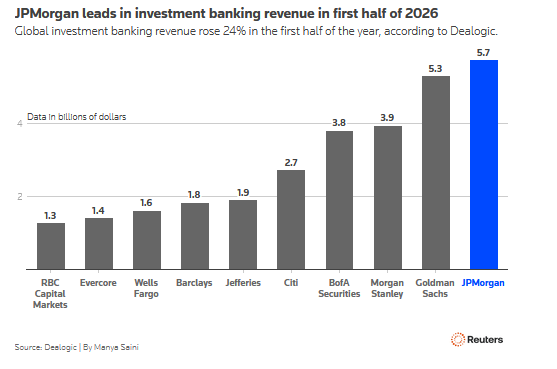
It also retained the top spot in global investment banking league tables, generating the highest investment banking revenue in the industry, according to Dealogic data.
The value of global mergers and acquisitions announced so far this year has surpassed $3 trillion, according to Dealogic data, adding momentum to one of banks’ biggest fee-generating businesses: advising on deals.

Rival Goldman Sachs(GS.N) and Bank of America(BAC.N) also posted higher profits on Tuesday, thanks to strength in trading and dealmaking. Wells Fargo’s (WFC.N) profit was boosted by higher interest income.
STOCK TRADING WINDFALL
Markets remained volatile during the quarter as the conflict in the Middle East and disruptions to shipping through the Strait of Hormuz rattled investors and drove swings across asset classes.
The jump in oil prices also rekindled concerns about inflation, prompting investors to reassess the outlook for Federal Reserve interest-rate cuts.
JPMorgan’s equity trading revenue surged 86%, while fixed-income trading revenue increased 6%.
The recovery in investment banking has coincided with elevated market volatility, giving Wall Street banks a boost across both businesses.
Stronger dealmaking and equity issuance have supported fees, while active client trading has lifted markets revenue.
Reporting by Manya Saini in Bengaluru and Nupur Anand in New York; Additional reporting by Johann M Cherian; Editing by Anil D’Silva
This article was first reported by Reuters