





Warsh Appears Before Congress Amid Focus on Federal Reserve Independence
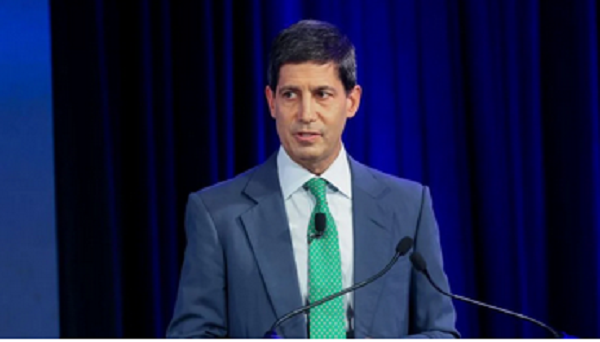
At Federal Reserve Chairman Kevin Warsh’s swearing-in ceremony in May, President Donald Trump was effusive about his pick to lead the U.S. central bank, pumping his fist and applauding alongside administration officials gathered in the White House.
“Go get ’em,” Trump said as Warsh took the podium for a roughly seven-minute address that was only a third as long as Trump’s remarks and blended compliments of the president with the new Fed chief’s ambitions for the central bank.
Just as former Fed Chair Jerome Powell was noted for rebuilding the central bank’s relationship with Congress, Warsh’s potential to keep Trump’s trust could prove an important asset as he manages monetary policy through a difficult-to-read moment in the economy, and oversees a review process touching on key issues for the Fed and the country.

Warsh is expected to further draw out his plans for the Fed and thoughts about the economy during two days of testimony before lawmakers in Congress on Tuesday and Wednesday. The testimony could also show if his first weeks in office have eased concerns that, far from managing Trump, Warsh will either meet the president’s persistent demands for lower interest rates or face the same blowback from the White House that clouded Powell’s tenure and ultimately put the then-Fed chief under a since-abandoned criminal investigation.
At the outset at least, Warsh’s initial steps are seen as showing more distance from Trump than not, with his appointments to a set of task forces last week noted for the level of expertise and the absence of the sort of ideological or partisan figures brought in at other agencies.
“If people were concerned he would be a ‘sock puppet,’ those fears should have been gone after the first press conference” following the Fed’s decision to hold rates steady, when Warsh’s comments were seen, if anything, as tilted toward keeping them that way, said Jon Faust, a former top adviser to Powell and now an economics professor at Johns Hopkins University.
The task force appointments, “really cement that view,” tapping a group of well-known economists, corporate executives and central bankers likely to operate largely as Warsh says he intends — as neutral arbiters of key debates, some new and some ongoing, Faust said.
Warsh is scheduled to appear before the Republican-controlled U.S. House of Representatives Financial Services Committee at 10 a.m. EDT (1400 GMT) on Tuesday, his first public session as Fed chief with lawmakers from that chamber.
The new Fed chief will appear before the Senate Banking Committee at 10 a.m. EDT on Wednesday. That committee, also controlled by Republicans, recommended Warsh for approval to the full Senate on a party-line vote in late April, with Democrats expressing particular concerns about his relationship with Trump and whether he would be truly independent after a selection process in which the president said he would only nominate someone he was certain would cut rates.
Warsh has shown no signs that a rate cut will happen soon.
“I agree that he got the president’s support by giving him dovish signals,” said Samuel Tombs, chief U.S. economist at Pantheon Macroeconomics. “The counterpoint is that now that Warsh is in position, he has the luxury of taking a long, impartial view … Powell successfully showed how independent a Fed chair can be, how political interference can only get so far. I’m sure Warsh has one eye on who Trump’s successor might be,” with his legacy and possible reappointment both at stake.
EARLY HIRES HAVE SHOWN NO PARTICULAR LEAN TO TRUMP SPHERE
If anything, Warsh has begun talking in more conditional terms about some of the things, like artificial intelligence, that before his nomination he said could lower inflation and lead to lower rates.

The monetary policy report submitted to Congress last week ahead of his testimony noted that AI investment is pushing up some prices, and other Fed policymakers have noted how it may be feeding a jump in software costs that is adding inflationary pressure from a new direction.
Warsh has also acknowledged that the timing of supply-side and productivity gains from AI is uncertain, while the impact on demand for capital, skilled construction labor, and infrastructure is occurring now.
His view contrasts with that of former Fed Governor Stephen Miran, who was appointed by Trump last year to temporarily fill a seat on the central bank’s Board of Governors. Miran, who also served as the head of the White House’s Council of Economic Advisers, advocated either a rate cut or a larger rate cut at each of the six Fed meetings he attended during his roughly eight-month tenure, and dissented each time.
While Warsh, unlike his colleagues, did not submit an interest rate projection at the Fed’s June 16-17 meeting and does not plan to do so, since he opposes that sort of “forward guidance,” he said at his press conference that there was only a single policy proposal on the table at his first meeting as Fed chief — with no discussion of a rate cut.
Along with the task force appointments, his other early hires have shown no particular lean to Trump’s sphere or the Make America Great Again movement.
Paul Winfree, one of the advisers Warsh hired on contract, wrote a chapter for the controversial Project 2025 document that included ideas such as abolishing the Fed or dropping its full employment mandate, though he later distanced himself from proposals he said were a synthesis of thoughts from other scholars.
Daniel Heil, a conservative policy analyst who worked with Warsh at Stanford University’s Hoover Institution, was tapped as interim policy adviser.
Warsh also hired John McConnell as a speechwriter. McConnell is a “pre-Trump” Republican who was a top adviser and writer for former President George W. Bush and his vice president, Dick Cheney.
From the Fed staff, Warsh enlisted veteran economists Daniel Covitz, who worked with Warsh during his time as a Fed governor from 2006 to 2011, and Eric Engstrom.

Like others who started out on Trump’s good side but later lost favor, Warsh’s standing with the president could be tested in coming months — if inflation persists, for example, and support among Warsh’s colleagues for rate hikes becomes too great to ignore. The Trump administration could also continue trying to fire Democratic appointees to the Fed board, including Powell, putting Warsh in the situation of either defending the institution, as his predecessor did, or angering the president.
But for now, at least, Warsh seems to be taking Trump at his word when the president at his swearing-in told him to “be totally independent. … Don’t look at me.”
“The president says he wants Kevin to do what he thinks is best. I don’t know if you can say how long that will last,” said former Cleveland Fed President Loretta Mester. But “so far so good,” said Mester, who described the composition of the new Fed task forces as “very promising.”
Reporting by Howard Schneider; Editing by Paul Simao
This article was first reported by Reuters