






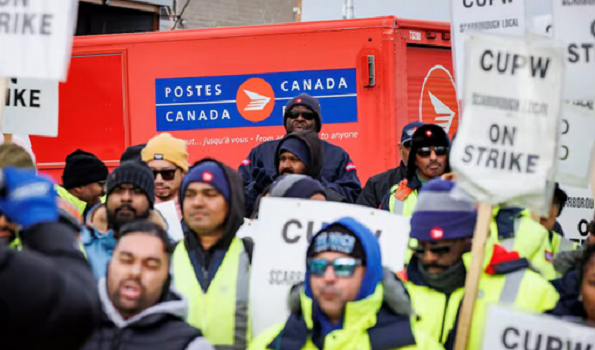
Canada Post Labor Vote Nears Completion With Uncertain Path Forward
As 53,000 postal workers wrap up voting Saturday on a tentative agreement to end a two-year contract dispute with Canada Post, labour analysts say the vote could be a lot closer than expected, and that the Crown corporation is moving ahead with a massive restructuring either way.
A divided union, an unusually long voting window, and concerns about the impact of the restructuring are just some of the reasons the vote by members of the Canadian Union of Postal Workers could be a close one, said Stephanie Ross, a labour studies professor at McMaster University.
“This is one of the most uncertain ratification processes I’ve ever observed,” said Ross, who noted that a public split among the union’s national executive board has seen several top officials — including national president Jan Simpson and negotiator Jim Gallant — come out against the five-year deal which a majority of the board has recommended.
“Leadership has an important role to play in shaping membership’s view of what’s been achieved,” said Ross. “This division at the top makes the outcome more uncertain.”

CUPW declined to comment for this article. In a written statement, Canada Post said it was optimistic union members would approve the deal.
“We remain hopeful employees will choose to ratify the agreements. They are the product of Canada Post and CUPW sitting down to negotiate new agreements at the table,” said Canada Post. The Crown corporation is scheduled to release first quarter results Friday, and is expected to reveal it lost significantly more than the $41 million lost in 2025’s first quarter.
The agreement is for a five-year deal, with wage increases of 6.5 per cent and three per cent in the first two years, and increases to match inflation in the final three years.
The agreement also maintains job security provisions for mail carriers.
Voting has been open since April 20 on what are actually two separate but related tentative agreements: one for CUPW’s rural and suburban bargaining unit, and the other with the urban bargaining unit. (Union members are also voting on a separate question on whether to give their union a fresh strike mandate.)
Opposition to the deal has been far more vocal from within the urban bargaining unit, Ross said.
“My sense is that it’s likely the rural and suburban group will ratify. There’s more unity there, including at the leadership level,” said Ross. “The real wildcard is on the urban agreement.”

If urban workers walk off the job, Ross noted, that could shut down the postal system for the third time in just over two years, because mail-sorting work is done by members of the urban bargaining unit.
“If you can’t get mail sorted, you simply can’t get it delivered,” said Ross.
The long voting window made for a closer vote than if it had been taken more quickly said Steven Tufts, a labour studies professor at York University.
“They dragged out the ratification process to strengthen the no vote. That’s pretty clear in retrospect,” said Tufts.
If the contract gets voted down by either unit, said Tufts, it could speed up a restructuring plan which includes the end of home delivery, as well as the closure of some rural and suburban post offices.
While Canada Post said earlier this year that it is studying which locations to close, Tufts said the Crown corporation almost certainly already has a target list.
“They have a spreadsheet somewhere with a bunch of post offices in red ready to go,” said Tufts.

Even if the contract is voted down by both bargaining units and the union gets another strike mandate, it’s not clear they’d have much to gain at the bargaining table, said the University of Toronto’s Rafael Gomez.
“Right now employees don’t have much leverage. There’s no pressure a work stoppage would bring,” said Gomez, director of U of T’s Centre for Industrial Relations and Human Resources. Some of that is because mail just isn’t as big a factor in Canadians’ lives as it once was.
“Eleven years ago the community mailboxes were an election issue,” said Gomez. “Now, you could have heard a pin drop when they said people weren’t going to to get home delivery any more. People just don’t really get anything in the mail.”
In April, Canada Post announced it would start converting the remaining homes that get mail delivery to community mailboxes later this year.
Last August, CUPW members rejected the Crown corporation’s “final” offer in balloting ordered by the federal government and overseen by the Canada Industrial Relations Board.
In late September, the federal government gave the green light for a broad restructuring of Canada Post, including elimination of home delivery, increased use of community mailboxes and shuttering of some rural post offices.
Joël Lightbound, federal minister of Government Transformation, Public Services and Procurement, said the restructuring was necessary to fight an “existential crisis” faced by the financially struggling Crown corporation.

Within hours of Lightbound’s September announcement, CUPW launched its second national strike in a year. That strike was subsequently downgraded to a series of rotating regional strikes.
On Nov. 7, the Crown corporation gave the federal government its implementation plan for the restructuring, but said it wouldn’t make details public until the plan is finalized and approved. The union has said the restructuring would lead to service cutbacks and job losses.
Canada Post CEO Doug Ettinger reiterated before a parliamentary committee in December that the Crown corporation is expecting 16,000 employees to retire or take voluntary departure by 2030, with another 14,000 leaving by 2035.
This article was first reported by The Star