







Markets Rebound as Softer Inflation Reinforces Expectations That the Fed Will Keep Rates Unchanged This Year
The Canadian Vanguard Stock Market Report Tuesday July 14, 2026 Edition
.
The Toronto Market
Tuesday’s Toronto Market Index
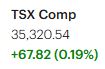
The S&P/TSX Composite Index advanced 67.82 points (0.19%) on Tuesday to close at 35,252.72. While the index finished approximately 200 points below its intraday high, the session was constructive overall, with the TSX remaining in positive territory from the opening bell through the close.
The index established its high within the first hour of trading before entering a prolonged period of consolidation. Trading activity became notably subdued during the final four hours, as the TSX moved within a relatively narrow range. This lack of volatility suggests that investors were generally comfortable maintaining existing positions rather than taking profits after the early advance.
One of the session’s more encouraging features was the market’s resilience in the face of renewed geopolitical tensions in the Middle East. Despite headlines that might have triggered a risk-off response, the TSX remained stable, indicating that investors viewed the developments as having limited immediate impact on market fundamentals.
From a technical perspective, the TSX continues to trade comfortably above its major moving averages, reinforcing the positive intermediate-term trend. Although the inability to hold the session’s high points to some resistance at higher levels, the absence of meaningful selling pressure and the orderly consolidation suggest that buyers remain in control. As long as the index continues to hold above key technical support levels, the broader outlook remains constructive, with investors likely to focus on upcoming corporate earnings, economic data, and central bank signals for the next directional catalyst.
Tuesday’s TSX Market Statistics
Market breadth turned positive on Tuesday, with advancing issues outnumbering declining issues by a comfortable margin. A total of 1,235 stocks advanced, compared with 903 decliners, resulting in an advancer-to-decliner ratio of 1.37:1—or roughly seven advancing stocks for every five declining stocks. An additional 179 issues closed unchanged. The positive breadth confirms that the day’s gains were broadly distributed across the market rather than driven by a handful of large-cap stocks.
The TSX recorded 135 new 52-week highs and 25 new 52-week lows, compared with 142 new highs and 40 new lows in the previous session. While the number of new highs eased modestly, the more significant decline in new lows reflects continued underlying strength in the market. The resulting new-high/new-low ratio remains comfortably positive and broadly consistent with recent market trends, suggesting that bullish momentum continues to outweigh selling pressure.
Total trading volume reached 366.4 million shares, down 10% from Monday’s 405.8 million shares. The lighter volume indicates somewhat reduced trading activity following the previous session. However, the combination of positive market breadth, a healthy new-high/new-low ratio, and the TSX’s ability to hold its gains throughout the day suggests that the advance was broad-based and orderly rather than speculative.
Overall, Tuesday’s statistics point to a constructive trading session. Although trading activity moderated, the positive breadth and continued leadership from stocks reaching new 52-week highs indicate that underlying market participation remains supportive of the current upward trend.
.
Tuesday’s Toronto TSX Market Wrap-Up Report
The S&P/TSX Composite Index extended its advance on Tuesday, gaining 67.82 points (0.19%) to close at 35,252.72. Although the index finished approximately 200 points below its intraday high, it remained in positive territory throughout the session. After reaching its high within the first hour of trading, the TSX spent much of the day consolidating in a relatively narrow trading range. The subdued price action during the afternoon reflected a balanced market in which investors appeared comfortable holding positions rather than taking profits.
Despite renewed geopolitical tensions in the Middle East, the Canadian equity market displayed notable resilience. The absence of meaningful selling pressure suggests that investors remained focused on corporate fundamentals and the broader economic outlook. Technically, the TSX continues to trade comfortably above its major moving averages, reinforcing the positive intermediate-term trend.
Sector performance was mixed, with leadership concentrated in cyclical and financial shares. Basic Materials led all sectors with a gain of 1.66%, supported by strength in precious and industrial metals. Financials added 0.61%, while Utilities edged higher by 0.18%. On the downside, Energy slipped 0.47%, Technology declined 1.10%, and Communication Services was the weakest-performing sector, falling 1.57%. At the industry level, Retail – Catalog & Internet Order surged 22.45%, making it the session’s strongest-performing industry group.
Canada’s major banks continued to provide leadership for the broader market, with all six of the country’s largest banks closing higher. Toronto-Dominion Bank led the group with a 1.24% gain, followed closely by Royal Bank of Canada, which advanced 1.04%. Continued strength in the financial sector remains an important pillar supporting the TSX, given the sector’s significant weighting within the index.
Market internals also reflected a constructive trading environment. Advancing issues outnumbered declining issues by 1,235 to 903, producing an advancer-to-decliner ratio of 1.37:1. The TSX also recorded 135 new 52-week highs versus only 25 new 52-week lows, indicating that leadership remains firmly tilted toward stocks making new highs. Although total trading volume declined approximately 10% from Monday’s level, the combination of positive breadth, a healthy new-high/new-low ratio, and stable afternoon trading suggests that buying interest remained broad-based rather than narrowly concentrated.
In company news, MDA Space Ltd. strengthened its balance sheet by raising approximately $819 million through a bought-deal offering of 23 million shares. Investors responded positively to the financing, sending the stock up 6.67% on trading volume of approximately 1.6 million shares. The successful capital raise reflects continued investor confidence in Canada’s growing space and satellite infrastructure sector.
Celestica Inc. declined 0.71% on relatively light volume of approximately 197,000 shares. More importantly from a technical standpoint, the stock is now trading below both its 25-day and 50-day moving averages. While this does not necessarily signal a change in the company’s longer-term fundamentals, traders should monitor the stock closely. Sustained trading below the 50-day moving average often reflects weakening intermediate-term momentum and may warrant a more cautious approach until the technical picture improves.
Key Takeaways for Traders and Investors
- The TSX remains technically healthy. The index continues to trade above its major moving averages, while Tuesday’s orderly consolidation suggests that buyers remain in control despite the inability to hold the intraday high.
- Market participation remains supportive. Positive market breadth and a strong new-high/new-low ratio indicate that the advance continues to be supported by a broad range of stocks rather than a narrow group of index heavyweights.
- Financials continue to lead. Strength across Canada’s major banks remains a constructive signal for the broader market, as the sector continues to provide stability and leadership.
- Watch for sector rotation. Basic Materials assumed market leadership on Tuesday, while Technology and Communication Services lagged. Continued rotation among sectors may create trading opportunities even if the broader index moves sideways.
- Respect technical signals on individual stocks. Stocks that fall below key moving averages, such as Celestica, deserve closer scrutiny. Conversely, companies demonstrating strong relative strength and making new highs continue to offer more favorable technical setups.
Overall, Tuesday’s session reflected a market that remains resilient, technically constructive, and supported by healthy internal indicators. Unless market breadth deteriorates materially or the TSX breaks below key support levels, the intermediate-term outlook continues to favor the bulls, although investors should remain alert to earnings announcements, economic releases, and geopolitical developments that could influence short-term market direction.
.
The US Markets
.
Tuesday’s U.S. Market Indexes
U.S. equities rebounded on Tuesday, with all four major market indexes closing higher after Monday’s broad-based decline. While the gains were relatively modest, the session reflected improved investor sentiment and a return to risk-taking, particularly in the technology sector.
The Dow Jones Industrial Average gained 9.63 points (0.02%) to close at 52,508.27. The S&P 500 advanced 28.25 points (0.38%) to finish at 7,543.59, while the Nasdaq Composite led the major indexes, rising 233.83 points (0.90%) to close at 26,107.01. The Russell 2000 Index added 11.60 points (0.39%) to end the session at 2,964.76.

Although all of the major indexes finished higher, Tuesday’s session was characterized by relatively low volatility and orderly trading rather than aggressive buying. The Dow opened sharply lower but quickly recovered nearly 500 points during the first half hour of trading. After that initial rebound, the index spent the remainder of the session trading within roughly 100 points of the previous day’s close, reflecting a balanced market and the absence of significant selling pressure.
Technology shares, particularly semiconductor stocks, provided the market’s leadership. The Nasdaq’s 0.90% advance represented the strongest performance among the major indexes and reflected renewed investor interest in growth-oriented sectors. However, the gain only partially recovered Monday’s 1.55% decline, suggesting that investors remain selective and are waiting for additional catalysts before extending the rally.
From a technical perspective, the market’s outlook remains constructive. The Nasdaq continues to trade comfortably above its 25-day, 50-day, and 200-day moving averages, reinforcing both its intermediate- and long-term uptrends. Tuesday’s rebound also suggests that buyers remain willing to step in on periods of weakness.
The Russell 2000 also recovered after two consecutive losing sessions. The small-cap index is currently holding just above its 25-day moving average while remaining well above its 50-day and 200-day moving averages. Holding above these key technical levels would help preserve the bullish intermediate-term outlook for small-cap equities.
.
Key Takeaways for Traders and Investors
- Tuesday’s rebound restored positive market sentiment. All four major U.S. indexes recovered from Monday’s weakness, although the gains were measured rather than decisive.
- Technology resumed market leadership. Semiconductor and other technology stocks drove the Nasdaq’s outperformance, reaffirming the sector’s role as the market’s primary leadership group.
- Low volatility is constructive. Following the Dow’s strong early recovery, the market traded in a narrow range for most of the session. The absence of heavy selling despite recent geopolitical developments suggests that investors remain focused on corporate earnings and the economic outlook.
- Technical trends remain supportive. The Nasdaq continues to trade above its major moving averages, while the Russell 2000 is successfully holding support near its 25-day moving average. These are constructive technical signals for the broader market.
- Watch for follow-through. Tuesday’s advance improved the short-term technical picture, but additional buying over the next several sessions would provide stronger confirmation that the broader uptrend is resuming after Monday’s pullback.
Overall, Tuesday’s trading reflected a healthy rebound following Monday’s decline. The recovery was broad-based, volatility remained subdued, and the major indexes preserved their favorable technical positions. While the market has not yet fully erased Monday’s losses, the underlying price action continues to support a constructive outlook for traders and long-term investors.
.
Tuesday’s U.S. Market Statistics
New York Stock Exchange (NYSE): Market internals improved significantly on the New York Stock Exchange, confirming the rebound in the major U.S. indexes. Advancing issues comfortably outpaced declining issues, with 2,843 advancers versus 1,615 decliners, while 455 stocks closed unchanged. The resulting advancer-to-decliner ratio of 1.76:1—approximately two advancing stocks for every declining stock—indicates that Tuesday’s gains were broadly supported across the market rather than driven by a small number of large-cap stocks.
The improvement was even more evident in the new highs and new lows data. The NYSE recorded 205 new 52-week highs and 109 new 52-week lows, a notable improvement from Monday’s 153 new highs and 193 new lows. Not only did the number of new highs increase substantially, but new lows also declined sharply, producing a decisive shift in market leadership. This reversal suggests that buying interest broadened considerably following Monday’s weakness and that investors were once again willing to accumulate stocks demonstrating relative strength.
Trading activity also strengthened modestly. Total NYSE volume reached 4.97 billion shares, up approximately 3% from Monday’s 4.81 billion shares. Rising volume accompanying improved market breadth generally provides greater confidence in the sustainability of the session’s advance, as it indicates increased investor participation rather than a low-volume technical bounce.
Overall, the NYSE’s internal statistics painted a constructive picture. After the sharp deterioration in Monday’s market internals, Tuesday’s improvement represented a meaningful recovery in investor sentiment and reinforced the view that the broader market remains in a healthy intermediate-term uptrend.
NASDAQ: Market breadth also improved on the Nasdaq, although the recovery was somewhat less robust than on the NYSE. Advancing issues totaled 2,763, compared with 2,121 declining issues, while 405 stocks finished unchanged. The resulting advancer-to-decliner ratio of 1.30:1—roughly six advancing stocks for every five declining stocks—ended a three-session streak of negative market breadth and confirmed a broader improvement in participation across technology and growth stocks.
The exchange recorded 112 new 52-week highs and 172 new 52-week lows, compared with 93 new highs and 226 new lows on Monday. Although new lows continued to outnumber new highs, the improvement was significant. New highs increased by more than 20%, while new lows declined by nearly 25%, indicating that downside momentum moderated considerably as investor sentiment improved.
Total Nasdaq trading volume rose to 7.64 billion shares, approximately 2% above Monday’s 7.47 billion shares. The modest increase in volume, combined with stronger market breadth and the Nasdaq’s leadership among the major indexes, suggests that buyers were willing to selectively re-enter growth-oriented sectors, particularly technology and semiconductor stocks.
.
Key Takeaways for Traders and Investors
- Market breadth improved materially. Both the NYSE and Nasdaq posted positive advancer-to-decliner ratios, confirming that Tuesday’s rally was supported by broad participation rather than a handful of mega-cap stocks.
- Leadership expanded. The NYSE experienced a notable reversal in its new 52-week highs and lows, with new highs comfortably exceeding new lows. This is an encouraging sign that market leadership remains healthy.
- The Nasdaq showed meaningful improvement but still has work to do. While breadth turned positive and the number of new lows declined sharply, new 52-week lows continue to outnumber new highs. Traders should monitor whether this trend continues to improve over the coming sessions.
- Higher volume added credibility to the rebound. Trading volume increased on both exchanges, providing greater confidence that Tuesday’s gains reflected genuine buying interest rather than a temporary technical bounce.
- The broader technical picture remains constructive. Tuesday’s market internals complemented the positive action in the major indexes, suggesting that Monday’s weakness was more likely a short-term pullback within an ongoing bullish trend than the beginning of a broader market reversal.
Taken together, Tuesday’s market statistics reinforce the view that investor confidence improved meaningfully following Monday’s selloff. The combination of stronger market breadth, healthier new-high/new-low readings, and modestly higher trading volume points to a market that remains fundamentally resilient. While additional follow-through will be important in the days ahead, the internal data continue to favor the bulls.
.
Tuesday’s U.S. Market Wrap-Up Report
U.S. equities rebounded on Tuesday as investors responded positively to a softer-than-expected inflation report while largely looking past renewed geopolitical tensions in the Middle East. Although crude oil prices extended their recent advance following reports of overnight military escalation, equity markets focused primarily on the improving inflation outlook and the prospect that the Federal Reserve may be less inclined to tighten monetary policy further in the near term.
The annual inflation rate eased to 3.5%, while the monthly increase represented the smallest rise since April 2020. The inflation data reinforced expectations that inflationary pressures continue to moderate, prompting investors to reduce the perceived probability of an additional Federal Reserve interest rate hike at the next policy meeting.
Against this backdrop, all four major U.S. equity indexes finished higher. The Nasdaq Composite led the advance with a gain of 0.90%, followed by the S&P 500, Russell 2000, and Dow Jones Industrial Average. Trading conditions remained relatively calm throughout the session. After recovering sharply from a weak opening, the Dow spent most of the day trading within a narrow range, reflecting an orderly market characterized by balanced buying and selling rather than speculative trading. The Nasdaq also recovered a portion of Monday’s decline and continues to trade comfortably above its major moving averages, reinforcing the market’s constructive intermediate-term technical outlook.
Sector performance reflected renewed investor appetite for growth stocks. Technology led the market with a gain of 1.74%, driven by strength in semiconductor, artificial intelligence, and cybersecurity companies. Basic Materials advanced 1.37%, Financials gained 0.57%, Energy rose 0.38% as higher oil prices supported the sector, and Utilities added 0.33%. Defensive sectors lagged, with Healthcare declining 1.57%, making it the weakest-performing sector of the day.
Market internals confirmed that Tuesday’s advance was broad-based. On the New York Stock Exchange, advancing issues outnumbered declining issues by 2,843 to 1,615, while the exchange recorded 205 new 52-week highs compared with 109 new lows—a significant improvement from Monday’s weaker statistics. Nasdaq market breadth also turned positive after three consecutive negative sessions, while the number of new 52-week lows declined markedly. Trading volume increased modestly on both exchanges, adding credibility to the day’s recovery and suggesting that institutional investors were active buyers.
.
Company Highlights
Corporate earnings and company-specific developments produced several notable trading opportunities.
IBM was the day’s largest disappointment, with the shares falling 25.21% after the company reported second-quarter earnings and revenue that missed analysts’ expectations. The sharp decline weighed on investor sentiment toward legacy enterprise technology companies but also triggered a rotation into firms expected to benefit from increased demand for next-generation AI infrastructure.
Goldman Sachs delivered one of the session’s strongest earnings reports. The investment bank reported a 55% year-over-year increase in investment banking fees to $3.4 billion, including a 130% surge in equity underwriting activity, reflecting a meaningful recovery in capital markets. Investors responded enthusiastically, sending Goldman Sachs shares 9.12% higher on volume of approximately 3.8 million shares.
Artificial intelligence infrastructure remained one of the market’s strongest investment themes. News that Nebius Group (NBIS) signed a computing services agreement worth more than $1 billion with Reflection AI through 2029 highlighted the continued expansion of AI-related capital spending. The agreement provides Reflection AI with access to Nvidia’s next-generation GB300 AI chips and reinforced investor optimism toward companies supplying AI infrastructure.
The AI theme also benefited server manufacturers and semiconductor-related companies. Dell Technologies advanced 7.12%, reflecting expectations for continued demand for AI servers and enterprise computing infrastructure.
Cybersecurity stocks continued to outperform as investors maintained their preference for companies benefiting from long-term structural growth. CrowdStrike Holdings gained 12.14%, while Palo Alto Networks advanced 6.84%, extending the sector’s strong relative performance.
Semiconductor shares staged a healthy rebound after Monday’s sharp selloff. Sandisk Corporation gained 5.01%, Micron Technology rose 4.92%, and Tower Semiconductor climbed 11.24%, demonstrating renewed buying interest in chipmakers after recent profit-taking. While Tuesday’s rebound was encouraging, the semiconductor sector has not yet fully recovered Monday’s losses, making continued follow-through buying an important indicator to watch.
.
Key Takeaways for Traders and Investors
- Inflation remains the market’s primary catalyst. Softer inflation data improved investor sentiment and reduced expectations of near-term Federal Reserve tightening, providing support for equity valuations.
- The market demonstrated resilience. Stocks largely ignored escalating geopolitical tensions, suggesting that investors remain focused on economic fundamentals and corporate earnings rather than headline risk.
- Technology leadership remains intact. AI infrastructure, semiconductors, cybersecurity, and enterprise technology continued to attract institutional capital, allowing the Nasdaq to outperform the broader market.
- Market internals strengthened materially. Positive market breadth, a sharp improvement in new 52-week highs versus new lows, and higher trading volume indicate that Tuesday’s advance was supported by broad investor participation rather than a narrow rally led by mega-cap stocks.
- Financials are re-emerging as a source of leadership. Goldman Sachs’ strong earnings and the sector’s positive performance suggest that improving capital markets activity could become an additional tailwind for equities.
- Watch for confirmation. Tuesday’s rebound was technically constructive, but traders should look for additional follow-through buying over the next several sessions to confirm that Monday’s weakness was simply a short-lived pullback within the broader bull market.
.
Market Outlook
Tuesday’s session reinforced the market’s underlying resilience. Investors responded favorably to encouraging inflation data, earnings-driven opportunities, and improving market breadth while showing little inclination to reduce risk despite heightened geopolitical uncertainty. The major indexes remain in constructive technical positions, and market internals suggest that institutional buying continues to support the broader advance. Assuming inflation continues to moderate and corporate earnings remain generally favorable, the path of least resistance for U.S. equities continues to point higher, although traders should expect periodic bouts of volatility as the market digests economic data, earnings reports, and geopolitical developments.
.
NOTICE TO READERS
The Canadian Vanguard Stock Market is about empowering you to build and manage your wealth by yourself. There is certainly no magic in managing finances or wealth but one needs to know what to do and commit to doing what is needed. When you are ready to start the journey to Take Charge and Put Your Destiny In Your Own Hands, start with reading The Canadian Vanguard every market day. If and when you need more related information or to advertise your business products or services in The Canadian Vanguard, Contact Us
Our readers are strongly advised to conduct their own research into individual stocks before making a purchase decision. In addition, investors are advised that past stock performance is no guarantee of future price appreciation. Any recommendation is not a guarantee of any particular stock’s future prices, and The Canadian Vanguard accepts no responsibility or liability for investors’ or readers’ purchases.
Stocks In The News/ Stocks To Watch and Market Strategy will soon be available only to Paying Subscribers. The dollar sign “$” in the Toronto Market section in the articles only stands for Canadian dollar and in the US market section “$” stands for US dollar.
(c) This article is published by The Canadian Vanguard on July 14, 2026