







Major Indexes Rise as Investors Rotate into Financials and Mega-Cap Tech; Semiconductor Stocks Retreat
The Canadian Vanguard Stock Market Report Wednesday July 15, 2026 Edition
.
The Toronto Market
Wednesday’s Toronto Market Index
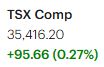
The S&P/TSX Composite Index advanced 95.66 points, or 0.27%, to close at 35,416.20.
The TSX posted an interesting trading pattern during Wednesday’s session, encountering resistance near the 35,473 level. A positive takeaway was that the index remained in positive territory throughout the trading day, reflecting steady buying interest.
From a technical perspective, the TSX continues to trade comfortably above its major moving averages, indicating that the broader uptrend remains intact. The index is holding firmly above the 35,000 level, and the overall chart continues to display bullish momentum.
The TSX’s all-time intraday high stands at 35,630, reached on June 17, approximately one month ago. On that day, the index finished the session at 35,125, leaving the current index level within striking distance of that record high.
Wednesday’s TSX Market Statistics
Market breadth remained constructive on Wednesday as advancing issues outpaced declining issues on the TSX. A total of 1,265 stocks advanced versus 950 that declined, resulting in an advance-to-decline ratio of 1.33:1 (approximately seven advancers for every five decliners). Another 137 issues finished unchanged, indicating broad-based buying interest across the market.
The exchange recorded 179 new 52-week highs and 34 new 52-week lows, compared with 135 new highs and 25 new lows in the previous session. New 52-week highs increased by approximately 33% from the prior day, reflecting improving price momentum and expanding leadership. Although the ratio of new highs to new lows eased slightly, the continued expansion in new highs suggests that investor confidence remains healthy and the underlying trend continues to strengthen.
Total trading volume reached 372.0 million shares, up 1.5% from 366.4 million shares traded in the previous session. While the increase in volume was modest, it accompanied positive market breadth, a constructive combination that indicates buying interest was supported by broader market participation rather than a narrow group of stocks.
Overall, Wednesday’s session was positive from both a technical and participation standpoint. Strong market breadth, a healthy expansion in new highs, and slightly higher trading volume reinforce the view that the TSX remains in a resilient uptrend, providing a supportive backdrop for both traders and longer-term investors.
.
Wednesday’s TSX Market Wrap-Up Report
The S&P/TSX Composite Index advanced 95.66 points, or 0.27%, to close at 35,416.20, extending its position above the psychologically important 35,000 level. The index remained in positive territory throughout the trading session, reflecting steady buying interest despite pockets of sector rotation.
The principal catalyst for Wednesday’s session was the Bank of Canada’s policy announcement. As widely expected, the Bank left its overnight policy rate unchanged at 2.25%, reinforcing expectations of a stable interest-rate environment. The decision was well received by investors and supported continued strength in interest rate-sensitive sectors, particularly financials.
Sector Performance
Financials led the market for a second consecutive session, extending Tuesday’s strong performance. The sector gained 1.46% as investors continued to rotate into Canadian banks and insurance companies. Telecommunications also posted a strong gain of 1.81%, while Consumer Discretionary advanced 1.02%.
Technology (-1.54%) and Basic Materials (-1.42%) were the weakest-performing sectors, suggesting that investors shifted capital from higher-growth sectors into more defensive and value-oriented areas of the market.
Financials Continue to Lead
Canada’s major financial institutions were among the market’s strongest performers.
- Royal Bank of Canada advanced 1.59% on 3.5 million shares traded and recorded a new 52-week high.
- Canadian Imperial Bank of Commerce gained 1.68% to close at $169.48 on approximately 2.0 million shares traded.
- Toronto-Dominion Bank rose 1.42%.
- National Bank of Canada climbed 2.27% to close at $235.32 on 697,600 shares traded.
- Manulife Financial gained 3.10% on 3.1 million shares traded, making it one of the strongest large-cap financial performers of the day.
The continued leadership from the financial sector remains an encouraging sign, as sustained advances in Canada’s largest sector often provide important support for the broader TSX.
Market Breadth Remained Constructive
Market internals continued to support the advance. Advancing issues totaled 1,265 versus 950 decliners, producing a healthy advance-to-decline ratio of 1.33:1. The TSX also recorded 179 new 52-week highs compared with only 34 new 52-week lows, indicating that market leadership continues to broaden even as the index trades near record territory.
Trading volume reached approximately 372 million shares, a modest increase from the previous session. Although volume was only slightly higher, it accompanied positive market breadth, suggesting that buying interest remained broadly supported rather than concentrated in only a handful of stocks.
Stocks to Watch
Construction-related companies continued to display impressive relative strength.
- Bird Construction Inc. surged 13.37% on approximately 679,000 shares traded.
- Aecon Group Inc. gained 9.06% on roughly 532,000 shares traded.
The strength in infrastructure and construction names suggests investors continue to position for long-term capital spending and infrastructure investment themes.
Within the technology and digital infrastructure space, Hut 8 Corp. remains a stock worth monitoring. Shares advanced 4.79% on approximately 447,000 shares traded, reflecting renewed investor interest in data center and high-performance computing businesses.
Technical Outlook
From a technical perspective, the TSX continues to trade comfortably above its major moving averages, confirming that the primary uptrend remains intact. The index also remains within reach of its record intraday high of 35,630 set on June 17. As long as the TSX maintains support above the 35,000 level, the intermediate-term technical outlook remains constructive.
Key Takeaways for Traders and Investors
- The TSX continues to exhibit healthy technical characteristics, trading above major moving averages while holding above the 35,000 level.
- Positive market breadth, expanding new 52-week highs, and modestly higher trading volume point to continued institutional participation in the rally.
- Financials remain the market’s leadership group, supported by a stable interest-rate outlook following the Bank of Canada’s policy decision.
- Sector rotation away from technology and into financials and defensive sectors is becoming more evident and warrants close monitoring.
- Construction and infrastructure stocks continue to display strong relative strength and may offer trading opportunities if momentum persists.
- With the TSX trading near record highs, traders should monitor whether the index can challenge and break above the 35,630 resistance level. A decisive breakout on stronger volume would reinforce the current bullish trend, while failure at that level could lead to short-term consolidation before the next directional move.
.
The US Markets
Wednesday’s U.S. Market Indexes
U.S. equity markets finished higher on Wednesday, led by a rebound in large-cap technology stocks that helped offset weakness in semiconductor shares.
The Dow Jones Industrial Average gained 150.37 points, or 0.29%, to close at 52,658.64. The S&P 500 advanced 28.81 points, or 0.38%, to finish at 7,572.40, while the Nasdaq Composite rose 162.22 points, or 0.62%, to close at 26,269.23. The Russell 2000 Index, which tracks small-cap stocks, added 11.50 points, or 0.39%, ending the session at 2,976.26.

Wednesday’s trading was characterized by a modest but broad-based advance, with investors rotating back into large-cap technology companies after recent profit-taking. While the overall market tone remained constructive, semiconductor stocks experienced notable selling pressure, limiting gains within the broader technology sector. As a result, the Nasdaq posted another positive session, although its advance moderated from Tuesday’s 0.90% gain to 0.62%.
From a technical perspective, the major U.S. equity indexes continue to display strong bullish characteristics. Both the Dow Jones Industrial Average and the S&P 500 remain comfortably above their key 21-day, 50-day, and 200-day moving averages, reinforcing the strength of the prevailing intermediate- and long-term uptrends.
The Russell 2000 extended its winning streak to a second consecutive session and has reclaimed its position above the 21-day moving average while continuing to trade well above its 50-day and 200-day moving averages. Continued strength in small-cap stocks would provide an encouraging sign that market participation is broadening beyond the largest capitalization companies.
The Nasdaq Composite also remains technically strong, trading above its 21-day, 50-day, and 200-day moving averages. However, Wednesday’s session highlighted continued sector rotation within technology. Investors favored mega-cap technology stocks, while semiconductor shares came under pressure, suggesting that capital is becoming more selective within the sector rather than exiting technology altogether.
Key Takeaways for Traders and Investors
- All four major U.S. equity indexes closed higher, reinforcing the market’s underlying bullish trend.
- Large-cap technology stocks regained leadership, helping lift the Nasdaq despite weakness in semiconductor shares.
- The Dow Jones, S&P 500, Nasdaq Composite, and Russell 2000 all continue to trade above their major moving averages, confirming positive technical momentum.
- The Russell 2000’s second consecutive gain suggests improving participation among small-cap stocks, a constructive signal for the broader market.
- Investors should continue monitoring sector rotation within technology. Sustained leadership from mega-cap stocks, combined with stabilization in semiconductor shares, would strengthen the case for another leg higher in the broader market.
.
Wednesday’s U.S. Market Indexes
U.S. equity markets finished higher on Wednesday, led by a rebound in large-cap technology stocks that helped offset weakness in semiconductor shares.
The Dow Jones Industrial Average gained 150.37 points, or 0.29%, to close at 52,658.64. The S&P 500 advanced 28.81 points, or 0.38%, to finish at 7,572.40, while the Nasdaq Composite rose 162.22 points, or 0.62%, to close at 26,269.23. The Russell 2000 Index, which tracks small-cap stocks, added 11.50 points, or 0.39%, ending the session at 2,976.26.
Wednesday’s trading was characterized by a modest but broad-based advance, with investors rotating back into large-cap technology companies after recent profit-taking. While the overall market tone remained constructive, semiconductor stocks experienced notable selling pressure, limiting gains within the broader technology sector. As a result, the Nasdaq posted another positive session, although its advance moderated from Tuesday’s 0.90% gain to 0.62%.
From a technical perspective, the major U.S. equity indexes continue to display strong bullish characteristics. Both the Dow Jones Industrial Average and the S&P 500 remain comfortably above their key 21-day, 50-day, and 200-day moving averages, reinforcing the strength of the prevailing intermediate- and long-term uptrends.
The Russell 2000 extended its winning streak to a second consecutive session and has reclaimed its position above the 21-day moving average while continuing to trade well above its 50-day and 200-day moving averages. Continued strength in small-cap stocks would provide an encouraging sign that market participation is broadening beyond the largest capitalization companies.
The Nasdaq Composite also remains technically strong, trading above its 21-day, 50-day, and 200-day moving averages. However, Wednesday’s session highlighted continued sector rotation within technology. Investors favored mega-cap technology stocks, while semiconductor shares came under pressure, suggesting that capital is becoming more selective within the sector rather than exiting technology altogether.
Key Takeaways for Traders and Investors
- All four major U.S. equity indexes closed higher, reinforcing the market’s underlying bullish trend.
- Large-cap technology stocks regained leadership, helping lift the Nasdaq despite weakness in semiconductor shares.
- The Dow Jones, S&P 500, Nasdaq Composite, and Russell 2000 all continue to trade above their major moving averages, confirming positive technical momentum.
- The Russell 2000’s second consecutive gain suggests improving participation among small-cap stocks, a constructive signal for the broader market.
- Investors should continue monitoring sector rotation within technology. Sustained leadership from mega-cap stocks, combined with stabilization in semiconductor shares, would strengthen the case for another leg higher in the broader market.
.
Wednesday’s U.S. Market Statistics
New York Stock Exchange (NYSE): Market internals remained constructive on the NYSE as advancing issues comfortably outpaced declining issues. A total of 2,704 stocks advanced, while 1,810 declined and 422 finished unchanged, producing an advance-to-decline ratio of 1.50:1, or approximately three advancers for every two decliners. The positive breadth indicates broad participation in Wednesday’s market advance rather than gains being concentrated in a small number of stocks.
The NYSE recorded 269 new 52-week highs compared with 124 new 52-week lows, up from 205 new highs and 109 new lows in the previous session. The sharp increase in new highs, together with a new highs-to-new lows ratio of more than 2:1, suggests improving market momentum and expanding leadership across sectors. This is generally viewed as a constructive signal for the sustainability of the current market trend.
Trading activity also strengthened. Total NYSE volume reached approximately 5.32 billion shares, a 7% increase from the previous session’s 4.97 billion shares. Higher trading volume accompanying positive market breadth reinforces the view that institutional investors were active participants in Wednesday’s advance, adding credibility to the day’s gains.
NASDAQ: Market breadth also improved on the Nasdaq, with advancing stocks outnumbering declining stocks for the first time in four trading sessions. A total of 2,747 stocks advanced versus 2,152 decliners, while 394 issues were unchanged, producing an advance-to-decline ratio of 1.27:1, or roughly six advancers for every five decliners.
Internal market statistics showed meaningful improvement despite continued weakness in portions of the semiconductor sector. The Nasdaq recorded 142 new 52-week highs and 158 new 52-week lows, compared with 112 new highs and 172 new lows in the previous session. The increase in new highs, coupled with a decline in new lows, points to improving market internals and suggests that selling pressure is beginning to moderate even though new lows continue to slightly exceed new highs.
Total Nasdaq trading volume was approximately 7.60 billion shares, down modestly by about 1% from the previous session. The slight decline in volume does not materially detract from the improvement in market breadth, although traders would generally prefer to see stronger volume accompanying future advances to confirm sustained buying conviction.
.
Key Takeaways for Traders and Investors
- NYSE market internals strengthened, with positive breadth, a more than 2:1 ratio of new highs to new lows, and a 7% increase in trading volume providing confirmation of the broader market advance.
- NASDAQ market breadth turned positive after three consecutive sessions of negative breadth, an encouraging sign that participation is broadening despite continued sector rotation within technology.
- New 52-week highs expanded on both exchanges, while new lows stabilized or declined, indicating improving market leadership and healthier underlying price action.
- Institutional participation appeared stronger on the NYSE, where higher trading volume accompanied positive breadth, adding credibility to Wednesday’s gains.
- Overall, Wednesday’s market statistics suggest that the underlying health of the U.S. equity market improved, supporting the bullish technical outlook reflected in the major indexes. Traders should continue monitoring whether improving market breadth is sustained in the coming sessions, particularly within the technology sector.
.
Wednesday’s U.S. Market Wrap-Up Report
U.S. equities closed higher on Wednesday as investors rotated within the technology sector rather than away from it. Buying returned to large-cap technology stocks, while semiconductor shares came under renewed selling pressure, highlighting a more selective approach to growth investing rather than a broad reduction in technology exposure.
The Dow Jones Industrial Average gained 150.37 points (0.29%), the S&P 500 advanced 0.38%, the Nasdaq Composite rose 0.62%, and the Russell 2000 added 0.39%. All four major indexes remain comfortably above their key 21-day, 50-day, and 200-day moving averages, confirming that the primary market trend continues to favor the bulls.
Market Drivers
Investor sentiment was supported by encouraging inflation data released before the opening bell. The U.S. Producer Price Index (PPI) declined 0.3% in June, while the previous month’s reading was revised lower, reinforcing expectations that inflationary pressures continue to moderate. The data offset concerns surrounding rising crude oil prices, which have been driven by ongoing geopolitical tensions in the Middle East.
Although higher energy prices remain a potential inflation risk, investors appeared willing to focus on improving inflation trends and resilient corporate earnings rather than short-term geopolitical uncertainty.
Another important development for Thursday’s session is the earnings report from Taiwan Semiconductor Manufacturing Co. (TSMC). The company reported a 23% increase in quarterly profit, with both revenue and earnings exceeding analysts’ expectations. Given TSMC’s central role in the global semiconductor supply chain, investors will closely monitor how the market responds, particularly following Wednesday’s weakness across semiconductor stocks.
Sector Performance
Consumer Discretionary led Wednesday’s advance, gaining 1.12%, reflecting continued optimism toward consumer spending and retail-related companies.
Financials rose 0.92%, extending their recent leadership as investors continued rotating into banks and diversified financial companies. Healthcare also finished higher, adding 0.33%, while Technology posted a modest gain of 0.23%. Although the technology sector closed higher overall, performance was mixed as strength in mega-cap technology companies offset weakness among semiconductor manufacturers.
Energy (-0.67%) and Utilities (-0.94%) were the weakest-performing sectors during the session.
Market Breadth and Technical Picture
Market internals improved noticeably across both major U.S. exchanges.
On the New York Stock Exchange, advancing issues outnumbered decliners by a healthy 1.50:1 ratio, while new 52-week highs exceeded new lows by more than two to one. Trading volume increased by approximately 7% from the previous session, indicating broader institutional participation in the market advance.
The Nasdaq also recorded improving internals. Advancing stocks outnumbered declining stocks for the first time in four trading sessions, while new 52-week highs increased and new lows declined. Although total trading volume eased slightly, improving breadth suggests that buying interest is broadening beyond a narrow group of stocks.
Collectively, these internal indicators reinforce the constructive technical picture already evident in the major indexes.
Company Highlights
Financial stocks continued attracting institutional buying.
Several major U.S. banks reached new 52-week highs, including:
- Goldman Sachs Group
- JPMorgan Chase & Co.
- Bank of America
- Morgan Stanley
The continued strength in financials suggests investors remain confident in the earnings outlook for the banking sector and continue rotating toward companies expected to benefit from a stable interest-rate environment.
Large-cap technology stocks also recovered strongly.
- Amazon gained 3.02%.
- Apple advanced 4.01%.
- Alphabet rose 3.17%.
- Microsoft added 2.78%.
The strength in these mega-cap companies provided the primary support for the Nasdaq Composite and offset significant weakness elsewhere within the technology sector.
AI infrastructure stocks, however, remained highly volatile. Dell Technologies declined 9.92% to close at $412.17 after rallying sharply in the previous session, illustrating the elevated volatility currently affecting many AI-related companies. Investors should continue to expect wide price swings in this segment as valuations remain sensitive to earnings expectations and sector sentiment.
Technical Outlook
The technical backdrop for U.S. equities remains constructive. All four major indexes continue to trade well above their primary moving averages, while improving market breadth and expanding new 52-week highs suggest the broader market remains healthy.
The principal area of concern remains the semiconductor industry, where continued selling pressure contrasts with renewed strength in mega-cap technology stocks. Whether semiconductor shares stabilize following TSMC’s earnings reaction could have an important influence on near-term market direction.
Key Takeaways for Traders and Investors
- The broader U.S. market remains in a confirmed uptrend, with all four major indexes trading above key moving averages.
- Wednesday’s gains were supported by improving market breadth, expanding new 52-week highs, and stronger participation on the NYSE, all of which reinforce the underlying strength of the rally.
- Investors are rotating within the technology sector rather than exiting it, favoring mega-cap technology companies while reducing exposure to semiconductor stocks.
- Financials continue to demonstrate leadership alongside large-cap technology, providing two important pillars supporting the current market advance.
- TSMC’s earnings and the market’s reaction on Thursday will be closely watched for signals on the semiconductor sector and the broader AI investment theme.
- While the longer-term technical outlook remains bullish, traders should continue to manage risk carefully in AI infrastructure and semiconductor stocks, where volatility remains significantly higher than in the broader market.
.
NOTICE TO READERS
The Canadian Vanguard Stock Market is about empowering you to build and manage your wealth by yourself. There is certainly no magic in managing finances or wealth but one needs to know what to do and commit to doing what is needed. When you are ready to start the journey to Take Charge and Put Your Destiny In Your Own Hands, start with reading The Canadian Vanguard every market day. If and when you need more related information or to advertise your business products or services in The Canadian Vanguard, Contact Us
Our readers are strongly advised to conduct their own research into individual stocks before making a purchase decision. In addition, investors are advised that past stock performance is no guarantee of future price appreciation. Any recommendation is not a guarantee of any particular stock’s future prices, and The Canadian Vanguard accepts no responsibility or liability for investors’ or readers’ purchases.
Stocks In The News/ Stocks To Watch and Market Strategy will soon be available only to Paying Subscribers. The dollar sign “$” in the Toronto Market section in the articles only stands for Canadian dollar and in the US market section “$” stands for US dollar.
(c) This article is published by The Canadian Vanguard on July 15, 2026