







Technology Earnings Power Nasdaq Sharply Higher as U.S. Indexes Rebound
The Canadian Vanguard Stock Market Report Thursday August 27, 2026 Edition
.
The Toronto Market
Thursday Toronto Market Index
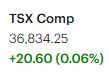
The Toronto S&P/TSX Composite Index rose 20.60 points, or 0.06%, to close at 36,834.25 on Thursday. TSX ends higher as tech and resource shares climb. On Thursday, Canada’s main stock index, the S&P/TSX Composite Index, rose by 20.6 points or 0.1%, closing at 36,834.25, maintaining proximity to its record high set earlier in the week. The modest gain was driven by the strong performance of technology and resource sectors, bolstered by rising commodity prices. These gains helped to counterbalance declines in the financial sector, even as investors processed a series of better-than-expected quarterly earnings reports from major banks. Overall, market sentiment remained positive, supported by strength in key growth-oriented sectors.
The TSX has now closed higher in four of the last five trading sessions. Although Thursday’s gain was modest compared with Wednesday’s 143.98-point decline, the advance was important because it prevented the index from recording two consecutive losing sessions. On Wednesday, Canada’s primary stock index, the S&P/TSX Composite Index, declined by 143.98 points or 0.4%, closing at 36,813.65. This downturn followed a record high close the day before. The drop was primarily driven by declines in metal mining shares, which surrendered some of their earlier gains. Additionally, renewed trade tensions weighed on investor sentiment, raising concerns about potential negative impacts on the Canadian economy.
The market’s performance, however, was not broad-based, with only four of the ten major sectors posting gains. Technology stocks were among the key contributors to the advance, helping offset weakness in other areas of the market. On Thursday, Canada’s main stock index, the S&P/TSX Composite Index, rose by 20.6 points or 0.1%, closing at 36,834.25, maintaining proximity to its record high set earlier in the week. The modest gain was driven by the strong performance of technology and resource sectors, bolstered by rising commodity prices. These gains helped to counterbalance declines in the financial sector, even as investors processed a series of better-than-expected quarterly earnings reports from major banks. Overall, market sentiment remained positive, supported by strength in key growth-oriented sectors.
Despite the mixed sector performance, the TSX continues to demonstrate considerable strength. The index has maintained its strong performance this year, continuing the positive trend established last year, and remains one of the better-performing major equity indexes.
The TSX’s internal strength also remains encouraging. More importantly, the index continues to trade well above its 25-day, 50-day, and 200-day moving averages. This positioning continues to support the broader bullish trend and indicates that, despite occasional pullbacks and short-term volatility, the underlying market structure remains strong.
Thursday’s TSX Market Statistics
At the TSX, advancing issues narrowly edged out declining issues on Thursday. There were 1,091 advancers compared with 1,048 decliners, producing an advancer-to-decliner ratio of 1.04 to 1, or approximately one decliner for every advancer. Another 146 issues were unchanged.
The exchange recorded 54 new 52-week highs and 25 new 52-week lows, compared with 83 new highs and 138 new lows on Wednesday. This represents a significant improvement in the market’s new-high/new-low profile. New 52-week highs outnumbered new lows by more than two to one, with a ratio of 2.16 to 1. By comparison, Wednesday’s ratio was approximately 0.60 to 1, with new lows substantially exceeding new highs.
The number of new 52-week lows also declined sharply, falling by approximately 82% from Wednesday’s 138 to just 25 on Thursday. At the same time, new highs remained well above new lows. This sharp improvement in the new-high/new-low balance is an important technical indication that underlying market conditions strengthened considerably during Thursday’s session.
Although the overall advance-decline balance was only marginally positive, the broader internal picture was constructive. The improvement in new-high/new-low breadth, particularly the dramatic contraction in new lows, suggests that downside pressure has eased significantly. Taken together, these indicators show that the TSX market internals remain strong and bullish, continuing the positive trend that has been evident since Friday.
Total trading volume on the TSX reached 398,557,778 shares, up approximately 8% from the 368,215,272 shares traded on Wednesday. The increase in volume alongside a positive close provides additional support for Thursday’s advance, although the relatively narrow advance-decline balance indicates that participation remained mixed across individual issues.
Thursday’s Toronto TSX Market Wrap-Up Report
The Toronto Stock Exchange finished Thursday modestly higher, but the headline gain does not fully capture the character of the session. The S&P/TSX Composite Index rose 20.60 points, or 0.06%, to close at 36,834.25. The advance was driven primarily by strength in technology stocks, while the overall market lacked broad participation.
Only four of the TSX’s ten major sectors finished higher. Technology was the clear leader, advancing 2.30%, followed by Basic Materials at 0.81%, Industrials at 0.24%, and Energy at 0.12%. The narrow sector participation suggests that Thursday’s positive index close was more dependent on a small group of outperforming sectors than on a broad-based improvement across the market.
Interest Rates Remain an Important Market Factor
The increase in Canadian bond yields remains an important consideration for equity investors. The yield on the Government of Canada 10-year bond rose to 3.71% on Thursday, up from 3.66% on Wednesday and 3.62% on Tuesday.
Rising bond yields can create headwinds for equities because higher yields increase the relative attractiveness of fixed-income investments and raise the discount rate applied to future corporate earnings. Growth-oriented and technology stocks can be particularly sensitive to changes in interest rates. However, Thursday’s strong technology-sector performance indicates that investors were willing to absorb the higher-yield environment and continue buying technology shares.
The rising yield therefore appears to have contributed to the mixed character of the session rather than preventing the market from advancing.
Technology Leads While Market Participation Remains Narrow
Technology was the strongest sector by a considerable margin, gaining 2.30% and providing much of the support behind Thursday’s positive index close. Without the technology sector’s contribution, the overall market would have been considerably weaker.
Several individual stocks also stood out. BlackBerry Limited (BB) surged 10.83%, while Bird Construction Inc. (BDT) gained 4.54%. Aecon Group Inc. (ARE) also ranked among the stronger non-mining and non-energy stocks in the session.
The concentration of gains in technology and a relatively small number of individual stocks is worth monitoring. A market can continue to rise on narrow leadership, but sustained advances are generally more convincing when participation broadens across sectors and individual issues.
Financials Weigh on the Index
The Financials sector declined 0.61% and was one of the principal areas of weakness on Thursday. The sector’s performance was not helped by the latest earnings report from National Bank of Canada, whose shares finished 0.12% lower.
Performance among the major Canadian banks was mixed. Toronto-Dominion Bank was the only member of the Big Six Canadian banks to finish higher, gaining 1.19%. Royal Bank of Canada declined 1.61%, while Canadian Imperial Bank of Commerce fell 2.84%.
Weakness in the Financials sector is significant because of the sector’s substantial weighting in the TSX. Continued weakness among the major banks could therefore become a meaningful headwind for the broader index if it persists.
Gold and Resource Stocks Continue to Show Strength
Strength in Basic Materials also contributed to Thursday’s advance. The sector gained 0.81%, reinforcing the continued strength visible in portions of the resource complex.
Franco-Nevada Corp. rose 1.48% and has now advanced in six of the last seven trading sessions. Agnico Eagle Mines Ltd. gained 0.49% and has risen in nine of its last twelve sessions.
The continued strength in selected gold-related stocks remains noteworthy. It suggests that investors continue to maintain strong interest in precious-metals exposure, while the broader resource complex remains an important source of support for the TSX.
Market Internals Remain Constructive
The most encouraging aspect of Thursday’s session was not the 0.06% index gain itself, but the improvement in several underlying market indicators.
Advancing issues narrowly outnumbered declining issues, with 1,091 advancers versus 1,048 decliners. More importantly, new 52-week highs substantially exceeded new 52-week lows, with 54 new highs compared with only 25 new lows.
This represents a significant improvement from Wednesday, when the exchange recorded 83 new highs and 138 new lows. The sharp reduction in new lows and the return to a positive new-high/new-low balance indicate that downside pressure has eased considerably.
Trading volume also increased. A total of 398.6 million shares changed hands, approximately 8% above Wednesday’s volume of 368.2 million shares. Higher volume accompanying a positive session provides additional support for the market’s underlying trend, although the narrow sector participation means the advance should not be interpreted as uniformly strong across the entire market.
Technical and Investment Perspective
Thursday’s session was another positive close for the TSX, but it was a quality-of-advance rather than a magnitude-of-advance story.
The index continues to trade comfortably above its 25-day, 50-day, and 200-day moving averages, preserving its broader bullish technical structure. The improving new-high/new-low balance is also encouraging, particularly because the number of new lows dropped dramatically from Wednesday.
The principal concern is breadth. Only four of ten major sectors advanced, and Financials—which carry significant influence on the TSX—declined. Technology provided much of the upward momentum, making Thursday’s advance relatively concentrated.
For traders, this creates an environment in which sector and stock selection remain especially important. Momentum traders may continue to find opportunities in technology and selected resource stocks, but should also watch for signs that leadership is becoming overextended or that breadth begins to deteriorate.
For longer-term investors, the more important question is whether the current bullish structure remains intact. At present, the combination of the index remaining above its major moving averages, improving new-high/new-low breadth, relatively strong volume, and repeated recent positive closes continues to favor the bulls. A sustained deterioration in breadth, a significant increase in new lows, or a decisive break below key moving averages would provide a stronger warning that the trend is changing.
Key Takeaway for Traders and Investors
The TSX remains technically bullish, but Thursday’s advance was narrow. The strongest signals remain the index’s position above its major moving averages and the substantial improvement in market breadth, particularly the collapse in new 52-week lows. These factors suggest that the underlying market remains healthy despite the modest headline gain.
However, traders should not mistake a positive index close for broad market strength. Technology and selected resource stocks are doing much of the heavy lifting, while Financials remain a notable source of weakness. Rising Canadian bond yields are another factor to monitor, particularly for interest-rate-sensitive sectors.
Bottom line: The broader trend remains favorable, but the next important technical signal will be whether market participation broadens. A TSX advance accompanied by more sectors participating, expanding new highs, and continued suppression of new lows would strengthen the bullish case. Conversely, renewed deterioration in breadth—especially a sharp increase in new lows—would be an early warning that the current advance is losing internal strength.
.
The US Markets
Thursday’s U.S. Market Indexes
U.S. equity markets had a strong session on Thursday, with all four major indexes closing higher. The advance was led decisively by technology stocks, with the Nasdaq Composite delivering the strongest performance of the major indexes.
The Dow Jones Industrial Average rose 105.56 points, or 0.20%, to close at 53,569.44. The S&P 500 advanced 55.29 points, or 0.72%, to finish at 7,730.99. The Nasdaq Composite rallied 411.16 points, or 1.57%, to close at 26,541.35, while the Russell 2000 gained 8.44 points, or 0.28%, to end at 3,014.34.
Technology Leads the Market
Thursday’s performance was clearly technology-driven. The Nasdaq’s 1.57% advance substantially outpaced the Dow’s 0.20% gain and the Russell 2000’s 0.28% increase. The S&P 500, which has significant exposure to large technology companies, also benefited, gaining 0.72%.
The strong performance in technology came after Nvidia reported quarterly results and provided an optimistic outlook, helping revive investor confidence in the artificial-intelligence and semiconductor investment theme. Other technology and AI-related stocks also participated in the advance. On Thursday, August 27, 2026, major U.S. stock indexes advanced, driven primarily by gains in the technology sector. The S&P 500 rose 0.7%, the Dow Jones Industrial Average increased by 0.2%, and the Nasdaq composite jumped 1.6%. The rally was fueled by robust quarterly profits reported by tech giants like Nvidia and Salesforce, with Nvidia leading the surge after surpassing analysts’ expectations and offering a strong revenue forecast, easing concerns in the AI sector. Treasury yields also inched higher. For the week, the S&P 500 rose 0.7%, Dow 0.5%, and Nasdaq 1.4%, while the Russell 2000 edged down 0.1%. Year-to-date, the Nasdaq is up 14.2%, the S&P 500 by 12.9%, the Dow by 11.5%, and the Russell 2000 by a notable 21.5%.On Thursday, the Nasdaq composite led the major U.S. indexes with a 1.6% gain, fueled by strong earnings reports from tech giants like Nvidia, Salesforce, and CrowdStrike.
The S&P 500 rose 0.7%, driven solely by gains in the technology sector, while the Dow Jones added a modest 0.2%. Nvidia surged over 9% as it surpassed a fresh breakout point, bolstered by robust Q2 earnings and optimistic guidance which included a major AI contract with Amazon Web Services. Salesforce jumped 22.6% on strong earnings and its growing AI partnership with Anthropic. CrowdStrike soared 18% after beating expectations and issuing positive guidance. Okta and Fortinet also posted strong gains following earnings reports. Despite the tech rally, some sectors like data storage lagged, with Everpure and Sandisk seeing notable declines. Gold miners retreated slightly after past gains, while crude oil rose 0.6% to $82.70. Economically, jobless claims unexpectedly dropped to 203,000. Overall, the market showed strong tech momentum led by continued enthusiasm for AI and cloud computing, while anticipation builds for Federal Reserve Chair Kevin Warsh’s upcoming speech in Jackson Hole.
Thursday was a strong technology-led session rather than a broad-based risk-on move across all segments of the equity market.
Large-Cap Stocks Continue to Lead
The Dow continues to demonstrate notable consistency, having closed higher more frequently than the other major indexes in recent sessions. However, Thursday was different in terms of performance magnitude. The Dow significantly underperformed the technology-heavy Nasdaq and also lagged the broader S&P 500.
The Russell 2000, representing smaller U.S. companies, gained only 0.28%. Its modest advance compared with the Nasdaq suggests that investors were more aggressively allocating capital toward large-cap growth and technology stocks than toward small-cap equities.
This relative performance is worth watching. A sustained bull market is generally healthier when leadership eventually broadens from mega-cap technology into small- and mid-cap stocks. For now, technology and large-cap growth remain the dominant sources of momentum.
Technical Position Improves
From a technical perspective, Thursday’s advance was constructive.
The Nasdaq Composite moved decisively back above its 25-day, 50-day, and 200-day moving averages. This is particularly important because the 200-day moving average is widely followed as a long-term trend indicator. Trading above all three averages puts the Nasdaq back in a more favorable technical configuration.
The S&P 500 and Russell 2000 also reclaimed their respective 25-day moving averages. Both indexes remain comfortably above their 50-day and 200-day moving averages, preserving their longer-term bullish structures.
The current technical picture therefore shows a market that has recovered short-term momentum without losing its longer-term trend.
Market Leadership Remains the Key Issue: For investors and traders, the most important question is whether Thursday’s technology-led rally develops into a broader market advance.
The Nasdaq’s strong move above its short-, intermediate-, and long-term moving averages is a positive signal. The S&P 500 also remains technically well positioned. The Russell 2000 is more mixed: although it reclaimed its 25-day moving average, its relatively small gain indicates that small-cap participation is still less convincing.
This divergence between technology and small-cap stocks is worth monitoring. If the Nasdaq continues to lead while the S&P 500 maintains its position above its major moving averages, the broader bullish trend remains intact. However, stronger participation from the Russell 2000 and other cyclical areas would provide additional confirmation that market strength is broadening.
Technical and Investment Perspective
Thursday’s market action strengthened the technical picture for U.S. equities.
The Nasdaq’s decisive recovery above all three major moving averages is particularly encouraging for momentum-oriented traders. The S&P 500 remains well positioned above its 50-day and 200-day moving averages, while the Russell 2000 has also maintained its longer-term bullish structure.
The primary risk is concentration of leadership. Technology stocks were responsible for much of Thursday’s market strength, and the Nasdaq’s 1.57% gain was more than seven times the Dow’s 0.20% advance. A technology-led market can remain strong, but investors should monitor whether participation broadens or whether the major indexes become increasingly dependent on a relatively small group of large-cap technology companies.
For traders, the technical setup favors continued attention to technology, semiconductor, AI, and other momentum-driven stocks, while watching the 25-day moving averages as near-term trend references.
For longer-term investors, the more important signal remains the position of the S&P 500 and Nasdaq relative to their 50-day and 200-day moving averages. As long as those longer-term trend indicators continue to hold, Thursday’s rally can be viewed as a constructive continuation of the broader bullish market structure rather than merely a one-day rebound.
Key Takeaway for Traders and Investors
U..S. equities remain technically bullish, but Thursday’s strength was heavily concentrated in technology.
The Nasdaq delivered the strongest signal by moving clearly back above its 25-day, 50-day, and 200-day moving averages. The S&P 500 and Russell 2000 also improved their short-term technical positions while remaining above their longer-term trend averages.
The next confirmation signal is breadth and leadership rotation. If technology continues to lead while the S&P 500 holds its major moving averages and small-cap stocks begin participating more strongly, the bullish case would become increasingly convincing.
.
Thursday’s U.S. Market Statistics
New York Stock Exchange (NYSE): Market breadth on the New York Stock Exchange was slightly negative on Thursday, despite the broader market indexes closing higher. There were 2,273 declining issues compared with 2,231 advancing issues, while 508 issues were unchanged. This produced a decliner-to-advancer ratio of approximately 1.02 to 1, meaning there were only slightly more decliners than advancers.
The relatively narrow negative breadth is important because it indicates that Thursday’s advance in the major indexes was not broadly supported across NYSE-listed stocks. The market was able to move higher despite a marginally negative advance-decline balance, suggesting that gains were concentrated in selected large-cap and technology-related stocks.
The NYSE recorded 192 new 52-week highs and 82 new 52-week lows, compared with 144 new highs and 66 new lows on Wednesday. New highs therefore increased by approximately 33%, while new lows increased by about 24%.
Despite the increase in both measures, the new-high/new-low balance remained decisively positive. There were approximately 2.34 new 52-week highs for every new low, or roughly seven new highs for every three new lows. This compares with approximately 2.18 to 1 on Wednesday, 1.33 to 1 on Tuesday, and 1.80 to 1 on Friday.
The continued dominance of new highs over new lows is a constructive technical signal. More importantly, the improvement from Tuesday’s much narrower new-high/new-low spread suggests that the underlying market structure remains favorable even though daily breadth was slightly negative.
Total NYSE trading volume reached 4,487,116,128 shares, approximately 6.5% higher than Wednesday’s 4,211,726,878 shares.
The combination of a higher index, increased trading volume, and a strong new-high/new-low balance is generally constructive. However, the slightly negative advance-decline balance indicates that Thursday’s strength was not broad-based across the exchange.
NASDAQ: NASDAQ market breadth was positive on Thursday, with 2,570 advancing issues compared with 2,325 declining issues. Another 386 issues were unchanged. This produced an advancer-to-decliner ratio of approximately 1.11 to 1.
The positive advance-decline balance provides additional support for Thursday’s strong Nasdaq index performance. Unlike the NYSE, the Nasdaq had more advancing than declining issues, although the margin was not particularly wide relative to the magnitude of the index’s gain.
The Nasdaq recorded 127 new 52-week highs and 119 new 52-week lows, compared with 94 new highs and 106 new lows on Wednesday. New highs therefore increased by approximately 35%, while new lows increased by approximately 12%.
This produced a new-high/new-low ratio of approximately 1.07 to 1. Although the ratio was much less impressive than the NYSE’s, the fact that new highs once again exceeded new lows is technically constructive. Wednesday’s ratio was approximately 0.89 to 1, meaning new lows exceeded new highs.
The improvement is therefore more important than the absolute ratio. The Nasdaq has moved from having more new lows than new highs on Wednesday to having slightly more new highs than new lows on Thursday. This suggests that the underlying momentum has improved alongside the strong performance of the technology-heavy Nasdaq Composite.
Total NASDAQ trading volume reached 7,678,436,938 shares, approximately 3.3% higher than Wednesday’s 7,432,165,799 shares.
The Nasdaq’s combination of a higher index, increased volume, positive advance-decline breadth, and an improvement in the new-high/new-low balance is a favorable technical combination. It provides stronger confirmation for Thursday’s advance than the headline index gain alone.
Technical Market Assessment: Thursday’s market internals present a constructive but somewhat uneven picture.
The NYSE showed slightly negative daily breadth, while the Nasdaq recorded positive breadth. However, both exchanges continued to show more new 52-week highs than new 52-week lows, and the number of new highs increased substantially on both exchanges.
The divergence between daily breadth and new-high/new-low breadth is worth watching. A market can continue advancing with narrow daily breadth as long as the longer-term participation indicators—particularly new highs versus new lows—remain healthy. The current data continue to support that interpretation.
Trading volume also moved in the preferred direction on both exchanges: the major indexes advanced while volume increased. Rising prices accompanied by higher volume generally provide better confirmation of an advance than rising prices on declining volume.
For traders, the key issue is whether Thursday’s improvement in Nasdaq breadth and new highs develops into broader participation. Continued strength in technology and large-cap growth stocks would support momentum, but a broader expansion in advancing issues and new highs would provide stronger confirmation.
For investors, the more important signal remains the persistence of new highs over new lows and the ability of the major indexes to remain above their key moving averages. At present, the internals do not indicate a significant deterioration in the broader bullish trend.
Key Takeaway for Traders and Investors
Thursday’s internals remained bullish, but the strength was not uniformly broad-based.
The NYSE posted slightly negative daily breadth, while the Nasdaq recorded positive breadth. Nevertheless, new 52-week highs continued to exceed new lows on both exchanges, with a particularly strong high-low balance on the NYSE.
The increase in trading volume on both exchanges while the indexes advanced is another constructive signal. Most importantly, the Nasdaq’s new-high/new-low balance improved from negative on Wednesday to slightly positive on Thursday, supporting the view that underlying technology-market momentum remains healthy.
Bottom line: The market internals continue to favor the bulls, but traders should watch breadth closely. A continued increase in new highs, declining new lows, and broader participation among individual stocks would strengthen the bullish case. Conversely, a sustained rise in new lows combined with deteriorating advance-decline breadth would be an early warning that the current advance is losing internal strength.
.
Thursday’s U.S. Market Wrap-Up Report
U.S. equity markets finished Thursday with a positive bias, but the advance was relatively narrow and heavily concentrated in technology and semiconductor stocks. The market’s strong headline performance therefore needs to be viewed alongside the limited sector participation.
Investors should also prepare for a potentially significant market-moving event on Friday. Federal Reserve Chairman Jerome Powell is scheduled to deliver a keynote speech at 10:00 a.m. EDT at the annual Jackson Hole Economic Policy Symposium. The conference began Wednesday, and the Federal Reserve Chair’s remarks at Jackson Hole are closely watched by investors because comments regarding inflation, interest rates, monetary policy, and the economic outlook can have an immediate impact on stocks, bonds, and currency markets.
For traders, Friday’s event represents an important source of event risk. Investors may want to account for the possibility of increased volatility around the speech, particularly in interest-rate-sensitive sectors and growth stocks.
Technology Dominates Thursday’s Advance: Market breadth was positive on Thursday, but the advance was far from broad-based. Only three of the eleven major market sectors finished higher.
Technology was by far the strongest sector, gaining 2.40% and providing much of the upward momentum behind the overall market. Basic Materials edged higher by just 0.06%, while Energy gained 0.02%.
The remaining eight sectors finished lower. Industrials declined 0.33%, while Financials fell 0.54%. Telecommunications Services and Durable Consumer Goods & Services were the weakest sectors, declining 1.24% and 1.25%, respectively.
The sector distribution is important from an investment perspective. A market advance led overwhelmingly by one sector can be powerful, particularly when that sector has substantial index weight, but it does not necessarily represent broad improvement in investor risk appetite.
Thursday was therefore a technology-led advance rather than a broad-based market rally.
Nvidia Sparks a Semiconductor Rally: The semiconductor group was the center of Thursday’s technology strength following Nvidia’s earnings report released late Wednesday.
Nvidia (NVDA) surged approximately 8.7%, closing at $227.98 on extremely heavy volume of approximately 298.7 million shares. The magnitude of both the price increase and trading volume makes Nvidia the clearest individual-stock contributor to Thursday’s technology momentum.
The reaction demonstrates the continuing influence of Nvidia and the artificial-intelligence investment theme on the broader technology sector. When a stock of Nvidia’s size moves nearly 9% on enormous volume, its impact extends well beyond the individual company and can materially influence sector ETFs and major market indexes.
For traders, Thursday’s Nvidia move represents a significant momentum event. For investors, however, the more important question is whether the strength spreads beyond Nvidia into the broader semiconductor complex and other technology groups.
Semiconductor Participation Was Uneven: The semiconductor rally was not uniformly distributed across the group.
Micron Technology (MU) opened higher but surrendered most of its early gains before recovering during the final half-hour of trading. The stock finished down approximately 0.32% at $935.39, with approximately 28.8 million shares changing hands.
Sandisk Corporation (SNDK) was even less responsive to the semiconductor rally. The stock opened higher but quickly moved lower and remained approximately 25 points below Wednesday’s closing level for much of the session. It recovered somewhat during the final half-hour but still closed at $1,484.95, with approximately 8.9 million shares traded.
The contrasting performances are noteworthy. Nvidia delivered a powerful breakout-type move, while other semiconductor names failed to participate meaningfully. This suggests that Thursday’s semiconductor strength was selective rather than universally broad-based.
For traders, this distinction matters. Strong performance by the sector leader is encouraging, but confirmation from a larger number of semiconductor stocks would provide stronger evidence of sustainable sector-wide momentum.
Marvell Faces After-Hours Selling
Marvell Technology (MRVL) provided a different signal following its second-quarter earnings report released after Thursday’s regular trading session.
The company had been expected to report adjusted earnings of approximately $1.10 per share on $3.5 billion in revenue, compared with adjusted earnings of $0.76 per share on $2.07 billion in revenue in the comparable quarter
.
NOTICE TO READERS
The Canadian Vanguard Stock Market is about empowering you to build and manage your wealth by yourself. There is certainly no magic in managing finances or wealth but one needs to know what to do and commit to doing what is needed. When you are ready to start the journey to Take Charge and Put Your Destiny In Your Own Hands, start with reading The Canadian Vanguard every market day. If and when you need more related information or to advertise your business products or services in The Canadian Vanguard, Contact Us
Our readers are strongly advised to conduct their own research into individual stocks before making a purchase decision. In addition, investors are advised that past stock performance is no guarantee of future price appreciation. Any recommendation is not a guarantee of any particular stock’s future prices, and The Canadian Vanguard accepts no responsibility or liability for investors’ or readers’ purchases.
Stocks In The News/ Stocks To Watch and Market Strategy will soon be available only to Paying Subscribers. The dollar sign “$” in the Toronto Market section in the articles only stands for Canadian dollar and in the US market section “$” stands for US dollar.
(c) This article is published by The Canadian Vanguard on August 27, 2026