






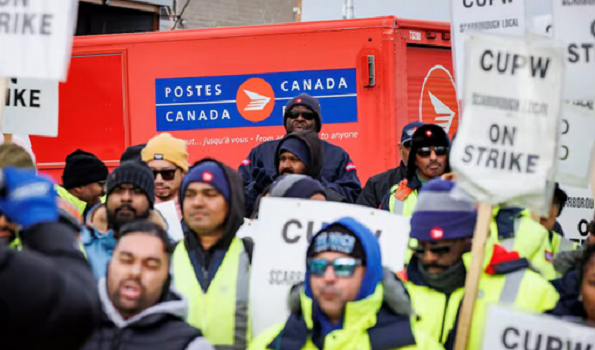
Postal Showdown: Workers Turn Down Canada Post’s Latest Dea
Canada Post employees have voted to reject the Crown corporation’s latest offer for a new collective agreement, a move that brings both parties back to the bargaining table and extends a labour dispute of more than 20 months.
Approximately 70 per cent of workers voted against what their employer had billed as its final offer, which the Canadian Union of Postal Workers had characterized as a deal that would erode employees’ job security and pension benefits, and expand part-time work at the expense of full-time jobs.
“We will reach out to Canada Post management to invite them back to the negotiating table. CUPW is committed to staying at the bargaining table and expects Canada Post to do the same,“ the union said in a statement Friday evening.
The vote, which was was administered by the Canada Industrial Relations Board opened on July 21 and closed Friday.
“This result does not lessen the urgent need to modernize and protect this vital national service. However, it does mean the uncertainty that has been significantly impacting our business – and the many Canadians and Canadian businesses who depend on Canada Post – will continue,” Canada Post spokesperson Lisa Liu said in an e-mailed statement.
The union, which represents roughly 55,000 postal workers, had been campaigning for its members to vote against the deal.
Negotiations for a new deal have been fraught and drawn out because the union and Canada Post are fundamentally at odds over how to restructure the postal service in an age where letter mail volume has significantly decreased and private delivery couriers are flourishing.
In an attempt to bring an end to negotiations, Canada Post had asked the federal government to employ a rarely-used provision of the Canada Labour Code that allows governments to bypass union leadership and direct union members to vote directly on terms of a new contract. Ottawa complied and a forced vote was announced in early June.
CUPW, too, had been keen on resolving negotiations, but continued to be unhappy with key terms in the new contract, particularly around the use of part-time workers for weekend parcel delivery. On multiple occasions, the union had proposed that Ottawa intervene to order binding arbitration. The union believed that a third-party arbitrator would be more likely to preserve full-time jobs.
Steven Tufts, an associate professor of labour studies at York University, said he’s not surprised members struck down the deal.
“The way the government handled the negotiation, by ordering a forced vote, removed the right to free collective bargaining and gave CUPW more ammunition,” he said.


Prof. Tufts said that by pushing for a member vote, Canada Post had made a gamble that there were significant divisions among young workers and old workers on the future of the postal service. “Younger workers have less protection in the collective agreement, and I think Canada Post was counting on them to push forward their vision of part-time, flexible work.”
He added that workers might have rejected the agreement because they viewed the vote itself as a process that was unfair.
Larry Savage, professor of labour studies at Brock University, said nobody at the bargaining table will be happy with the result.
“While Canada Post’s strategy backfired, the fact that 30 per cent of postal workers were willing to settle should make union negotiators a little nervous. The path to a negotiated settlement is as muddy as ever.”
Canada Post blames high labour costs, pension obligations and the rigidity of the collective agreement for its inability to compete with private delivery giants such as DHL, UPS and Amazon. In particular, the corporation wants to create more flexible, part-time jobs to increase the pace of weekend delivery. The corporation had also proposed implementing dynamic routing – delivery routes that change according to mail and parcel volumes – which would mark a drastic shift away from the current fixed routes.
CUPW is vehemently against both those changes, arguing that it will result in fewer overall full-time jobs at the postal service.
Canada Post had been pushing for its employees to accept the offer partly because it said the negotiations – which included a one-month strike in late 2024 – had cost the corporation hundreds of millions of dollars. In 2024, Canada Post reported a loss of $841-million, a significant uptick from a $748-million loss the previous year. The corporation projects that its losses will grow from $900-million in 2025 to $1.7-billion in 2029.
On the wage front, Canada Post had offered increases of 13 per cent over four years, a $1,000 signing bonus for full-time employees, and a $500 signing bonus for part-time employees.
In May, an independent commission appointed by the federal government to understand why Canada Post is losing money concluded that CUPW had to make changes to the collective agreement to allow for greater use of part-time employees. The commissioner, William Kaplan, wrote that the positions should not be “gigified,” but “good, attractive and unionized jobs.”
This article was first reported by The Globe and Mail