






U.S. Opens Anti-Dumping Investigation Targeting Canadian Mushroom Imports
A face-off between North America’s mushroom kingpins is entering trade-law turf as the U.S. kicks off an anti-dumping investigation, a move taken at the behest of one of its largest growers.
It started Sept. 16 when an alliance spearheaded by mushroom giant Giorgio Fresh Co. and five other growers filed a petition alleging Canadian fresh mushrooms imports are heavily subsidized, low-priced and outcompeting the national industry.
An investigation by the U.S. International Trade Commission – an independent, non-partisan federal agency – was announced Friday.
Canada is shipping mountains of mushrooms south at a rapidly increasing rate, which far surpasses those sent north of the border, based on data from Statistics Canada.
But there is no evidence this is because of unfair trading practices, says the Canadian mushroom industry association. Canadian growers are snapping up market share because they are more often better at growing high-quality fresh mushrooms, said another one of the largest mushroom producers in North America – South Mill Champs.
“Frankly, the U.S. growers haven’t invested in modernization,” said Lewis Macleod, chief executive officer of Pennsylvania-based South Mill Champs, whose operations are split evenly between the U.S. and Canada. A number of operations across the U.S. have invested, he said, but not at the same rate.
“Canada invested. The retailers have seen how much better performance they get from a modern, fresh, longer lasting mushroom, and they insist on Canadian.”
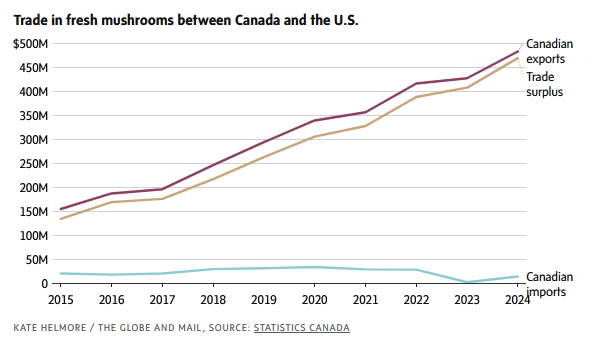
Canada’s $750-million fresh mushroom industry exported more than $487-million of product in 2024, the overwhelming majority to the U.S. (more than $482-million of mushrooms in 2024).
And these exports have steadily increased over the past 10 years, climbing more than 200 per cent from $155-million in 2015.
The vast majority of these mushroom exports are classified as Agaricus – the industry term for a wide range of common mushrooms such as button, portabella and cremini.
The trade imbalance has also skewed more in Canada’s favour. Canada imported only $14-million worth of U.S. fresh mushrooms in 2024, driving a trade surplus of more than $460-million, which has increased by almost 250 per cent over the past 10 years.
But this mounting trade imbalance is not evidence of dumping, said Ryan Koeslag, executive vice-president of Mushrooms Canada, the national industry association. Canada is selling more mushrooms in the U.S. because, for the most part, Canada makes better mushrooms.
Starting 15 to 20 years ago, the Canadian industry invested in modern technology and infrastructure coming out of Europe, the hotbed of mushroom innovation.
Mushrooms are now grown in indoor warehouses on “bunkbeds seven tall,” said Mr. Koeslag. In these controlled environments, the compost and climate have been perfectly formulated to optimize yields, while the doors are sealed with new technology that nearly eliminates pests.
A key transition was from wooden shelving to metal shelving, said Mr. Macleod, whose operations in both Canada and the U.S. have adopted the new technology. It means temperature can be better controlled. It is amendable to automated harvesting. It cuts down growing time. It controls pests (flies can hide in wooden shelves), and it yields whiter, denser mushrooms that have a longer shelf life.
Investment drove growth in total production, which expanded from 126,000 short tons in 2015 to 164,000 short tons in 2024, according to Statistics Canada. From 2023 to 2024 alone, the sector grew 4.6 per cent in sales, the ninth consecutive annual increase.
The U.S. industry at large has not adopted this technology at the same rate, said Mr. Macleod.
And that means U.S. mushrooms are losing shelf space to Canadian or U.S. companies that have invested in the new infrastructure.
“People with modern infrastructure have gained retail business,” he said.


This anti-dumping investigation also takes energy away from the most important challenge right now, said Mr. Koeslag. While efficiencies drive more and more production, mushrooms remain a price-sensitive product, he said. They are not a “centre-of-the-plate” staple in many North American households. As a result, current inflationary pressures are hurting consumer demand.
North America’s mushroom industry should instead be focused on how to increase consumer demand, he said. Per capita consumption of mushrooms in the U.S. in 2023 was 3.4 pounds. In Britain, per capita consumption of mushrooms is around 6.6 pounds.
Mr. Macleod also thinks the anti-dumping investigation is a “distraction.”
“I would much rather the industry was looking at how we grow consumption rather than what is – in my opinion – a transparent tactic to compensate for our success in the market.”
The move is also raising concerns that other companies or industries might follow suit, given the current trade tensions.
“Our concern is that a U.S. political environment favouring protectionism could attract more complaints from sectors who expect a favourable hearing,” said Michael Harvey, executive director of the Canadian Agri-Food Trade Alliance.
Giorgio Fresh Co. did not respond to numerous requests for comment. The Globe and Mail also reached out to the law firm representing the Fresh Mushrooms Fair Trade Coalition and did not receive a response.
The U.S. national mushroom associations – the Mushroom Council and American Mushroom – were not involved in the petition and refused to comment on its members’ legal actions before a U.S. federal agency.
This article was first reported by The Globe and Mail