





Ottawa and Alberta Forge Landmark Energy Pact, Marking a New Phase in Cooperation
Alberta and Ottawa have agreed to a new energy accord that seeks to spur an industrial transformation, signalling a seismic shift in the federal government’s relationship with the oil and gas sector and the province, as Mark Carney abandons many of his predecessor’s signature climate policies.
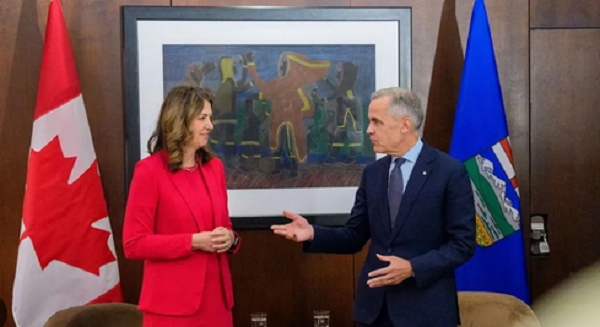
The Prime Minister and Alberta Premier Danielle Smith signed the memorandum of understanding in Calgary Thursday, a deal both governments said positions Canada as a global energy superpower while also meeting climate goals.
The MOU aims to unlock Alberta’s energy sector and diversify export markets in the face of Donald Trump’s trade war, laying the conditions for construction of a new oil pipeline to the West Coast.
The deal, which set off alarm bells among environmentalists and some Indigenous leaders, follows vehement opposition from British Columbia Premier David Eby over the prospect of a pipeline.
It also cost Mr. Carney a cabinet minister: former environment minister Steven Guilbeault announced late Thursday that he was quitting his current cabinet post. Bloc Québécois Leader Yves-François Blanchet said pointedly that Thursday will be remembered as the day a federal commitment to combatting climate change died.

The new pipeline, as outlined in the deal, would include Indigenous co-ownership. The agreement also suspends clean-electricity regulations for Alberta with the proviso that the province increases its industrial carbon price.
In addition, it says the federal government won’t implement its oil and gas emissions cap. And, should the pipeline come to fruition, Ottawa would adjust the current oil-tanker ban so that more bitumen could be exported to Asian markets.
The agreement also lays out a plan for construction of the Pathways Project – a massive carbon-capture and storage effort that the deal says will be built by 2040 to achieve emissions reductions at date-specific intervals. The MOU also proposes a methane emissions-reduction agreement.
“It’s a framework for building more competitive, independent and sustainable economies in Alberta and across Canada,” Mr. Carney said.
During Question Period in the House of Commons, Conservative Leader Pierre Poilievre – whose campaign platform earlier this year included pledges to remove some of the same regulations lifted by the MOU – accused Mr. Carney of promising not a pipeline, but a pipe dream.
Mr. Carney and Ms. Smith held separate events after signing the deal. Each were greeted by standing ovations from hundreds of business leaders cautiously celebrating not just the economic message of the new deal but the potential political one: a long-standing war between Ottawa and Alberta over resource development was over.
“I am not blind to the fact that the people of Alberta have had the rug pulled out from underneath them too many times to count over the past 10 years,” Ms. Smith told reporters after the signing ceremony.
“I also know that a new relationship and a new beginning need a starting point grounded in good faith, and today, I hope, is that new starting point.”
Federal Natural Resources Minister Tim Hodgson was in Calgary for the signing of the MOU.
“This is a recognition that there is a new working relationship, there is a new level of shared determination to meet the moment,” he said in an interview.

Martha Hall Findlay, Suncor’s former chief sustainability officer, told The Globe and Mail on the sidelines of a Calgary Chamber of Commerce luncheon with Mr. Carney Thursday that she has not been so optimistic about energy policy in a very long time.
Now the director of the School of Public Policy at the University of Calgary, Ms. Hall Findlay called the buzz around the MOU “extraordinary,” if somewhat tempered with caution after years of federal policies that the sector believed stymied growth.
Though the deal commits to reaching net-zero emissions by 2050, Ms. Smith said it also means commitments to any interim targets are now gone – something federal Environment Minister Julie Dabrusin disputed later in the day.
For his part, Mr. Carney noted measures in the MOU such as Pathways, an agreement to reduce methane emissions by 75 per cent over 2014 levels by 2035, and a stronger industrial carbon-pricing system will make a difference.
“We are going to get to our greenhouse-gas objectives, our climate objectives, only through massive investment,” Mr. Carney told reporters.
Though the deal is between Ottawa and Alberta, it also stresses that British Columbia will be brought to the table, specifically on the development and construction of the pipeline.
But Mr. Eby said Thursday that his province should have been at the table during talks to develop the MOU.
He told reporters he’s concerned that the pipeline project will become an “energy vampire,” sucking attention and limited government, Indigenous and provincial resources into a plan with no proponent, no route and no support among Coastal First Nations.
Mr. Eby added that lifting the tanker ban to support the pipeline could also threaten $1.7-billion worth of economic activity and thousands of jobs.
Marilyn Slett, president of the Coastal First Nations and elected Chief of the Heiltsuk Nation, agreed.
“We have zero interest in co-ownership or economic benefits of a project that has the potential to destroy our way of life and everything we have built on the coast,” she said in a statement.
But George Arcand Jr., former Confederacy of Treaty 6 grand chief, said Alberta First Nations began early discussions with the province on the pipeline project about two months ago.
“It’s a new opportunity because we’ve not been involved to this level before,” said Mr. Arcand. “Whether we own 10 per cent, 20 per cent, 30 per cent of a particular asset, that’s big dollars, and we’ve never had that. TMX hasn’t provided that for us.”
Ms. Smith said she hopes the deal with Ottawa helps quash separatist sentiment in her province.
“Genuinely addressing the concerns of Albertans is always a pathway to have a good and solid relationship,” she said.
But the fact that the MOU commits Alberta to boosting its industrial carbon price also marks a reversal for the province, which earlier this year froze the price at $95 per tonne.
The MOU promises to raise the minimum credit value, which it calls the “effective price,” to $130 per tonne. It does not set a deadline, but both sides are committing to a new agreement on carbon pricing by April 1.

The clean-electricity regulations will be suspended in the meantime and, once a new industrial pricing agreement is reached, will be lifted entirely for Alberta.
Mark Poweska, the chief executive of Calgary-based power provider ENMAX Corp., called Thursday “a monumental day,” particularly when it comes to the suspension of the clean-electricity regulations.
“By carving out the CER and leaving a carbon tax in place, it allows us to balance affordability and reliability, and still focus on sustainability because of the carbon tax influence on that,” he said in an interview.
More broadly, though, the agreement recognizes Canada can become an energy superpower and reduce its reliance on the U.S. as a trade partner if it comes together as a nation, he said. “We are a resource-based country, and this unlocks the ability for us to diversify.”
The agreement has and may continue to have internal political ramifications for Mr. Carney. His MPs have already been raising concerns about the rollback of environmental protections.
When asked about those pressures Thursday, Mr. Carney said he was making the best deal.
“It’s going to make Canada more resilient, more sustainable,” he said.
With reports from Matthew Scace, Andrea Woo, Adam Radwanski and Laura Stone
This article was first reported by The Globe and Mail