



GSM Cellphones Ltd 750x150 250129_left

GSM Cellphones Ltd 750x150 250129_left

HomeStock MarketsStocks Extend Pullback as Bond Yields Rise, Triggering Ongoing Rotation Out of Technology

Stocks Extend Pullback as Bond Yields Rise, Triggering Ongoing Rotation Out of Technology

Stocks Extend Pullback as Bond Yields Rise, Triggering Ongoing Rotation Out of Technology

The Canadian Vanguard Stock Market Report Tuesday May 19, 2026 Edition

.

The Toronto Market

Tuesday’s Toronto Market Index

The Toronto S&P/TSX Composite Index slipped 92.11 points, or 0.27%, to close at 33,741.24. Although the TSX finished lower, the decline was more moderate compared with Friday’s sell-off. All four North American market benchmarks that we track also ended the day in negative territory, with the TSX emerging as the strongest performer among them.

Trading volume was roughly in line with Friday’s session. The index staged a sharp rebound from around midday through approximately 2 p.m., but those gains were quickly erased during the final two hours of trading. The market ultimately closed at its lowest level of the day, a development that could weigh on short-term market sentiment.

Today’s weakness was largely tied to ongoing concerns about inflation and the possibility that interest rates may remain elevated for longer than previously expected.


Tuesday’s TSX Market Statistics

At the TSX, declining issues outnumbered advancing issues. Specifically, there were 1,365 decliners and 862 advancers, producing a decliner-to-advancer ratio of 1.58 to 1 — or roughly three declining stocks for every two advancing stocks. In addition, 140 issues closed unchanged.

The exchange recorded 189 new 52-week highs and 128 new 52-week lows, compared with 120 new highs and 84 new lows posted on Friday.

Total trading volume on the TSX reached 563,879,656 shares, virtually unchanged from the 562,564,641 shares traded on Friday. Trading activity now appears to be returning to more typical daily average levels. Investors seem to be gradually adjusting to the effects of ongoing geopolitical turmoil, either by accommodating the uncertainty or incorporating it into their market expectations and investment planning.

Tuesday’s Toronto Market Wrap-Up Report

The Toronto stock market closed lower on Tuesday, although the session represented a notable improvement compared with Friday’s broader sell-off. The Toronto S&P/TSX Composite Index declined 92.11 points, or 0.27%, to close at 33,741.24. Despite the lower finish, the TSX was actually the strongest performer among the four major North American market benchmarks monitored during the session.

For investors and traders, Tuesday’s market action reflected a cautious but still resilient tone. Seven of the TSX’s major sectors finished higher, indicating that selective buying interest remained active despite ongoing concerns surrounding inflation and the possibility of higher interest rates persisting longer than expected.

The Energy sector, up 2.02%, led the market higher. Continued geopolitical tensions in the Middle East and the ongoing closure of the Strait of Hormuz kept investor attention firmly focused on oil and gas supply considerations. Energy security and pricing remain dominant themes for both institutional and retail investors, and that reality continues to support Canadian energy-related equities.

Technology followed closely behind, gaining 1.60%, while Durable Consumer Goods & Services advanced 1.26%. Financials, a critical sector for the Canadian market, posted a modest gain of 0.06%, suggesting that investors remain cautious but not outright bearish toward the banking and financial space.

On the downside, Discretionary Consumer Goods & Services declined 1.64%, while Basic Materials dropped sharply by 3.93%, making it the session’s weakest-performing sector. Basic Materials has increasingly struggled since tensions escalated in the Middle East, as investors continue shifting attention toward energy availability, transportation costs, and inflation-sensitive industries.

Market breadth remained negative on Tuesday. Declining issues outnumbered advancing issues by 1,365 to 862, producing a decliner-to-advancer ratio of approximately 1.58 to 1, or roughly three declining stocks for every two advancing stocks. An additional 140 issues finished unchanged. For traders, this reflected underlying caution beneath the market’s relatively stable index performance.

The TSX also recorded 189 new 52-week highs and 128 new 52-week lows, both noticeably above Friday’s levels. The increase in new highs suggests that pockets of market strength continue to emerge despite overall volatility, particularly in defensive and energy-linked sectors.

Trading activity remained steady. Total TSX volume reached 563.9 million shares, virtually unchanged from Friday’s 562.6 million shares traded. Volumes now appear to be stabilizing around normal daily averages, suggesting that investors may be gradually adapting to ongoing geopolitical uncertainty and incorporating those risks more systematically into their market expectations and trading strategies.

Intraday trading patterns may also warrant attention. The TSX rallied strongly from around midday through approximately 2 p.m., but those gains were reversed sharply during the final two hours of trading, leaving the market to close at its lowest level of the day. For short-term traders, that type of late-session weakness may indicate lingering uncertainty and reduced conviction heading into the next trading session.

In company-specific developments, aerospace manufacturer Bombardier Inc. announced the redemption of US$750 million in senior notes due 2029. According to the company, the redemption will be funded through proceeds from a new notes offering combined with US$250 million from Bombardier’s existing cash reserves. The move is viewed by many investors as part of the company’s continued balance sheet restructuring and capital management strategy.

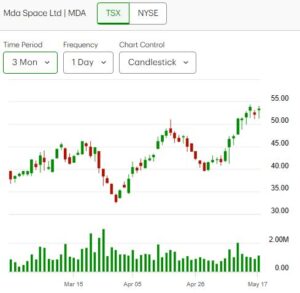
Space and satellite-related technology also continued attracting attention. MDA Space Ltd. remains uniquely positioned within Canada’s growing space infrastructure sector. The company specializes in satellite systems, earth and space observation technologies, and exploration infrastructure — areas expected to benefit from rising global demand for telecommunications, surveillance, and remote connectivity services.
     

Among actively traded stocks, Canadian Natural Resources Limited gained 2.83% to close at $67.95 on volume of 10.3 million shares. Suncor Energy rose 1.94% to $95.81 with 8.2 million shares traded, while Enbridge Inc. advanced 2.75% to close at $78.22 with 17.3 million shares changing hands.

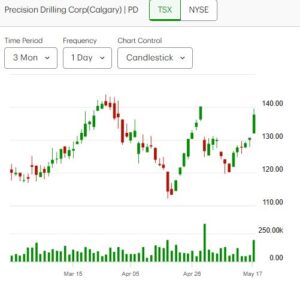
Oilfield services company Precision Drilling Corporation climbed 5.34% to close at $137.62, reflecting continued strength across energy-service names as crude oil market risks remain elevated.
       

Meanwhile, Thomson Reuters Corporation continued its recent momentum, gaining 5.42% to close at $120.24 on 1.44 million shares traded. The stock has now outperformed during the last two consecutive sessions, attracting increased attention from momentum-focused traders and institutional investors alike.

.

The US Markets

Tuesday’s U.S. Market Indexes

All major U.S. market indexes closed lower on Tuesday as investors continued reacting to rising bond yields, interest rate concerns, and ongoing weakness in technology and AI-related stocks.

The Dow Jones Industrial Average declined 322.24 points, or 0.27%, to close at 49,363.88. The S&P 500 fell 49.44 points, or 0.67%, ending the session at 7,353.61, while the Nasdaq Composite dropped 220.02 points, or 0.84%, to finish at 25,870.71. The small-cap focused Russell 2000 Index declined 28.03 points, or 1.01%, closing at 2,747.07.

Investor sentiment was pressured primarily by higher bond yields. The U.S. 10-year Treasury yield climbed to approximately 4.685%, reinforcing concerns that interest rates could remain elevated for longer than many market participants had previously anticipated. Rising yields typically place additional pressure on small-cap stocks because many of those companies rely more heavily on borrowing and external financing to fund expansion and operations.

That dynamic was clearly reflected in Tuesday’s trading activity. The Russell 2000 Index experienced the sharpest decline among the major indexes during much of the session before recovering modestly into the close. For traders and portfolio managers, the relative weakness in small-cap stocks continues to signal caution toward economically sensitive and debt-dependent sectors.

Oil prices also remained a central market focus. Crude oil had risen sharply on Monday amid geopolitical tensions in the Middle East, but prices eased slightly on Tuesday after President Donald Trump stated on social media that serious negotiations with Iranian leaders were continuing. Energy markets remain highly sensitive to developments involving the Strait of Hormuz and broader regional stability, both of which continue influencing inflation expectations and investor positioning.

The technology sector remained under pressure for a third consecutive session. Both the S&P 500 and Nasdaq have now closed lower for three straight trading days. While the S&P 500’s decline was relatively moderate, the Nasdaq’s drop of more than 0.8% highlighted ongoing weakness in high-growth technology and AI infrastructure stocks.

The recent pullback in technology shares may not be entirely surprising to experienced market participants. The Nasdaq had become significantly extended following its strong rally over recent months, particularly among artificial intelligence, semiconductor, and infrastructure-related equities. Tuesday’s session suggested that investors may now be rotating toward more defensive positioning while reassessing valuations amid rising yields and inflation uncertainty.

For traders, the current environment continues to favor selective positioning, disciplined risk management, and close monitoring of interest rate expectations, bond yields, and geopolitical developments, all of which remain key drivers of short-term market direction.

     

Tuesday’s U.S. Market Statistics

Market breadth on Tuesday reflected broad-based weakness across both the New York Stock Exchange and the NASDAQ, reinforcing the cautious tone that dominated trading throughout the session.

At the New York Stock Exchange (NYSE), declining issues significantly outnumbered advancing issues. There were 3,255 decliners compared with 1,224 advancers, while 387 issues finished unchanged. This produced a decliner-to-advancer ratio of approximately 2.66 to 1 — or roughly five declining stocks for every two advancing stocks.

The NYSE also recorded 140 new 52-week highs and 225 new 52-week lows, compared with 167 new highs and 152 new lows posted in the previous session. The increase in new lows alongside the decline in new highs suggests that selling pressure broadened across multiple sectors as investors continued reducing exposure to higher-risk assets.

Total NYSE trading volume reached approximately 5.55 billion shares, down slightly by about 1% from the 5.60 billion shares traded in the previous session. The modest decline in volume may indicate that, while selling pressure remained widespread, panic-driven liquidation was relatively limited.

At the NASDAQ, market breadth was also decisively negative. Declining stocks outnumbered advancing stocks by more than two to one. Specifically, there were 3,297 decliners and 1,519 advancers, while 376 issues closed unchanged, resulting in a decliner-to-advancer ratio of approximately 2.17 to 1.

The NASDAQ posted 89 new 52-week highs and 274 new 52-week lows, compared with 128 new highs and 234 new lows recorded yesterday. The deterioration in internal market statistics reflects continued weakness in technology, growth, and AI-related shares, sectors that have recently come under pressure as Treasury yields moved higher.

NASDAQ trading volume totaled approximately 10.24 billion shares, down about 4% from the previous session’s 10.64 billion shares traded. Despite the lower volume, the sharp imbalance between declining and advancing stocks highlighted persistent selling pressure, particularly within speculative and momentum-driven areas of the market.

For investors and traders, Tuesday’s statistics suggested that the market’s weakness extended well beyond the headline indexes. Internal market breadth continued deteriorating, especially on the NASDAQ, indicating that caution remains elevated as participants monitor interest rates, bond yields, inflation expectations, and geopolitical developments for further direction.

Tuesday’s U.S. Market Wrap-Up Report

U.S. equities remained in a controlled pullback phase on Tuesday as investors continued adjusting to rising Treasury yields, inflation concerns, and extended valuations in several high-growth sectors. Despite the market weakness, the overall decline still appears orderly rather than panic-driven, particularly given the strong gains recorded by the major indexes over recent weeks.

The Nasdaq Composite and S&P 500 have now closed lower for three consecutive sessions. Both indexes had become technically extended following several weeks of sustained upward momentum, especially within artificial intelligence, semiconductor, and infrastructure-related stocks. From a market structure standpoint, the current pullback may actually help improve longer-term market stability if it remains moderate and controlled.

Small-cap stocks experienced the greatest pressure during Tuesday’s session. The Russell 2000 Index underperformed large-cap and mid-cap indexes as higher Treasury yields continued weighing on companies that rely more heavily on debt financing and growth capital. Rising borrowing costs remain a significant concern for smaller companies in a high-interest-rate environment.

For investors and active traders, the key issue now is whether the current decline remains a short-term consolidation or evolves into a more prolonged correction phase. If weakness extends beyond several sessions, portfolio management and risk-control strategies become increasingly important. Investors may want to review their rules regarding profit protection, position sizing, and exposure management, particularly in stocks that have become significantly extended from their technical support levels.

For traders holding positions with limited support cushions, preserving gains may become more important than attempting to capture additional upside during heightened volatility. Markets that experience extended rallies often undergo rotational pullbacks as institutional investors rebalance positions and reduce short-term risk exposure.

Sector performance on Tuesday reflected a defensive shift in investor positioning. Telecommunications Services led the market higher, gaining 1.24%, while Energy advanced 0.70% and Utilities added 0.59%. The relative strength in Utilities and Telecommunications suggested that some investors rotated toward more defensive and income-oriented sectors amid rising uncertainty.

Technology declined 0.84%, while Financials fell 0.94%. Basic Materials was the weakest-performing sector, dropping 2.47%. Continued weakness in Basic Materials indicates that mining and commodity-related equities remain under pressure as investors focus more heavily on interest rates, slowing economic expectations, and energy-related geopolitical risks.

Market breadth statistics also reflected broad-based weakness beneath the surface. On the New York Stock Exchange, declining stocks outnumbered advancing stocks by approximately 2.66 to 1, while the NASDAQ recorded a decliner-to-advancer ratio of roughly 2.17 to 1. In addition, both exchanges posted substantially more new 52-week lows than highs, particularly on the NASDAQ, where technology and growth stocks continued losing momentum.

Wednesday’s session could become especially important for active traders focused on technology and artificial intelligence-related stocks. AI-driven momentum has been one of the primary forces behind the market’s advance over the past year, and NVIDIA Corporation (NVDA) remains central to that theme. NVIDIA is scheduled to report earnings after Wednesday’s market close, an event widely viewed as potentially market-moving for the broader technology sector.

Several AI infrastructure and optoelectronics-related stocks have already weakened over the last three sessions, suggesting that traders may be reducing exposure ahead of the earnings announcement. NVIDIA’s report could either stabilize market sentiment and reignite buying interest in technology shares or accelerate the current pullback if expectations are not met.

Retail investors will also be closely watching earnings from Walmart Inc., which is scheduled to report Thursday morning. Walmart shares rose 0.6% on Tuesday as investors positioned ahead of the company’s outlook on consumer spending trends, inflation pressures, and household demand patterns.

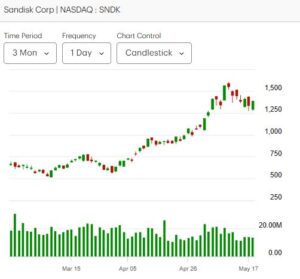
In semiconductor and memory-related trading, SanDisk Corporation (SNDK) outperformed during the session, rising 3.77% to close at $1,383.29 on volume of 13.3 million shares. Micron Technology Inc. also posted gains, advancing 2.52% to close at $698.74 with 61.72 million shares traded. Strength in selected memory and storage-related names suggested that investors continue selectively accumulating segments of the semiconductor space despite broader technology weakness.


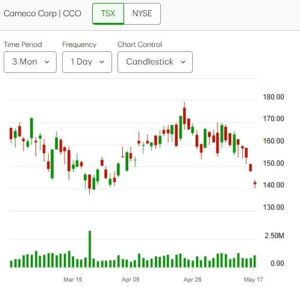
Within the energy sector, Cameco Corporation (CCJ) remains an important company for long-term investors to monitor. Although Cameco operates within the broader energy industry through nuclear power infrastructure and uranium production, current market attention remains heavily concentrated on traditional oil and gas companies because of tensions involving the United States, Iran, and the Strait of Hormuz.


As a result, nuclear-related equities such as Cameco have recently underperformed relative to conventional energy producers. However, for long-term investors, the company could regain market attention once geopolitical tensions ease and investor focus broadens again toward long-term energy diversification, nuclear generation infrastructure, and global electricity demand growth.

Key Takeaways for Investors and Traders

  • Markets remain in a controlled pullback phase:
    The recent decline in the major U.S. indexes still appears orderly rather than panic-driven. After several weeks of strong gains, especially in technology and AI-related stocks, some consolidation was expected and may actually help stabilize the market technically.
  • Rising bond yields are becoming the market’s main pressure point:
    The U.S. 10-year Treasury yield near 4.7% continues to weigh on growth-oriented sectors, particularly small-cap and technology stocks. Higher yields increase financing costs and generally reduce investor appetite for speculative assets.
  • Technology stocks are entering a critical short-term test:
    The NASDAQ has now declined for three consecutive sessions as investors reduce exposure ahead of major earnings announcements. AI infrastructure and semiconductor stocks remain highly influential in determining broader market direction.
  • NVIDIA earnings could become a major market catalyst:
    NVIDIA Corporation is scheduled to report earnings after Wednesday’s market close. Because NVIDIA has become central to the AI investment narrative, its results and forward guidance could significantly impact technology stocks, market sentiment, and short-term trading momentum.
  • Defensive sector rotation is becoming more visible:
    Investors showed increased interest in Telecommunications Services, Utilities, and Energy stocks during Tuesday’s session. This suggests that some institutional money may be shifting toward more defensive positioning while market uncertainty remains elevated.
  • Market breadth weakened noticeably:
    Declining stocks substantially outnumbered advancing stocks on both the NYSE and NASDAQ, while new 52-week lows increased. This indicates that weakness is spreading beyond just a handful of large-cap technology names.
  • Energy markets remain heavily influenced by geopolitics:
    Ongoing tensions involving Iran and the Strait of Hormuz continue supporting oil and gas-related stocks. Energy security concerns remain an important factor for both inflation expectations and sector leadership.
  • Risk management becomes increasingly important during pullbacks:
    Investors and traders should closely monitor support levels, portfolio exposure, and profit protection strategies. In periods of elevated volatility, disciplined position management often becomes more important than aggressively pursuing additional upside.
  • Long-term opportunities may emerge beneath short-term volatility:
    While oil and gas currently dominate energy-related investing themes, sectors tied to long-term infrastructure trends — including nuclear energy, semiconductors, AI infrastructure, and satellite communications — may continue offering selective opportunities for patient investors once current geopolitical tensions begin to ease.

.


NOTICE TO READERS 

The Canadian Vanguard Stock Market is about empowering you to build and manage your wealth by yourself. There is certainly no magic in managing finances or wealth but one needs to know what to do and commit to doing what is needed. When you are ready to start the journey to Take Charge and Put Your Destiny In Your Own Hands, read The Canadian Vanguard every market day. If you need more related information,  Contact Us

Our readers are strongly advised to conduct their own research into individual stocks before making a purchase decision. In addition, investors are advised that past stock performance is no guarantee of future price appreciation. Any recommendation is not a guarantee of any particular stock’s future prices, and The Canadian Vanguard accepts no responsibility or liability for investors’ or readers’ purchases.

Stocks In The News/ Stocks To Watch and Market Strategy will soon be available but only to Paying Subscribers. The dollar sign “$” in the Toronto Market section in the articles only stands for Canadian dollar and in the US market section “$” stands for US dollar.

(c) This article is published by The Canadian Vanguard on May 19, 2026